

Last week, Sea Limited announced two rather unexpected developments: the potential IPO of its digital financial services arm, Monee, and the launch of a new AI-first enterprise cloud business, Sea Cloud.
I’ve already discussed my thoughts on the Monee IPO, including why I believe there are legitimate strategic and capital-related reasons for pursuing a public listing.

In this article, I want to focus on the second announcement, Sea Cloud.
“For more than ten years, we have quietly built and run our own cloud platform. It was never a side project. It is the backbone powering Garena, Shopee and Monee’s scale every single day, at a level of cost and reliability we could not have bought from anyone else.
Over the last two years, around 500 Sailors have been rebuilding that platform to power something new: the wave of AI applications rising across every part of Sea. Because of their work, taking an AI idea from a whiteboard to production inside our company is now dramatically faster than it was two years ago.
We are now going to offer that capability to the world. Its name is Sea Cloud.”
- Sea Limited CEO, Forrest Li
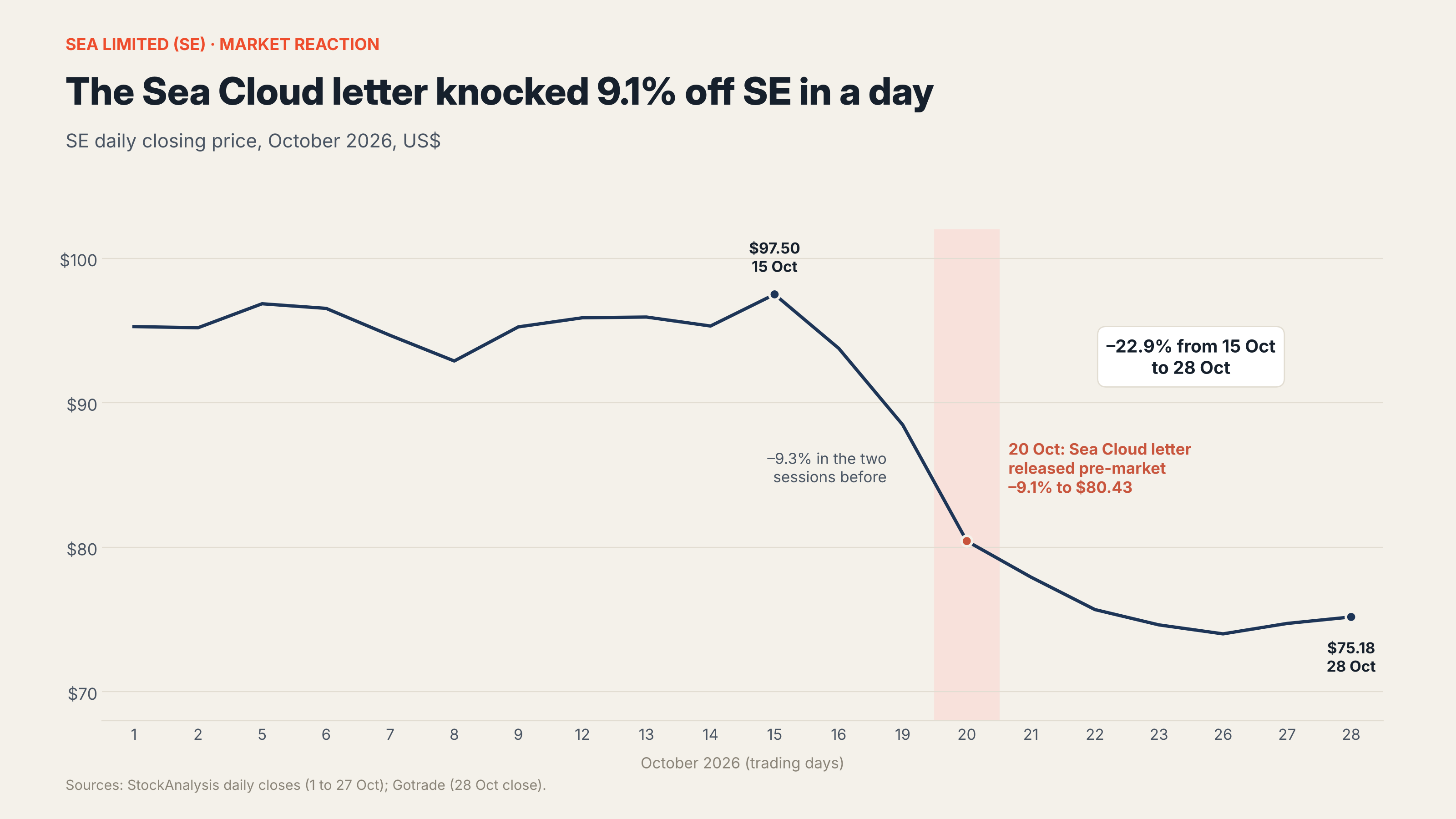
As many have pointed out, the reason Sea fell 9.1% on the day of announcement was likely related to this announcement rather than that of the potential Monee IPO.
At first glance, it is understandable why investors might be concerned. After all, Sea is an e-commerce, gaming and fintech conglomerate. Why is it suddenly entering the cloud computing business, an industry dominated by some of the world’s most capital-intensive technology companies?
The immediate comparison is naturally with Amazon Web Services (AWS), Microsoft Azure and Alibaba Cloud.
These businesses have spent tens of billions of dollars building their infrastructure, and the idea of Sea entering the same market, after a period where it has embarked on multiple capital intensive ventures may be worrying to investors.
I think there is more nuance to the story.
The announcement is not quite as surprising as it initially sounds, particularly when we examine what Sea has already built internally over the past decade.
More importantly, I think investors need to distinguish between Sea attempting to become the next AWS and Sea commercialising infrastructure and capabilities it already owns.
These are two very different propositions with vastly different implications for capital requirements, profitability and ultimately shareholder value. Since we have very little information available at the moment, the best we can do is to speculate through scenario analysis.
Sea already has a cloud business that it has operated for over a decade.
One of the more interesting developments preceding the Sea Cloud announcement was a presentation given by Sea at NVIDIA AI Day Singapore in September 2026.
During the presentation, Sea described its transformation from a digital-native company into what it calls a full-stack AI company.
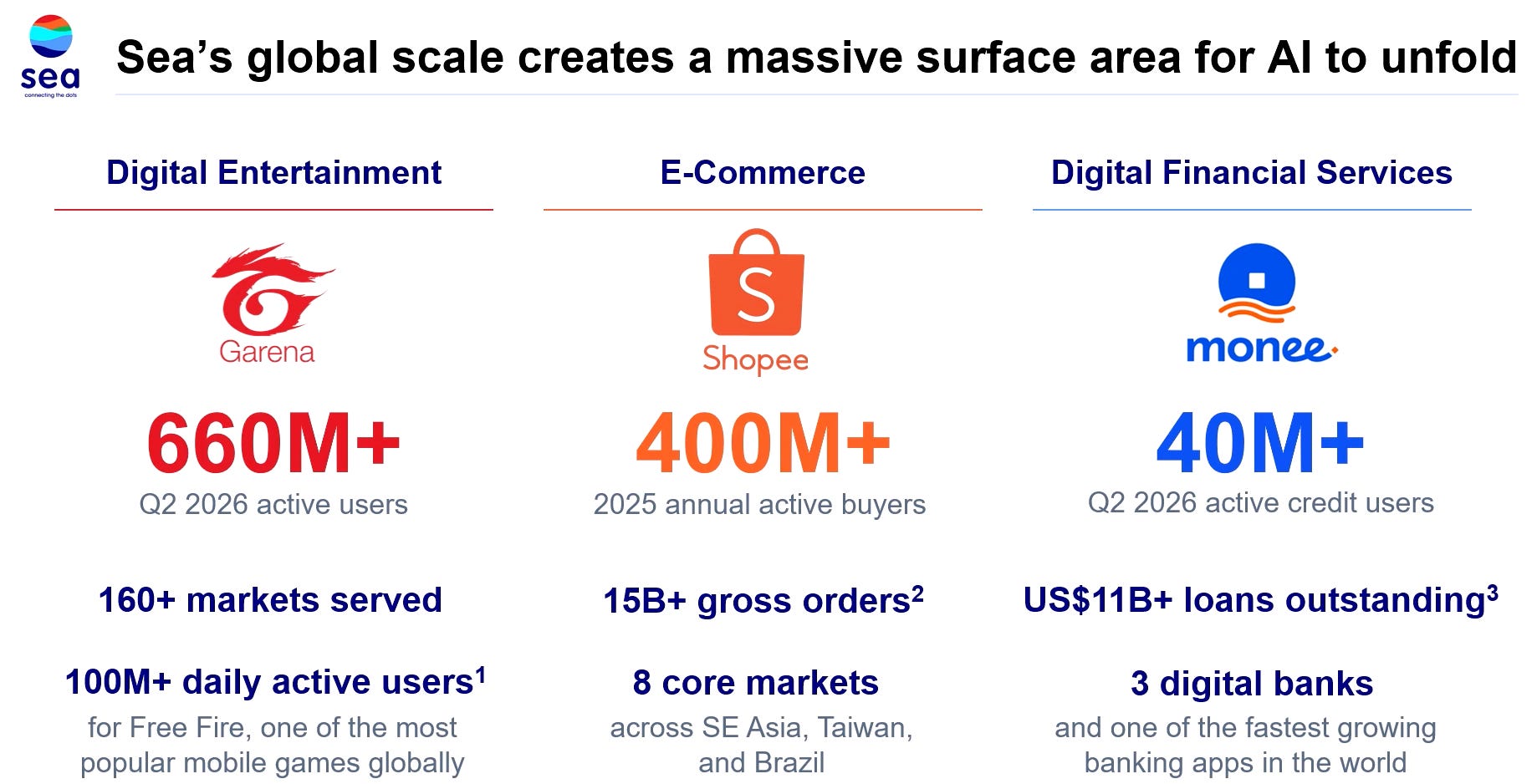
The most revealing part was the infrastructure disclosure that it shared.
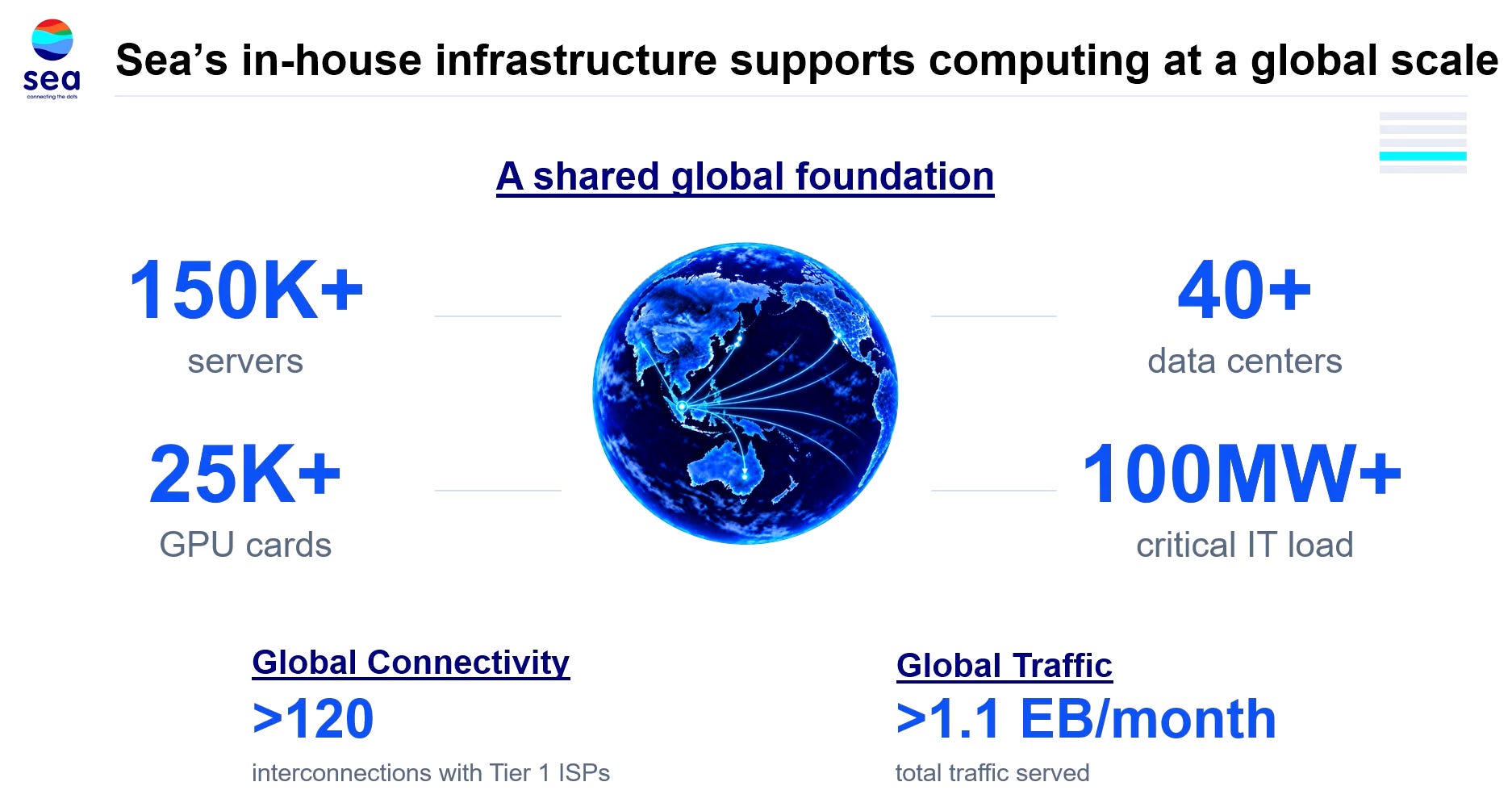
Sea currently operates:
Over 150,000 servers and 25,000 GPUs.
More than 40 data centres worldwide with >100 MW of combined critical IT load.
Connections to more than 120 tier-one internet service providers.
A network carrying more than 1.1 exabytes of monthly traffic.
This equates to watching 700 million hours of high-definition video.
These are substantial figures for a company that operates outside of the cloud and compute space, and is primarily associated with e-commerce, gaming and financial services.
Importantly, Sea’s infrastructure team already manages the entire lifecycle of its infrastructure, from design and procurement to deployment, testing, operations and maintenance.
The company relies on colocation partners for data-centre facilities, meaning it does not necessarily have to own the underlying buildings or land. However, it manages much of the computing infrastructure operating within them.
This distinction matters because it demonstrates that Sea has already developed expertise in operating computing infrastructure at scale.
Sea has also been purchasing NVIDIA accelerators since 2018, was Southeast Asia’s first NVIDIA DGX A100 customer and recently announced that it would become the first enterprise in the region to adopt NVIDIA’s Vera Rubin platform.
In other words, Sea’s investment in computing infrastructure is hardly a recent development.
It has been building these capabilities for more than a decade, initially to support Garena, Shopee and Monee, and increasingly to support AI-related workloads.
The question is whether these existing capabilities can now be monetised externally.
