

On 20th October 2026, Sea Limited announced 2 potentially significant developments.
Plans for an IPO of its digital financial services business, Monee
The launch of Sea Cloud, an AI-first enterprise platform
Both announcements came through an internal letter from CEO Forrest Li, commemorating the 9th anniversary of Sea’s IPO in 2017.
The market’s initial reaction was positive, with the stock up 2.5% in pre-market, before closing down 9.1% at the end of the market close.
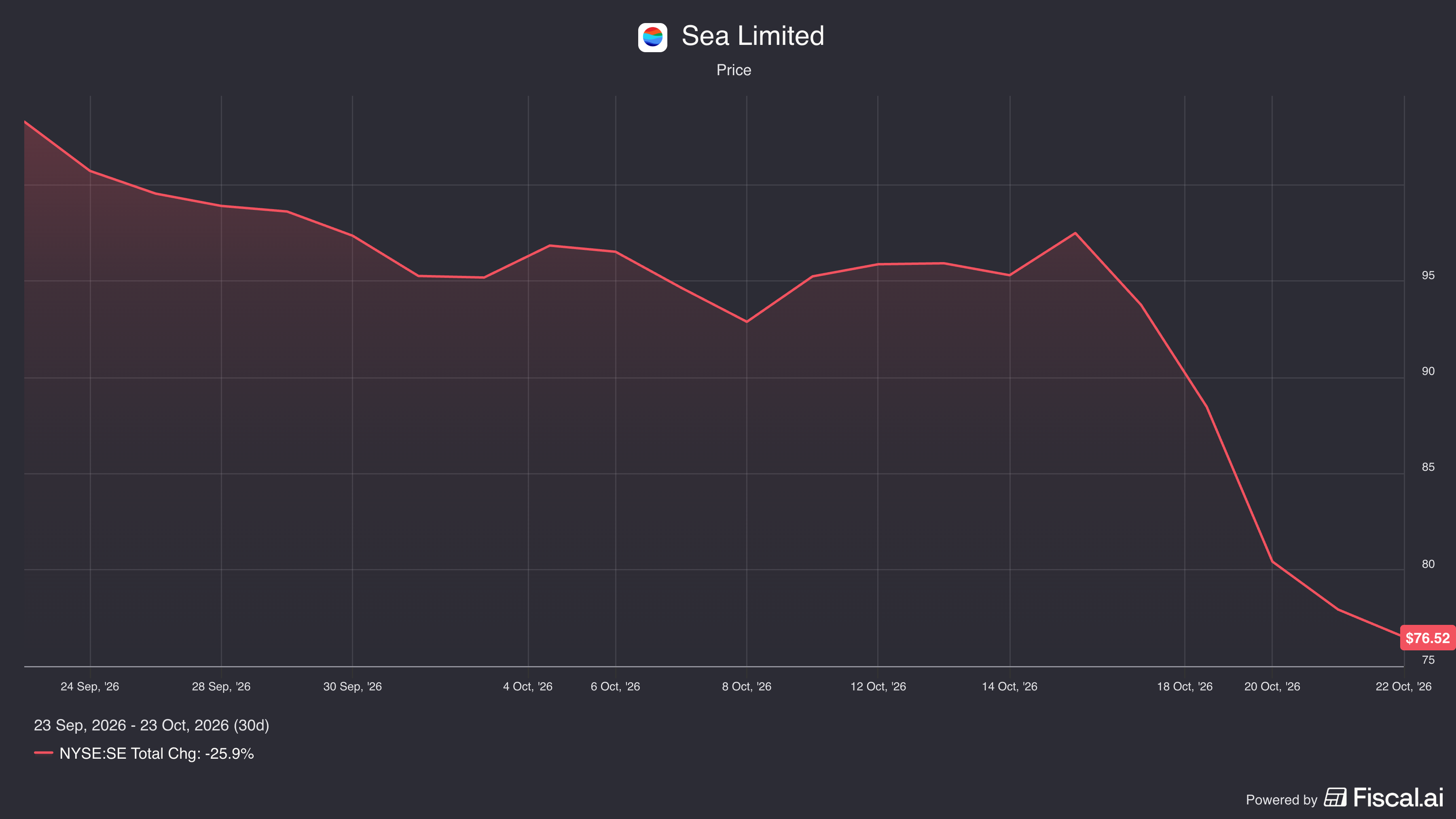
At first glance, the two developments might seem unrelated. One involves potentially separating an existing business, while the other involves entering an entirely new market. However, I think both announcements are worth considering within the broader context of Sea’s capital allocation strategy.
Sea Limited has spent years building three increasingly profitable businesses, and management now appears to be considering how to fund the next phase of growth while exploring a fourth business opportunity.

In this piece, I will be discussing Monee’s IPO specifically, while leaving the Sea Cloud launch for another article.
Why IPO Monee in the first place?
In the letter, Forrest suggested that Monee is approaching the stage where it can operate as a more independent business, and that a public listing could give it greater resources to accelerate growth.
“We believe Monee is approaching the point where it can stand on its own two feet and begin its own race. Going public could give it the resources and the room to go further and faster than it can today.”
- Forrest Li, CEO of Sea Limited
I think there are three plausible motivations behind the proposed IPO: unlocking shareholder value, accessing capital and establishing Monee as a standalone financial institution.
Is this really a spin-off?
Before that, I wanted to discuss a common misconception that I’ve seen going around.
Many investors seem to be assuming that Sea intends to spin off Monee in a traditional sense, distributing shares to existing shareholders and separating the two businesses.
I don’t think this is the most likely outcome.
Instead, I suspect Sea will pursue a partial IPO, selling a minority stake in Monee while retaining majority ownership and control.
There are several possible structures:
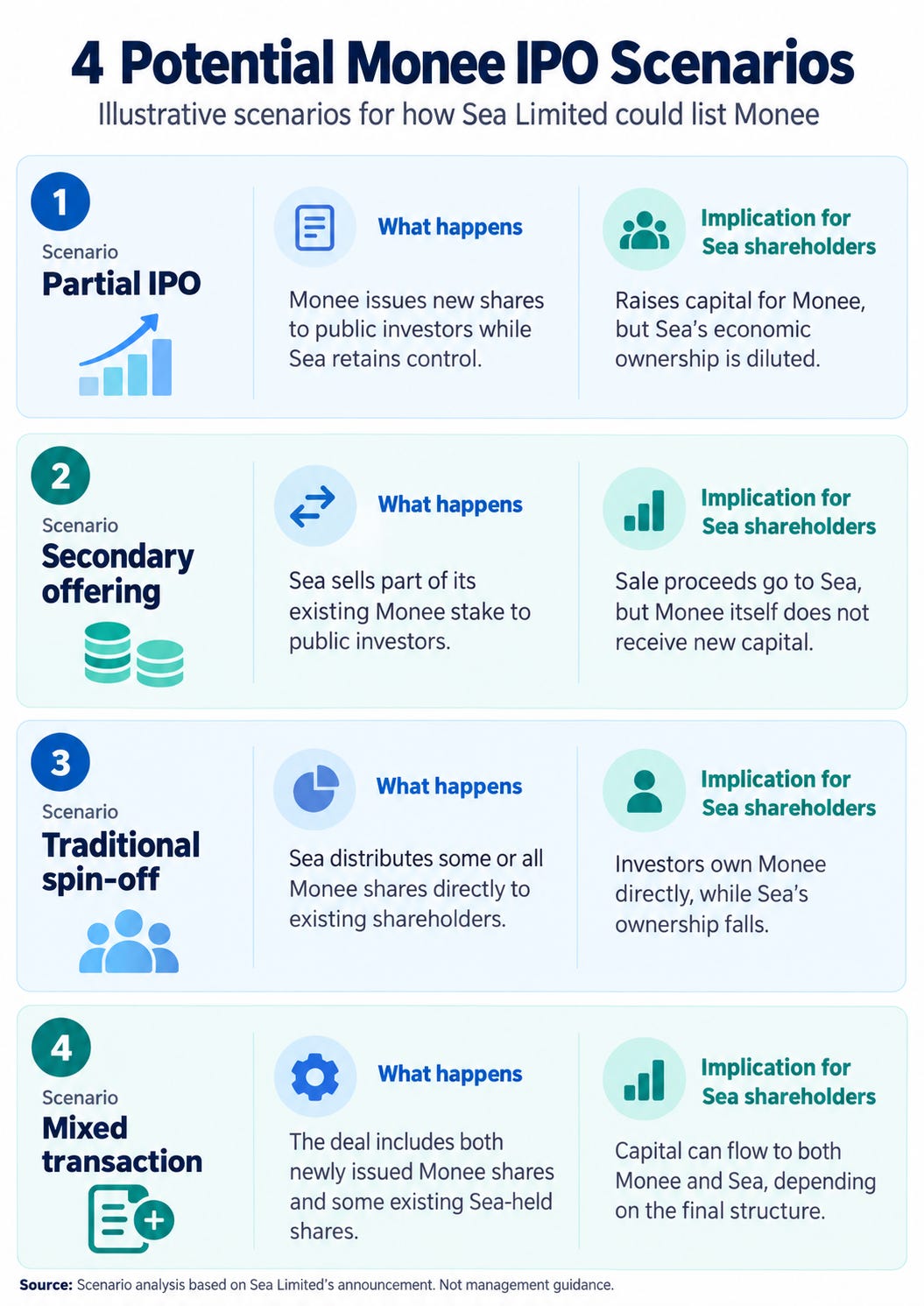
My base case is a partial IPO involving newly issued shares.
This seems most consistent with Forrest’s emphasis on providing Monee with additional resources to expand.
For example, suppose Monee were valued at $20B before the IPO and issued $4B in new equity as part of the IPO. Its post-money valuation would rise to $24B, with new investors owning ~16.7% of the business while Sea retains ~83.3% of it.
Monee would receive the $4B in cash to fund further expansion, and Sea would continue to consolidate the business as long as it retains control.
This is quite different from a traditional spin-off, where the parent might distribute shares to existing investors without raising new capital.
Importantly, a partial IPO does not necessarily destroy the synergies between Shopee and Monee. Both businesses can continue operating within the same ecosystem, subject to regulatory requirements and appropriate commercial arrangements.
I would be surprised if management were willing to relinquish control of Monee entirely given the strategic importance of embedded financial services to Shopee.
In the next section, we’ll discuss the 3 plausible explanations for a Monee IPO.
1. Unlocking Shareholder Value
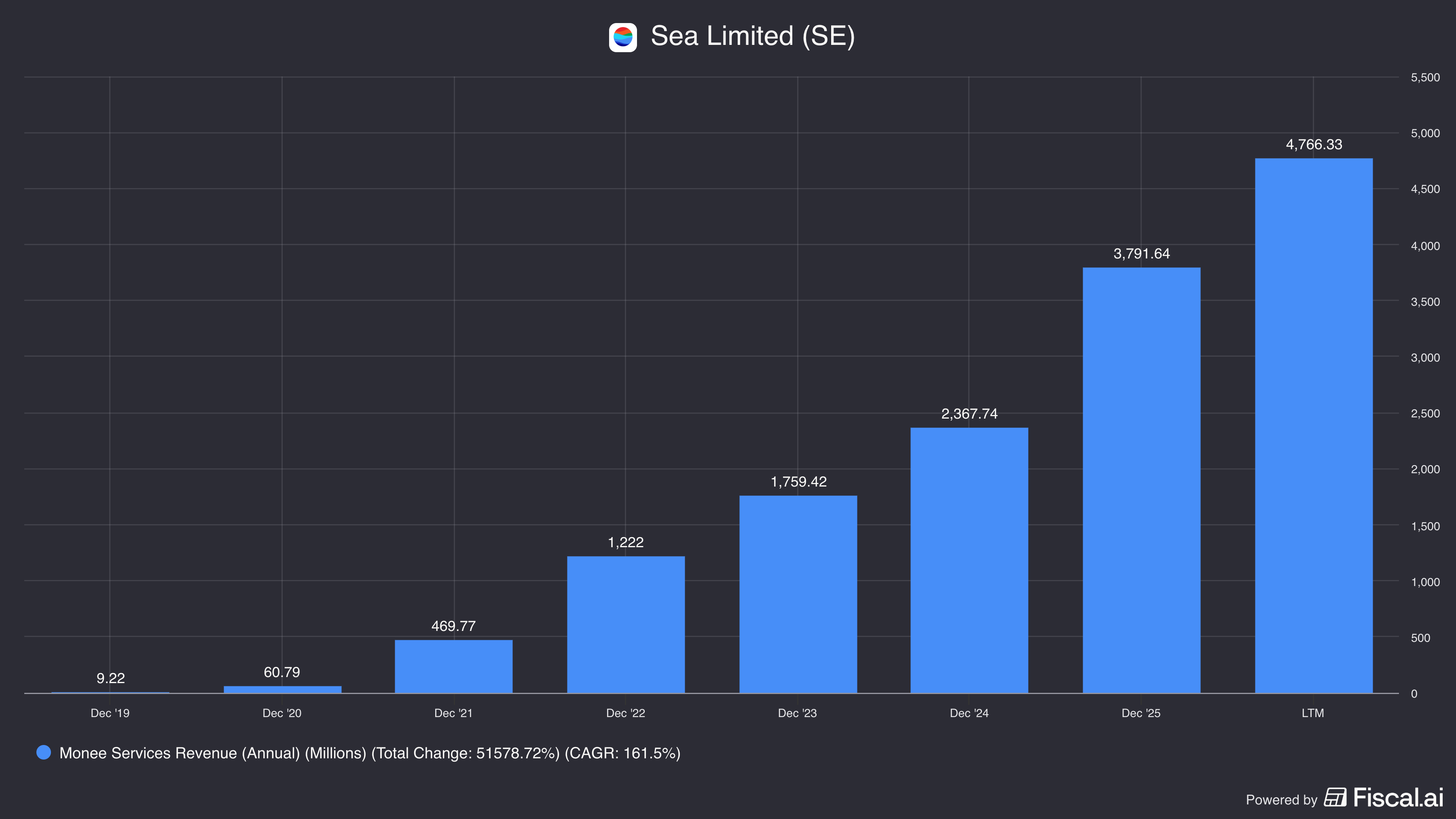
Monee has rapidly grown into a substantial business over the past several years. In Q2 2026, it generated $1.4B in revenue, representing 58.9% YoY growth, while its outstanding consumer and SME loan portfolio reached $11.1B, up 62.5% YoY.
In fact, revenue has grown at a 161% CAGR since 2019.
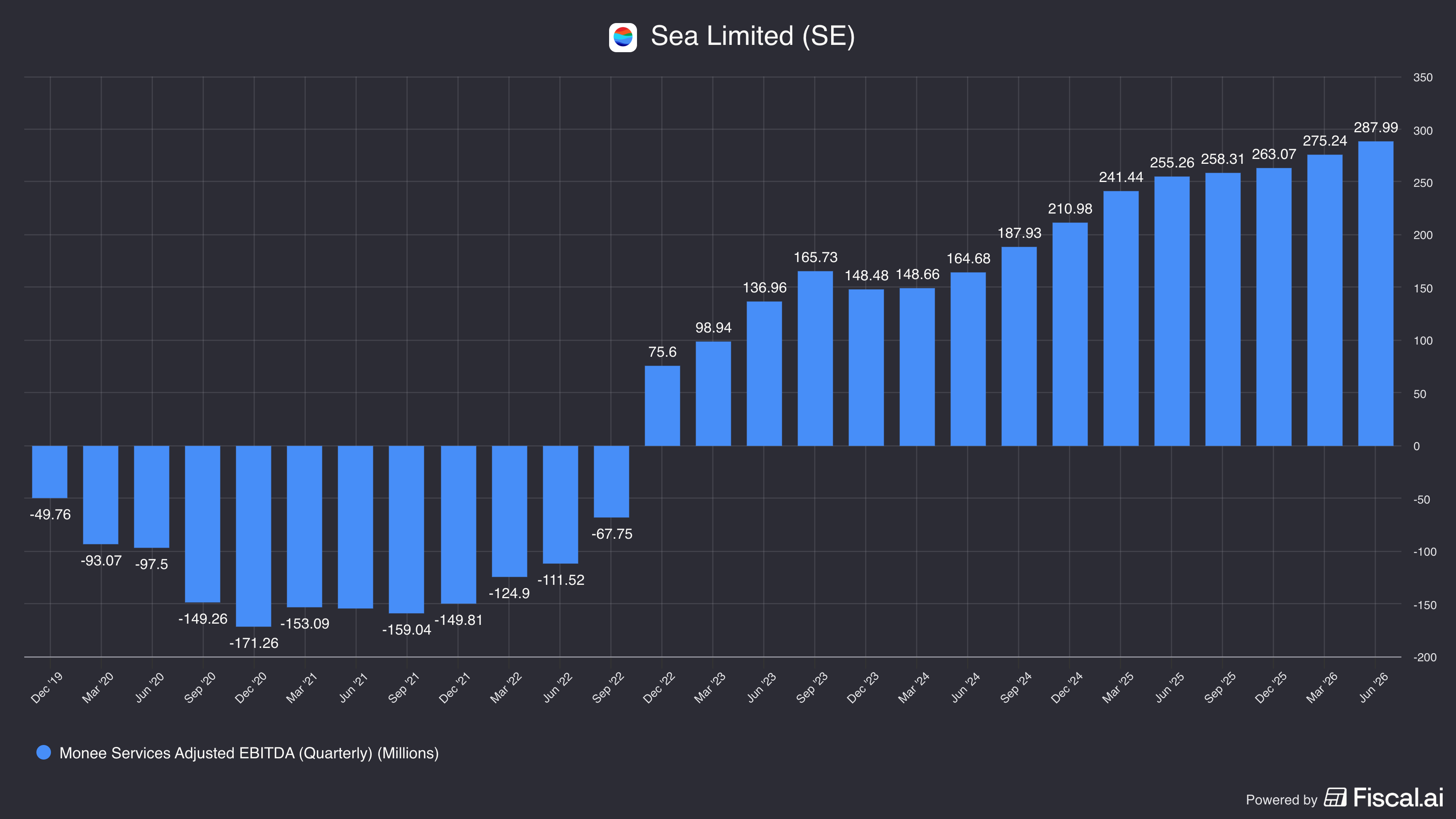
On the profitability end, it has had a remarkable turnaround over the past few years, now generating north of $1B in Adj. EBITDA on an annualised basis.
In other words, Monee is no longer a small financial services operation built to service Shopee. It is a meaningful contributor to Sea’s overall revenue and profitability profile, at 18% of group revenues and 31% of group Adj. EBITDA.
The key question, is whether the market is appropriately valuing this business within Sea.
DBS recently estimated that Monee could be worth between $18B to $22B, based on 12-15 times projected 2027 adjusted EBITDA of $1.5 billion. The bank argued that Sea’s prevailing share price implied a considerably lower valuation for the division. As I write this, Sea is trading at $34B in market cap with nearly $7B in net cash.
On a simplified sum-of-the-parts basis, assigning Monee a valuation of $18B-$22B would leave a surprisingly modest residual value for Shopee and Garena. Of course, this isn't a clean enterprise value calculation, particularly given Monee's financial balance sheet and the capital required to support its lending operations.
Nevertheless, I think there is a reasonable argument that Monee could receive a more appropriate standalone valuation as a listed company, particularly if investors can analyse its financial performance separately from Shopee and Garena.
2. Accessing Capital
The other plausible explanation for Monee’s IPO is its increasingly substantial capital requirements.
Historically, Monee operated primarily as a payments business, benefiting from Shopee’s enormous transaction volume and existing customer base. However, the business has increasingly shifted towards lending, which has fundamentally different economics.
