

Grab reported Q2 2026 Earnings after the market close on 4th Aug 2026.
Revenue: $997M v $991M est. (+22% YoY, +21% Constant Currency)
EBITDA: $168M (+54% YoY), 16.9% Margin v 13.3% A Year Ago
GAAP Profit: $235M v $20M in Q2 2025
EPS: $0.06 v $0.02 est.
Selected Key Metrics
On-Demand GMV: $6,463M (+21% YoY, +22% CC)
Group MTUs: 54M (On-Demand MTU +17% YoY)
On-Demand GMV per MTU: +3% YoY
Gross Loan Portfolio: $2,297M (+197% YoY, roughly doubled ex-Superbank)
Loans Disbursed: $1.2B (+72% YoY)
Customer Deposits: $2.5B
Operating Profit: $19M (+$12M YoY)
Adjusted Free Cash Flow: $73M (-39% YoY)
What stands out most from these numbers is probably the GAAP profit of $235M v $20M last year. However, it must be said that this is largely an accounting abnormality and not a 10x in earnings growth.
The $235M profit includes a one-time $307M non-cash gain from re-measuring its stake in Superbank that it has just consolidated into their portfolio, a $66M favourable tax movement from recognising deferred tax assets, and partially offset by a $183M fair value loss on financial assets and liabilities (this is largely the convertible-note derivative).
If we strip these out, the underlying result is a $19M operating profit, which is a +$12M gain YoY. Therefore, the key is to watch the operating profit of the business at least in the short to medium term as management expects “a degree of variability tied to fair value measurements” to keep distorting the profit line in H2.
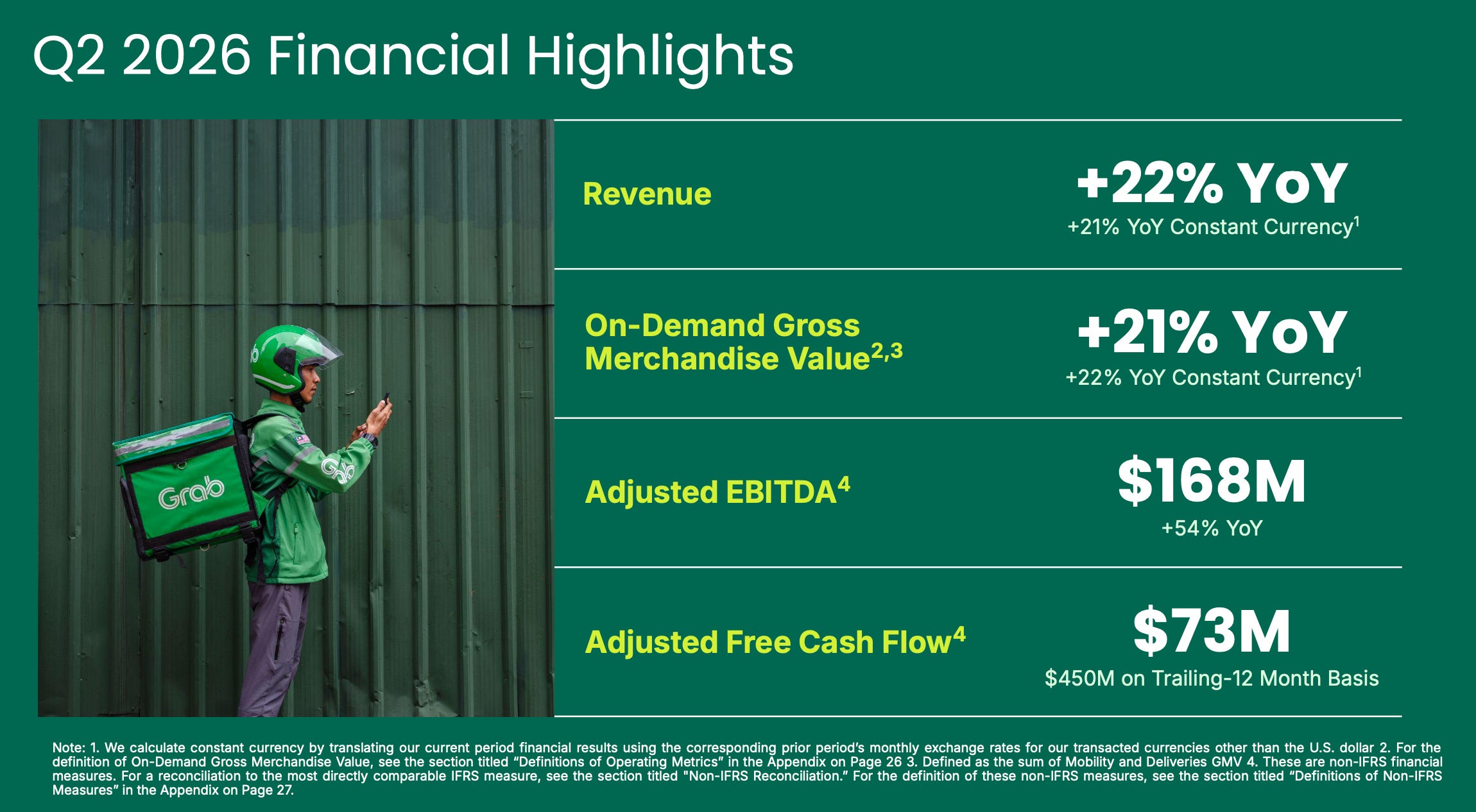
Adj. EBITDA is where we can see true operating leverage in the business, with it growing +54% YoY, over double the revenue rate. This also represents 18 straight Q’s of Adj. EBITDA growth with expanding margins to boot.
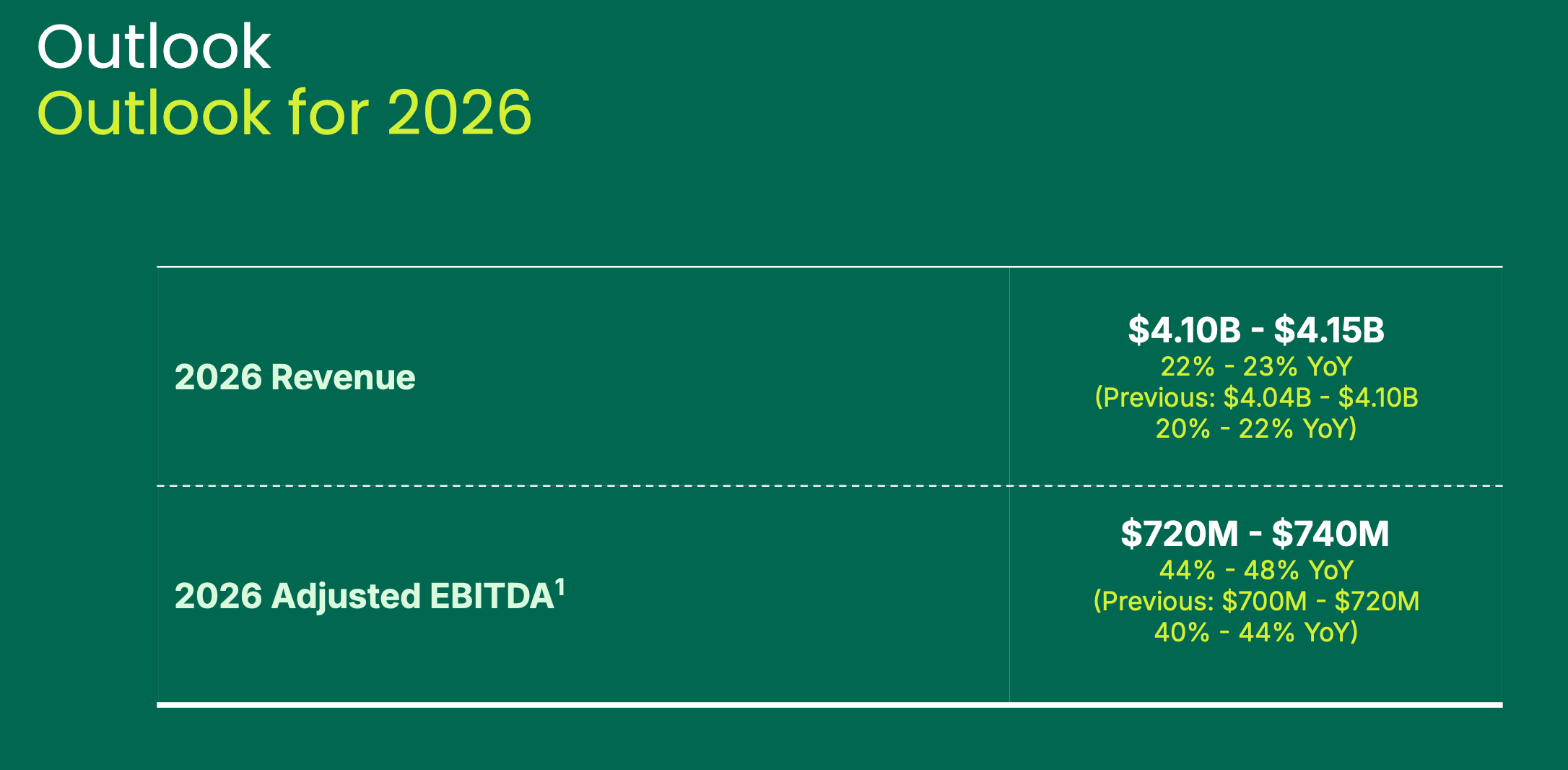
Grab also raised FY 2026 guidance to $4.10B-$4.15B in revenue and $720M-$740M in Adj. EBITDA, reflecting the strength of their underlying business alongside the consolidation of Superbank and the acquisition of Stash.
The board also authorised an additional $750M in share repurchases, bringing cumulative authorisation to $1.75B since 2024.
In this piece, I will break down the earnings in full, highlight key points on management commentary during the call and discuss my personal thoughts in the last section.
Table of Contents
Deliveries & Mobility
GFin, Financial Services
Key Call Commentary
Positives & Negatives
Conclusion
1. Deliveries & Mobility
Deliveries
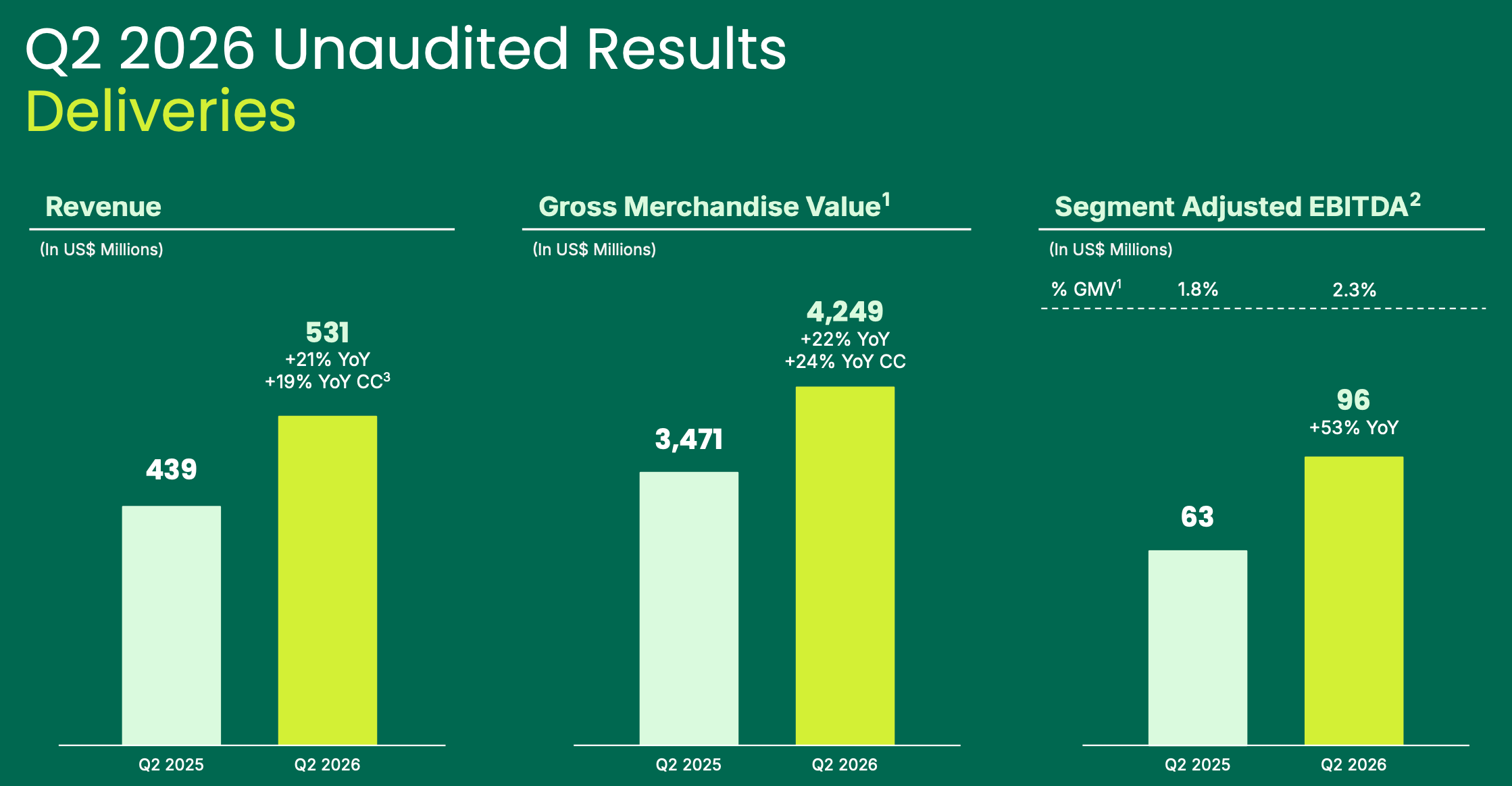
Deliveries remains the largest segment by GMV and Revenue.
Revenue grew 21% YoY (19% CC) to $531M, driven by GMV expansion and continued momentum in advertising. GMV grew 22% YoY (24% CC). Adj. EBITDA margin also grew from 1.8% to 2.3%, tracking closer towards management’s long-term target of 4+% margins.
I think the increase in margins is particularly impressive as they continue to pour growth into the lower-margin grocery business.
Advertising continues to be a strong driver in deliveries. Quarterly active advertisers on the self-serve platform grew 21% YoY and average spend per advertiser grew 24% YoY.
Mobility
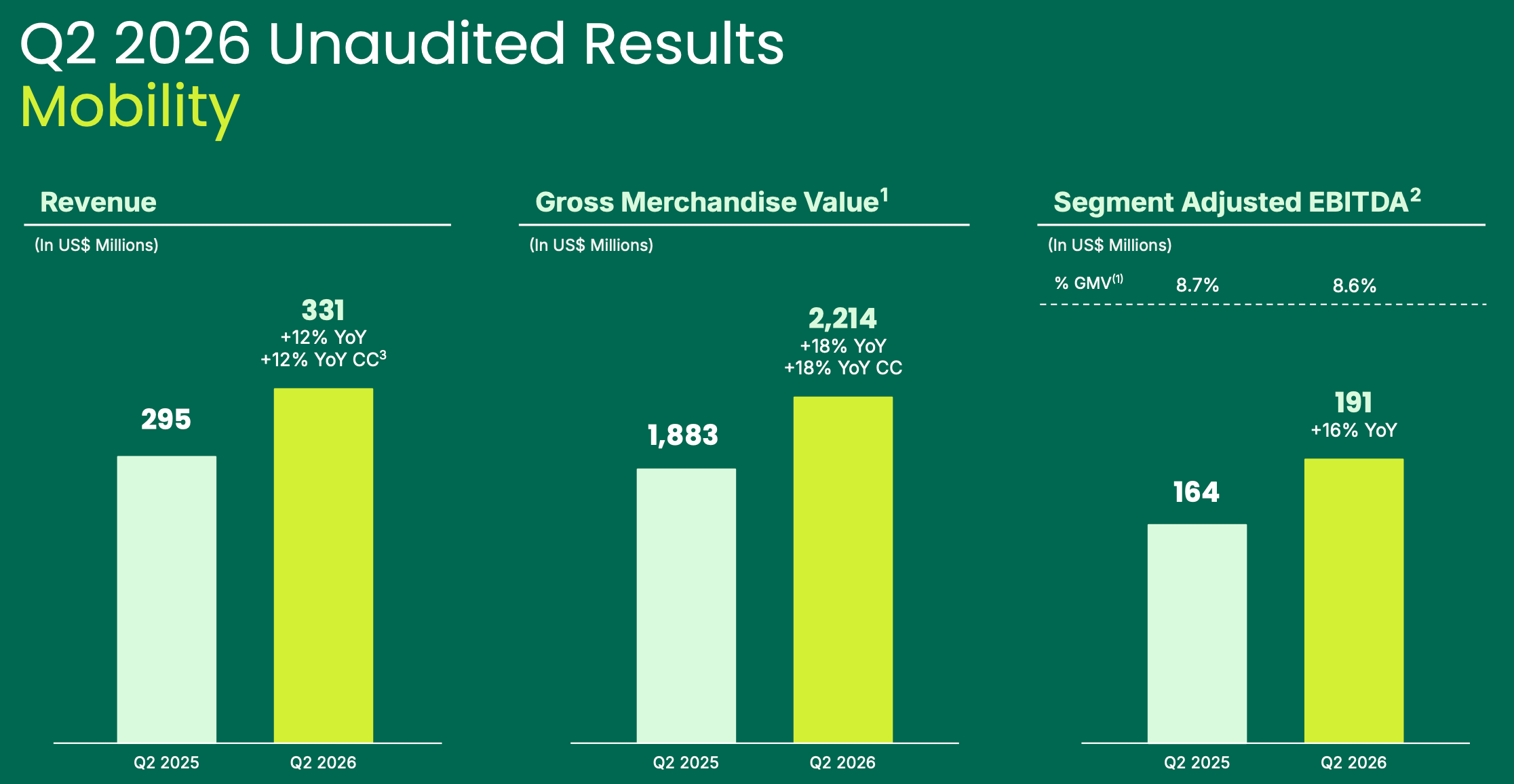
Mobility was certainly hit by the fuel crisis in Q2. Revenue grew just 12% YoY, a clear deceleration from 19% in Q1. GMV grew 18% YoY to $2,214M, but transactions grew 28% YoY.
This also means that part of the reduction in revenue is due to average ticket falling, which has been part of Grab’s affordability plan since last year. Through the fuel spike, it is likely that Grab has leaned more into saver products and driver incentives to keep both sides of the marketplace intact.
As I’ve said, and continue to say, supply is the limiting factor for Grab, not demand. These factors led to net take rate compression with mobility take rate coming in at 15.0% vs 15.8% a year ago.
Fortunately, Grab’s efforts to keep drivers on the road have paid off, with monthly active driver-partners hitting an all-time high, up 19% YoY, and driver earnings rising 4% YoY, funded partly by $7M of direct fuel-support spend.
2. GFin, Financial Services
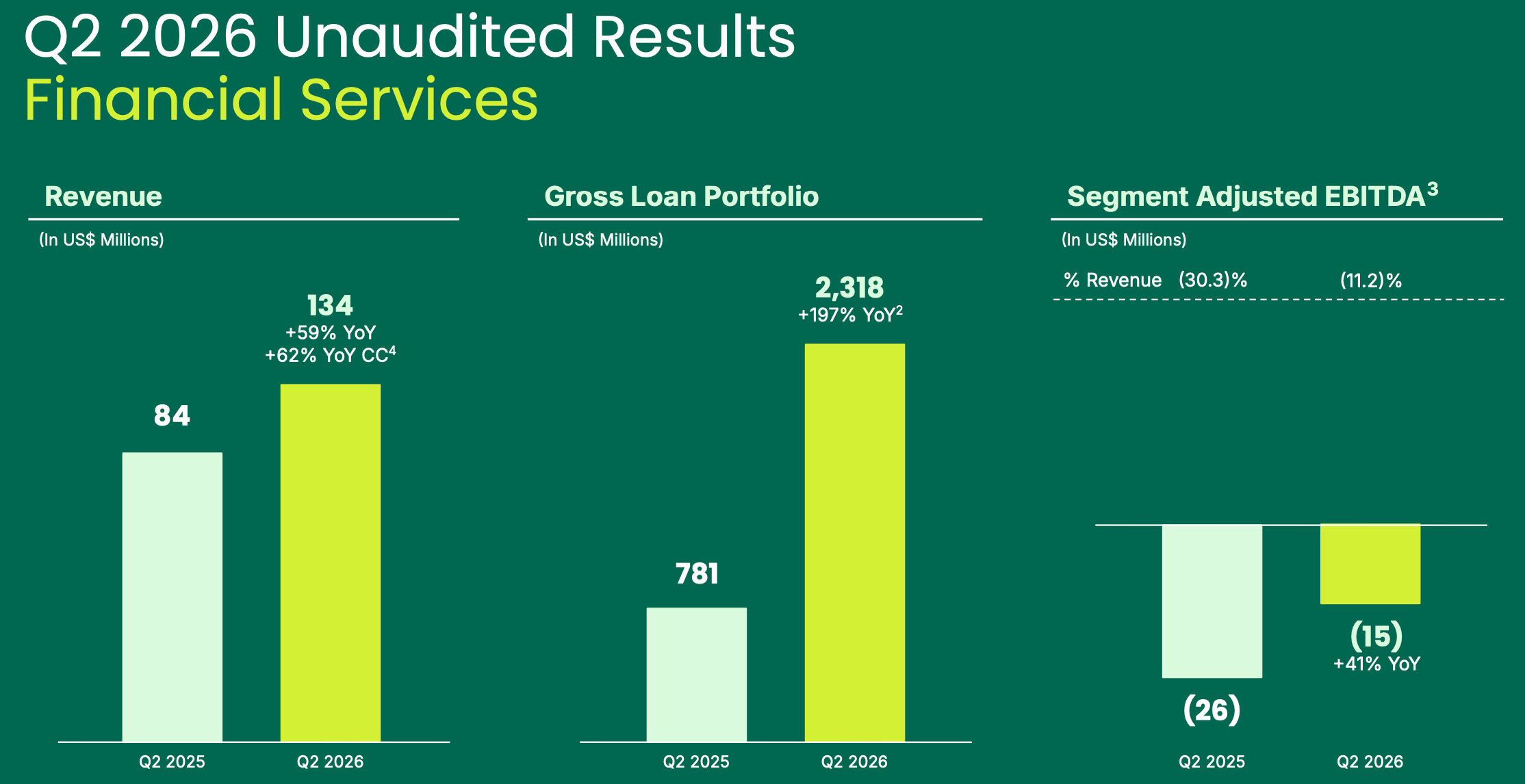
Q2 was a particularly strong quarter for GFin, when we look at the headline numbers. However, some of it was inflated by the consolidation of Superbank.
On 20th May 2026, Grab announced that their combined direct and indirect shareholding in Superbank will increase to over 50% from 37% prior, due to the transfer of Singtel Alpha Investments Pte. Ltd.'s shareholding in Superbank to GXS Bank Pte. Ltd.
As a result, Superbank’s numbers was consolidated into the GFin segment for the first time this quarter. Grab’s Gross Loan Portfolio increased by 197% to $2.318B this quarter, but management shared that organic lending growth ex-Superbank was closer to 100%. Those are still excellent numbers.
It is good to see that numbers are growing more aggressively and faster than its previous pace, which I have spent the last few quarters arguing for. I believe at Grab’s scale, it should be growing its loan portfolio at ~100%, especially as it has the cash to support it.
Management also shared that the Fin Services segment will be profitable in the 2nd half of 2026, as promised almost 4 years ago.
Superbank
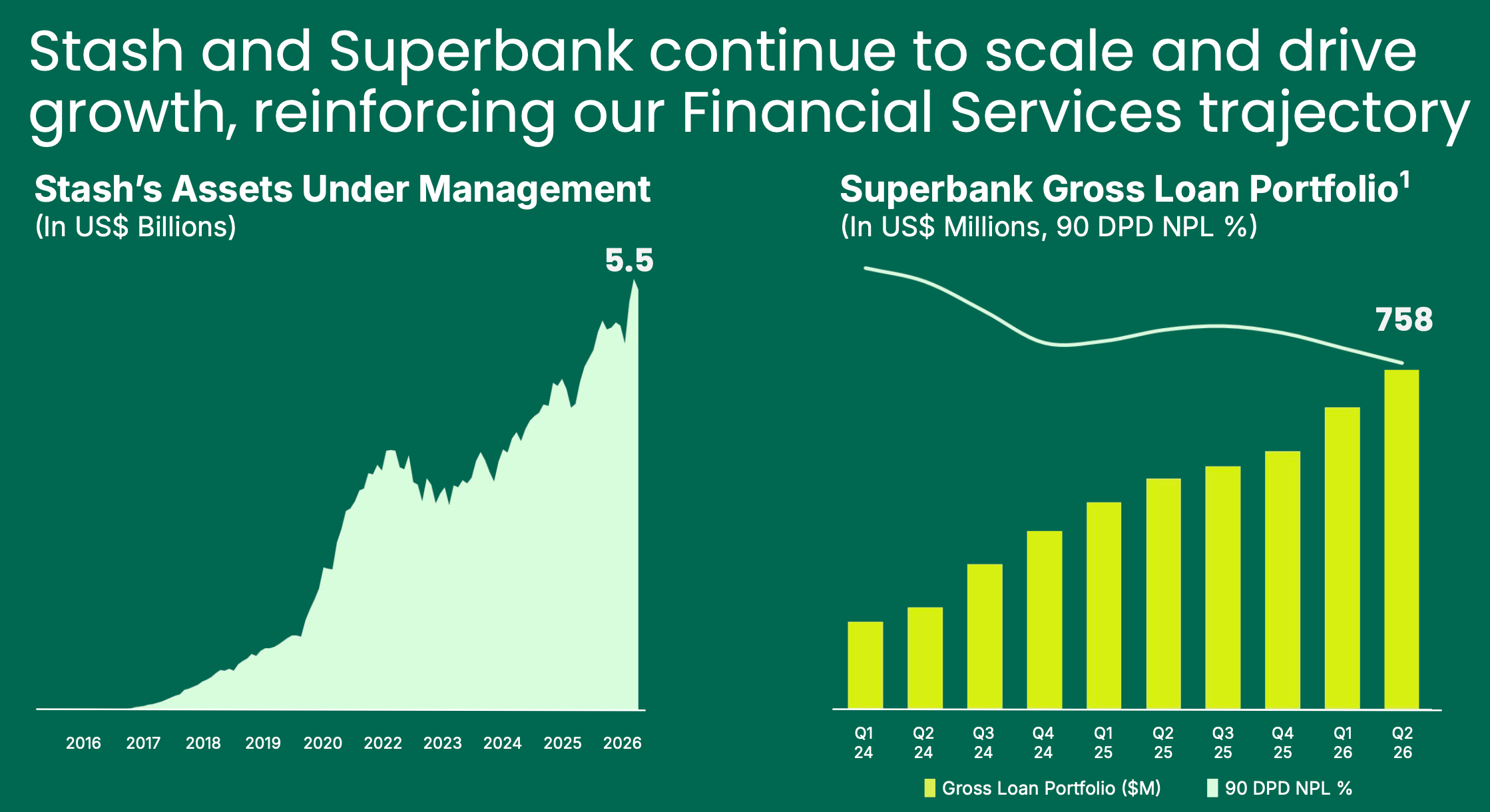
Management revealed more numbers on Superbank this quarter. Superbank now serves 7.4M customers with daily transactions above 1 million. It was profitable for the full year in 2025, posting a pre-tax ROE of 5.7% and a cost-to-income ratio of 55% this quarter. Management expects this to fall below 50% by year-end. Over 60% of Superbank users also use Grab and OVO, which shows the ecosystem flywheel appears to be working as expected.
Stash
In Q1, Grab announced that it would be acquiring Stash for US$425 million for a 50.1% initial equity stake, with the remaining 49.9% bought at fair market value over three years.
This initial acquisition is expected to be completed in Q3 2026, and would add an AI-powered wealth platform with $5.5B in AUM. Grab shared that its AUM is growing at 22% YoY, with over 1M active subscribers.
This moves Grab’s GFin beyond lending into wealth, which I believe is the logical next step for a deposit base of $2.5B.
3. Key Call Commentary
Grab again hosted a live earnings video call with their IR head, Ken Lek, taking charge of summarising questions and reading them out. On the call were the usual trio of CEO Anthony Tan, CFO Peter Oey and COO Alex Hungate.
Here are some of the key quotes that I thought were useful for investors.
On AI Efficiency for the Business
“Underpinning all of this is our Grab AI intelligence layer, which now processes trillions of tokens every month. Our cost per AI interaction with driver and merchant partners has approximately halved versus a year ago, while monthly interactions grew tenfold.”
On Uber’s CEO Dara Exiting The Board & Potential Competition
“As we disclosed on July 6, Dara stepped down from our board effective that date, as we continue to enhance our governance in connection with our proposed acquisition of foodpanda’s Taiwan business. Dara joined us in 2018 in connection with the sale of Uber’s Southeast Asia business to Grab and has been a valued voice in our boardroom for eight years. On behalf of the board, everyone at Grab, I want to thank him personally for his contributions. We maintain ongoing dialogue with Uber in their capacity as a shareholder in Grab.”
“As shared in our previous public filings, Uber is restricted from competing with Grab in our core markets until 1 year following a full sale of its Grab shareholding.”
As I highlighted when the news first broke, this is nothing more than a necessary step-down to ensure compliance to regulations. It is not a fracturing of the Grab-Uber relationship and I do not expect it to change. Uber still remains the largest single shareholder in Grab.
On GrabMart’s Growth
“GrabMart users grew 42% year-on-year, but even then, Mart still only consists of about 14% of our food user base. Still lots of upside there. We spent the year really strengthening the foundations to create the best possible consumer experience. Leveraging both the offline anchors like Jaya Grocer and Everrise in Malaysia, and also deepening our partnerships with leading supermarket chains in every country across the region. We’ve been able to put together a broad everyday assortment of SKUs, we’re also cross-selling organically using GrabMore, which continues to improve in terms of its effectiveness as a cross-selling channel.”
“GrabMart grew GMV at 1.7x the rate of food deliveries this quarter. We expect this kind of growth to outpace the overall deliveries portfolio, and obviously, therefore, it will end the year at a slightly higher proportion of deliveries GMV. Longer term, we can see that some of the global peers are reporting something like 30% or even higher for grocery penetration. There’s obviously lots of upside there when you compare against best in class outside of Southeast Asia, and we’ll continue to target that kind of a much higher growth for grocery going forward.”
“Most importantly for us, grocery already drives more frequent user behaviour than food alone, and that’s really important because we see that frequency expansion and transaction growth coming through this quarter with MTU growth at 54% year-on-year. That really shows that consumers like this Mart service and come back with multi-year kind of frequency increases for us. We’re scaling groceries deliberately, but we’re doing it within our commitment to grow deliveries margins year-on-year.”
As I discussed in the $65B quick-commerce opportunity piece, I believe Mart is a massive opportunity for Grab. It is great to see that Grab expects deliveries margins to continue growing despite the focus on groceries and the expanding contribution to overall GMV.
On Indonesia’s Commission Caps and Potential for Spillover
“The two-wheel taxi business, or as we call it, Ojol in Indonesia, represents 6% of our total mobility GMV, so relatively small. It does contribute, though, positive adjusted EBITDA to our business today. The good news is that with the changes that have been implemented in July, we expect to be able to maintain this positive margin profile going forward for the Ojol business in Indonesia.”
“The full year guidance, I can confirm, does assume that the commission structure remains as currently implemented for Ojol only, and there’s no information that we have to suggest that anything otherwise will occur. Overall, therefore, reiterating our group mobility margins for the second half will remain within the historical range of between 8.5% and 9%.”
This addresses the precedent-and-spillover worry that I flagged last quarter, at least for now. I believe this is something that has to be continually watched in the next few quarters.
On Outlook for Fuel Prices & Mobility Margins
“I don’t think any of us are going to stand here and try to predict fuel price through the rest of the year. It’s obviously a very volatile situation. I tell you what, we are committed to continuing to support our drivers no matter what happens. We have committed $7 million already to build support programs since the spike began in March, and that’s been successful because it has allowed us to maintain the health of the marketplace, with more drivers coming into the marketplace to drive for Grab.”
“EVs are coming into the marketplace in Southeast Asia in a very rapid rate. We’re being a catalyst for that because we think that this is a structural buffer for volatility in oil prices going forward. It fundamentally reduces the total cost of ownership for drivers. EVs actually have lower costs once the initial investment is made in the vehicle. This quarter, for example, we announced nine new fleet partnerships in Thailand. We’ve announced a new partnership with Wuling in Indonesia, and we’ve expanded charging access through the app for drivers in the Philippines.”
On the AV Rollout in Southeast Asia
“Over 50% of all transactions in Southeast Asia are two-wheel, below $1 per ride, making AVs uneconomical for commercial rollout. Singapore specifically is only 10% of all four-wheel transactions regionally.”
“Our edge beyond partnership is a decade of mapping POI high density regulatory and customer relationships centered on trust that actually makes this work at scale. Since January, our Ai.R shuttle, Ai.R shuttle, has served over 9,000 riders. We’ve moved through this deliberately with community rides first, then full public operations in April. When we surveyed rides, or specifically riders with the government, 99% said they would recommend it to a friend.”
“Two weeks ago, we announced the next phase. Supported by our government, our riders will now be able to book their own AV, go point to point, and be able to go directly straight to markets, pharmacies, schools, train stations, instead of following a fixed loop. That opens to trial riders over the next few months, and to the general public in Q4, when we start charging commercial fares. That makes Punggol our first point to point revenue-generating autonomous service.”
4. Positives & Negatives
Positives:
Deliveries expanded margin despite grocery growth
Deliveries segment EBITDA reached 2.3% of GMV, up 45bps from 1.8%, on 24% constant-currency GMV growth. The subtle point behind this is that GrabMart, the lowest-margin segment, grew at 1.7 times the rate of food deliveries and therefore diluted the segment mix. This means the underlying food delivery margin expanded by more than just 45 bps.
Advertising is the key lever of this margin expansion. Active advertisers grew 21% and spend per advertiser grew 24%, so advertising revenue grew roughly 50% YoY, and advertising is close to pure incremental margin. I wrote a piece on GrabAds a year ago, which I highlighted as Grab’s 4th pillar. I would highly recommend reading the piece to understand the potential of this segment:

Management is prioritising Financial Services
GFin' revenues grew 59%, loans disbursed grew 72% to an all-time high $1.2B, while the segment loss narrowed to negative $15M from negative $26M. Management reiterated H2 2026 segment profitability and projected the loan book to exceed $3B by year-end.
What is so key about Grab’s Fin Services business is their funding model. Grab acquires borrowers at near-zero marginal cost through the existing super-app that they own. They then underwrite on proprietary transaction and behavioural data, and fund the loans with $2.5B of low-cost DigiBank deposits. This is the exact playbook that Nubank and Sea’s Monee have employed to great success.
It is a structural edge over standalone FinTech lenders who fund through wholesale markets. Encouragingly, Superbank itself is already profitable and Stash, their newest acquisition is too.
Capital Allocation has stepped up tremendously in the past year
One of the key negatives I highlighted last year was Grab’s massive $6B net cash position, which I thought demonstrated poor capital allocation.
In the past year, they have made several large acquisitions and investments, as well as share buybacks. I think these are very positive signs.
For instance, Grab has acquired FoodPanda Taiwan for $600M, Stash for $425M (initial 50%, which means total of ~$850M), invested in Infermove, Momenta, WeRide, Vay Technology, May Mobility etc. They have also authorised another $750M buyback following the completion of $400M of their $500M share buyback plan. Most of the deals will close in H2 2026 which should bring net cash down to ~$3B.
It is also good to see that Grab’s management views the current stock price to be depressed and attractive levels to repurchase shares. I continue to believe that there is a severe dislocation between the stock price and fundamentals of the business.
Negatives:
Overall incentives are on an upward trajectory
On-Demand incentives reached 10.9% of On-Demand GMV, up 72bps YoY. Since incentives are contra-revenue, this increase is mechanically dragging the take-rate down even though unit contribution might be healthy. Hence, part of the take-rate decline is an accounting side-effect.
That said, overall incentives increasing is still not good for the business. In Deliveries, Grab is still out-earning the rising incentives. However, in the Mobility segment this quarter, segment margin is contracting. This is partially due to multiple factors such as Indonesia’s commission caps, the oil crisis etc. However, it is still key to watch whether this continues in future.
Revenues have not accelerated
Despite GFin becoming a larger portion of overall revenues, it is notable that Grab’s revenues have not accelerated in the past 8 quarters or so. Personally, I find that disappointing as Grab’s rivals have weakened considerably in the past few years.
Gojek is a declining force in Indonesia, their largest market, while FoodPanda and Deliveroo have gradually exited the region. Much of the growth appears to be coming inorganically now too, through acquisitions. I would like to see more organic growth from the core business.
5. Conclusion
Overall, I thought this was a strong quarter for the business amidst the oil price headwinds. We saw a narrow beat in the top-line, no doubt due to uncertainty in the region.
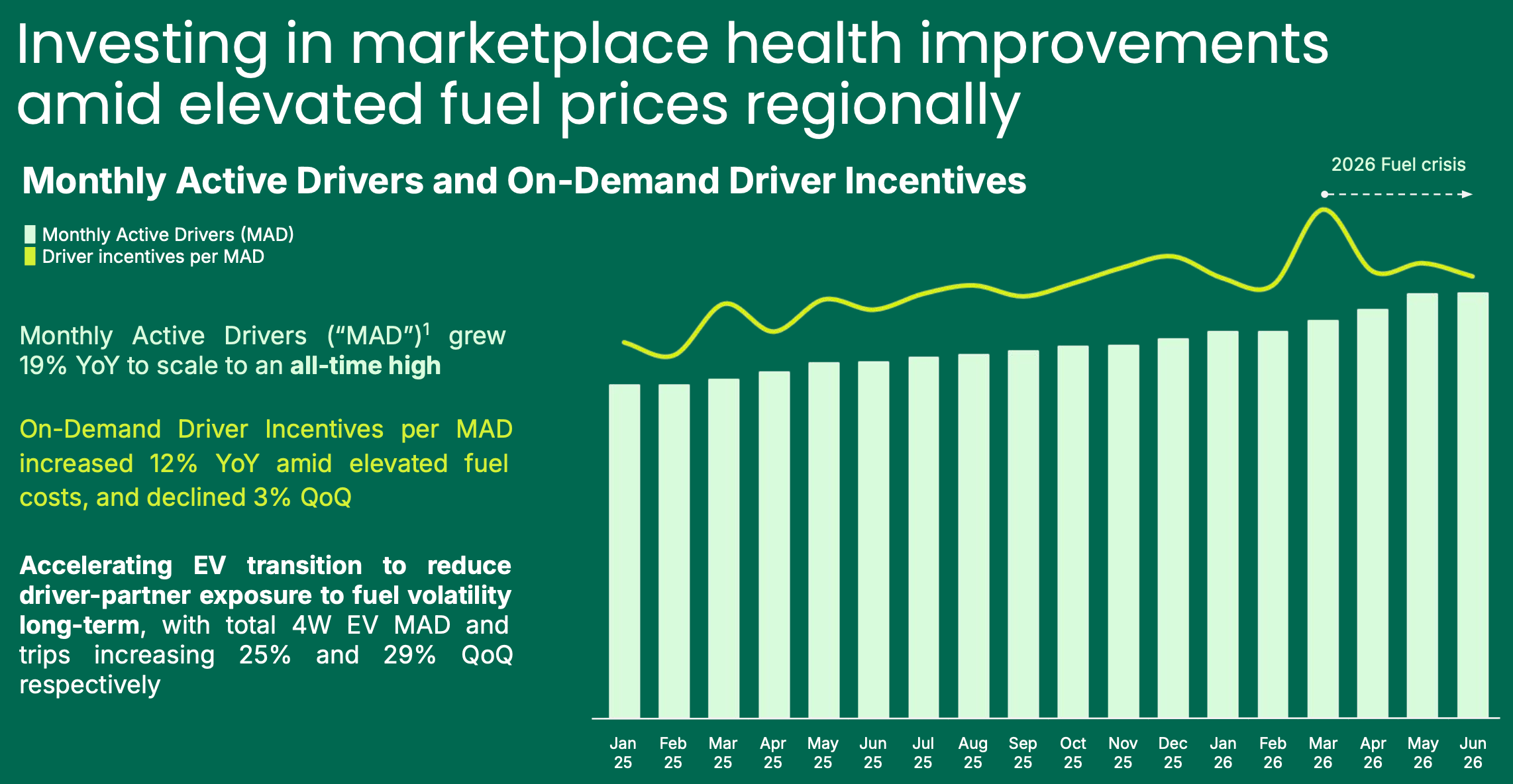
In March, Grab invested heavily in on-demand driver incentives to spur supply amidst the peak of the oil crisis. Since then, monthly active drivers have scaled to an all-time high. This is extremely bullish news for the business, as supply remains the main limiting factor for growth.
Since then, driver incentives have declined which is a good sign considering the still-elevated oil prices.
My position in the stock remains unchanged for now. I have not added to the stock recently as I want to see a genuine acceleration in revenues. The thesis remains on schedule as operating leverage is driven across the business. I remain hopeful that the Fin Services business can accelerate and garner larger market share in the region.
Grab is still one of my core holdings, and I believe the stock price is dislocated from the business. We are now moving into the 2nd year of full profitability, and I believe the stock will eventually follow the earnings trajectory.
Thanks for reading! If you enjoyed this piece, please give it a like and consider subscribing to a tier of your choice.
As a reminder, paid subscribers typically receive 6-8 articles a month covering:
Earnings Reviews (Grab, Sea Limited, dLocal, Mercado Libre and more)
1-2 Deep Dives (always happy to receive suggestions)
Portfolio Review (sharing all my positions & changes)
Disclaimer: The content presented in this thesis is for informational and academic purposes only and does not constitute financial advice. The analysis and opinions expressed are based on research and should not be interpreted as a recommendation to buy, sell, or hold any security. Readers should conduct their own due diligence and consult with a qualified financial advisor before making any investment decisions.
Love this - thanks Gab!