

The common advice given to new investors is to hold onto winners and cut your losers.
The reason behind this, is that the most you can lose on a stock is 100%, while the upside is theoretically unlimited. A stock that compounds at 20% a year for 20 years becomes almost 40 times larger. Selling a winner too early, could therefore equate to losing money on multiple stocks.
Many great investors talk about this, Peter Lynch, who averaged 29.2% annual returns from 1977 to 1990 for example:

What Constitutes the Long Term?
My counter-argument is that this assumes you are an exceptional stock picker, with the unique capability to pick stocks that outperform in the long term.
Now what constitutes the long term?
Everyone’s answer will differ, but I think a useful data point is to look at this chart:
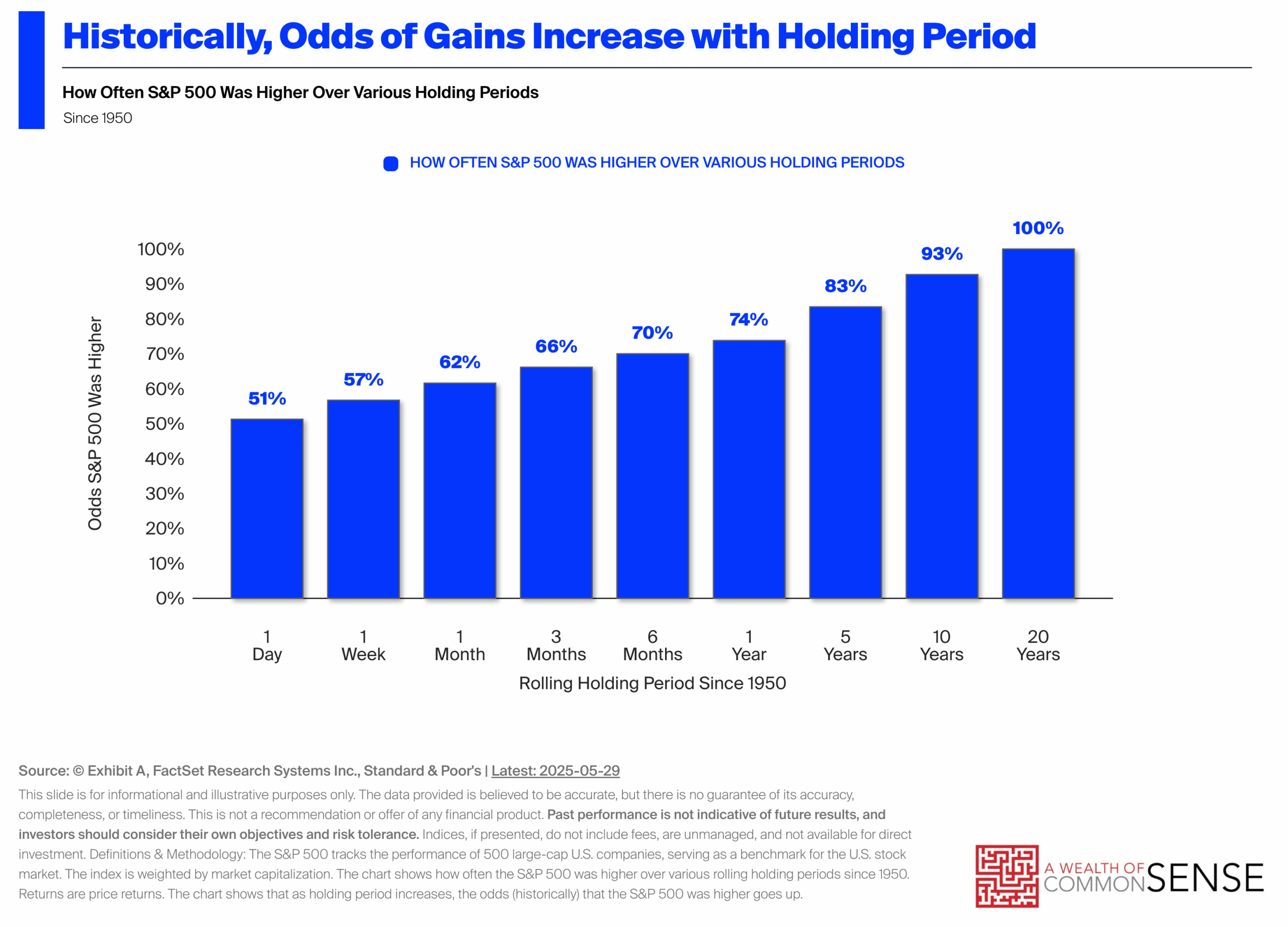
Over a 10 year period, the S&P500 was higher 93% of the time.
Over a 20 year period, the S&P500 was higher 100% of the time.
To be extremely safe, let’s pick 20 years as the long term benchmark. Holding stocks for 20 years, would therefore mean stock pickers shouldn’t lose money, right?
Not quite.
The reason is pretty simple. The index constitutes 500 stocks, that are adjusted on a quarterly basis. Therefore, these 500 stocks today are not the same 500 stocks from 1, 3, or 5 years ago. When you buy the S&P 500, you are buying a portfolio that constantly evolves. Companies shrink, disappear, get acquired or are removed from the index. New winners enter. Existing winners become larger weights.
The index does the selection for you over time, while a stock picker doesn’t quite have that luxury.
The Market’s Odds are NOT our Odds
It is perfectly reasonable to look at the chart above and conclude that time is the friend of the investor. However, the truth is that time is not necessarily the friend of every individual stock.
Hendrik Bessembinder's research on individual companies makes this distinction very clear.
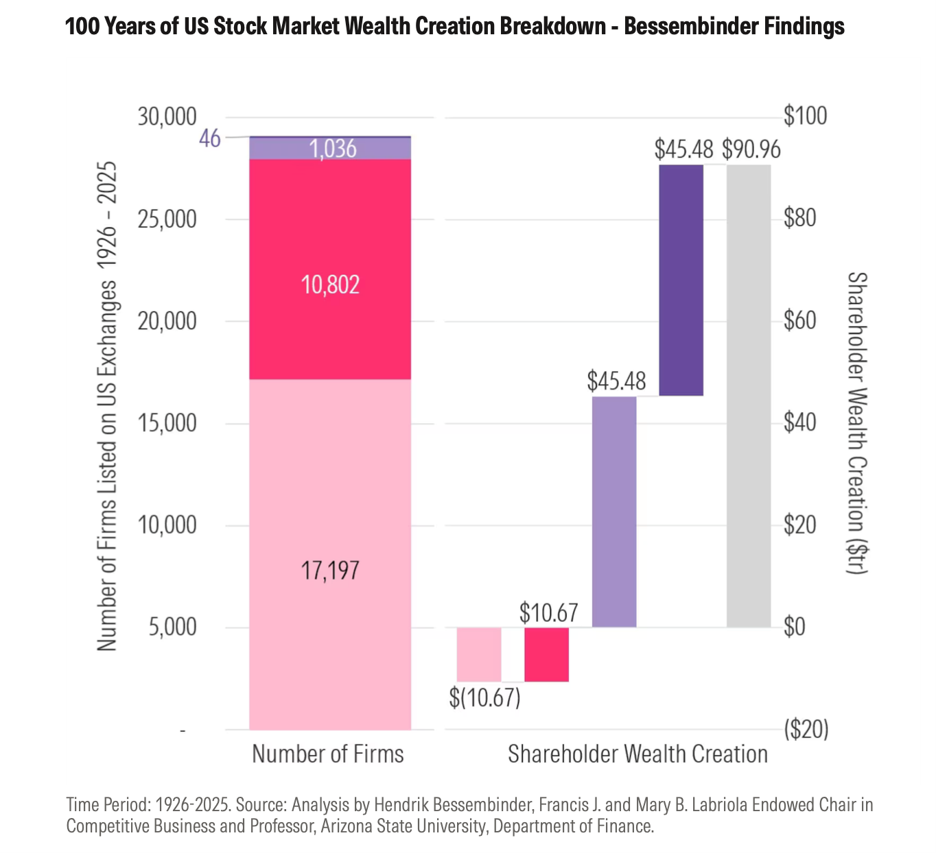
Looking at almost 29,000 US-listed stocks between 1925 and 2023, he found that 51.6% generated negative cumulative returns over their lifetimes. Yet a small number of extraordinary companies produced enormous returns, enough to pull the overall market upwards.
Earlier work by Bessembinder found that just 4% of listed US companies accounted for the entire net wealth creation of the US stock market since 1926, while the remaining 96% collectively did no better than one-month Treasury bills.
Globally, the evidence is similar. Research covering more than 64,000 stocks found that just 2.4% of companies accounted for all $75.7 trillion of net global stock-market wealth creation between 1990 and 2020.
The advice to "let your winners run" exists precisely because stock-market returns are so positively skewed. Missing one Amazon, Microsoft or Nvidia can matter far more than avoiding dozens of mediocre investments.
However, this creates another problem:
How do you know if you own an Amazon, or a mediocre business?
We Identify Winners Retrospectively
If a stock goes up 3x in 5 years, it is easy to tell ourselves that we were right and that the correct decision is simply to keep holding.
However, a rising share price does not necessarily mean the company will continue compounding for the next decade. Likewise, a stock that has fallen 50% is not automatically a loser.
Sometimes the business is progressing exactly as expected while the market has simply changed what it is willing to pay for it. (Multiple compression)
This is where survivorship bias creeps in. We study companies like Amazon, Apple Nvidia, Microsoft and conclude that the lesson was to never sell your winners.
The issue is that we are focusing on a small number of companies that survived, adapted and compounded for decades. There were many other winners who won for 10 years and suddenly stopped winning, either by stagnating, being disrupted or simply becoming too expensive.
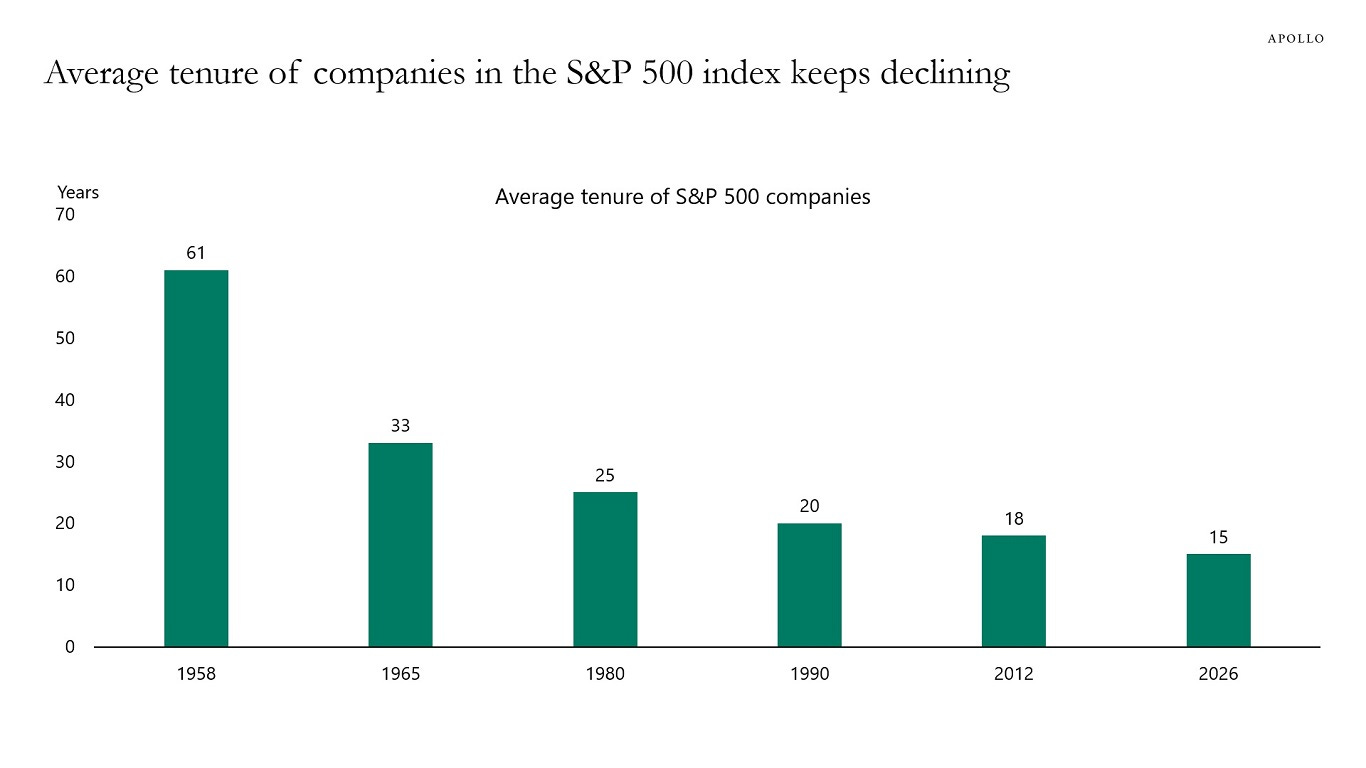
In fact, the duration of winners that have continued winning have shrank considerably in the past century, no doubt due to the advancement of technology, which rapidly accelerates both the upward and downward trajectory of businesses.
In 1958, the average tenure of a company in the S&P 500 index was 61 years. Today, it is just 15 years. Interestingly, this is not even as long as the long term we determined earlier on.
We spend enormous amounts of time studying the businesses that successfully navigated multiple technological cycles, competitive threats, recessions, management transitions and valuation bubbles.
We spend far less time studying the companies that looked equally dominant at some point and then stopped winning.
There have been plenty of these, as judged by the stats above. This can be due to market leadership changes, industries maturing, technology shifts, regulatory changes and management teams changing or simply losing their edge.
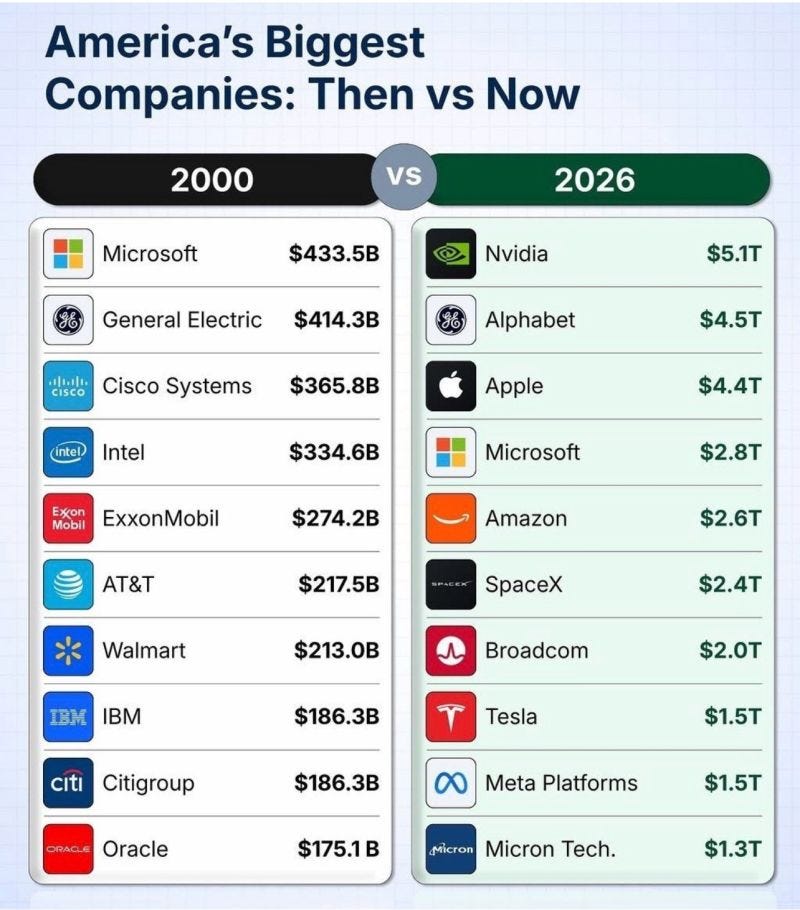
In just 26 years, the top 10 has evolved massively. Of the 10 largest US companies in the world in 2000, only 1 remains in the list. That is Microsoft, which has been overtaken by 3 businesses who were not even near the top of the list 26 years ago.
Today’s dominant companies are not guaranteed to remain tomorrow’s dominant companies.
These are not just any 10 random businesses, they were the most dominant businesses in their time, and yet, they have fallen behind.
The counterpoint is that, while these businesses have not remained at the top, perhaps they have still done incredibly well, but been outdone by recent winners.
I looked at the top 10 US companies in 2000, mapped out their annual returns and compared it to the S&P 500. Here are the results:
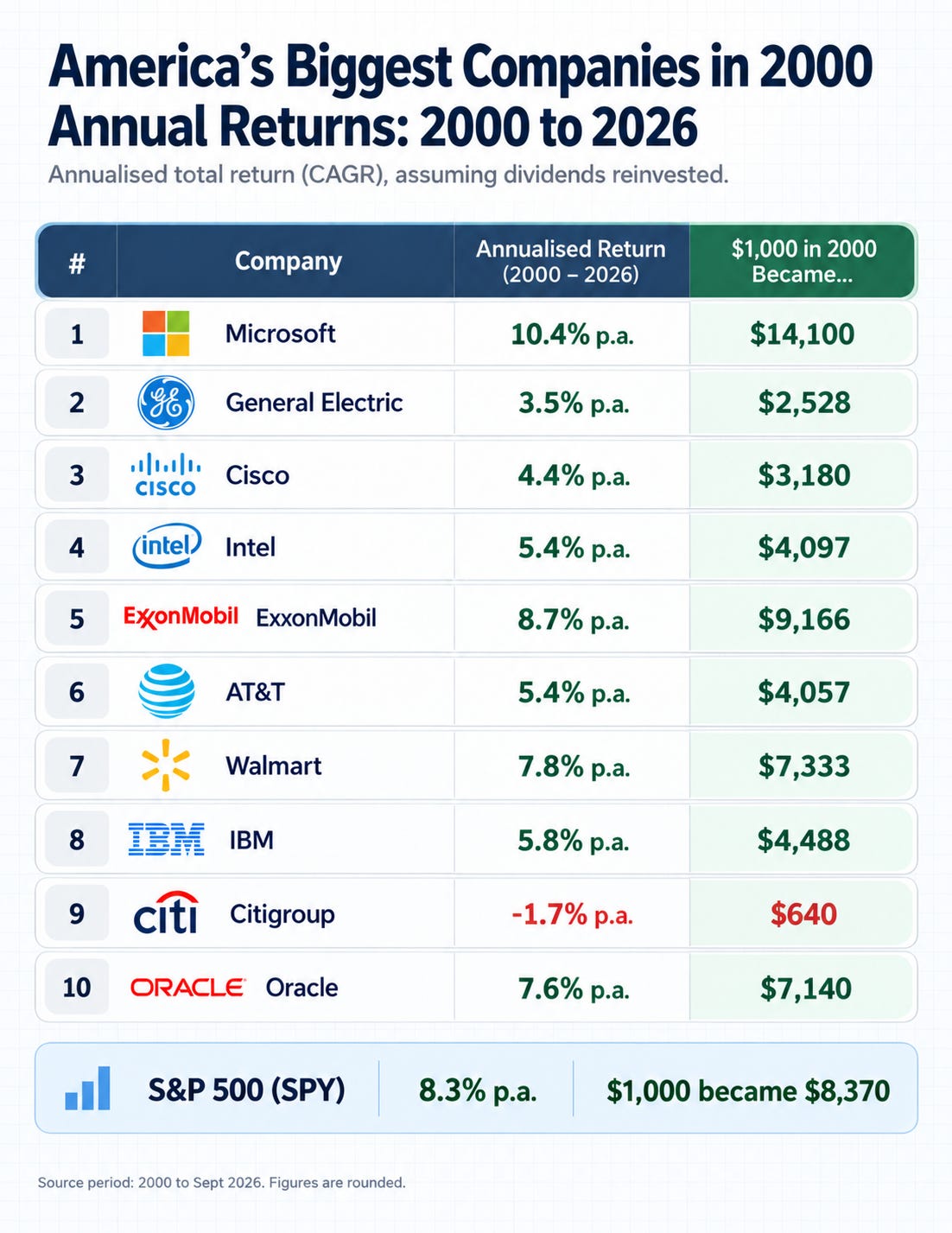
Even the top 10 US companies, who would be deemed as “winners”, failed to beat the the overall index. Of the 10 on the list, only Microsoft and ExxonMobil have had market-beating returns, while the likes of General Electric, Citigroup and Cisco have struggled.
Key Takeaways
The data we just looked at tells us two things:
We want to own the tiny number of extraordinary winners
Since stock returns are so positively skewed, selling a genuine long-term compounder too early can be one of the most expensive mistakes an investor makes.
Yet,
Most individual companies will NOT become those extraordinary winners
This means that simply holding onto winners and hoping they remain winners is not a suitable strategy.
That is the paradox of the “letting your winners” run advice.
We want to hold onto great companies long enough to capture the extreme right tail of returns, but in real time, we will not know with certainty which companies are going to remain in that right tail.
It sounds obvious when phrased this way, however in practice, this is incredibly difficult.
Let’s walk through a practical example.
Imagine you bought a company at $10.
5 years later, it trades at $50.
The business performed brilliantly, your thesis was right and you made 5x your money.
Now, imagine that I discovered that same company for the first time today.
The stock trades at $50. Would I buy it?
This is actually the same question existing shareholders should ask themselves, but often avoid.
The only thing that matters at this point is:
What return can this business plausibly generate from $50 onwards?
I think this thought experiment is incredibly useful because ownership creates psychological baggage. When we have made a lot of money in something, we naturally become attached to the investment.
It becomes our winner, and selling feels like abandoning something that has worked. There is also the fear that it keeps going up after we sell, which creates one of the most painful forms of investment regret.
The correct benchmark we should be gauging it against, is opportunity cost.
Capital has an opportunity cost.
Suppose you own a fantastic business trading at a valuation that you believe implies a 7% annual return over the next five years. You also identify another business where you believe the expected return is 15%.
If you decide to keep the existing winner, you are effectively choosing 7% over 15% expected returns. Of course, expected returns are uncertain, and the forecasts may simply be wrong. Incumbent businesses often continue to surprise positively too.
Re-underwriting the winner.
If you had to take away just one thing from this article, I think it would be to continually ask if your stocks are still winners (not from a stock price standpoint, but from a fundamental business standpoint)
The real skill is not holding our winners blindly, but consistently evaluating these businesses, re-underwriting them as they become larger positions and being ready to take profits when the situation changes.
Don’t hold your winners blindly.
Constantly re-evaluate if they are still worth holding.
Don’t be afraid to take profits when the thesis changes, or the opportunity cost is too large.
Thanks for reading!
-Gab
P.S. This is a very different piece from my typical article, but I felt compelled to write this, and I hope this is helpful for you if you read through this short piece.
Paid Subscription Upgrade
If you’d like to support the work I do, consider becoming a paid subscriber. Your support will allow me to spend more time finding asymmetric opportunities in the market, writing and analysing various businesses.
As a reminder, paid subscribers get access to:
Monthly Portfolio Updates (+98% in 2024, +26% in 2025)
Earnings Reviews on Portfolio Companies (SE, GRAB, DLO, MELI etc)
Archive of Deep Dives and Posts (20 Deep Dives and counting)
You can get 30% off your first month with the link below.
Disclaimer: The content presented in this thesis is for informational and academic purposes only and does not constitute financial advice. The analysis and opinions expressed are based on research and should not be interpreted as a recommendation to buy, sell, or hold any security. Readers should conduct their own due diligence and consult with a qualified financial advisor before making any investment decisions.
In light of what you shared, are you considering selling/trimming any of your holdings? If not, does that mean you consider them all undervalued in respect to an index beating return?
Agreed! I always evaluate my current holdings as if I'm building a brand-new position.
The tricky variable is tax friction. Here in Germany, a ~26% tax on gains means selling a 2x winner instantly wipes out 13% of your capital.
When running my scenario models, the replacement stock needs to beat the original by roughly 2.6% per year over 5 years just to break even on that tax hit. So taking profits must be done carefully in times of (obvious) overvaluation but are absolutely necessary as outlined in your article!
Anyone living in countries with tax-deferred accounts (like IRAs or ISAs) consider yourself lucky!