

SpaceX goes into 2027 as the best-positioned AI compute operator in the market, and their lead has extended massively in the past 6 weeks.
Neoclouds have watched their share prices collapse in the past month and their access to cheap capital disappear. Meanwhile SpaceX has priced the largest GPU financing on record, made its biggest model rival its largest customer, and kept adding capacity.
When compute is scarce, the company with capacity, capital and customers at the same time sets the terms. Right now, that company is SpaceX.
Here are my updated thoughts on SpaceX’s positioning:
Compute is scarce, and SpaceX dominates it
SpaceX’s nameplate compute went from 0.6 GW to 1.7 GW in 12 months, with management guiding for as much as 3 GW by year-end.
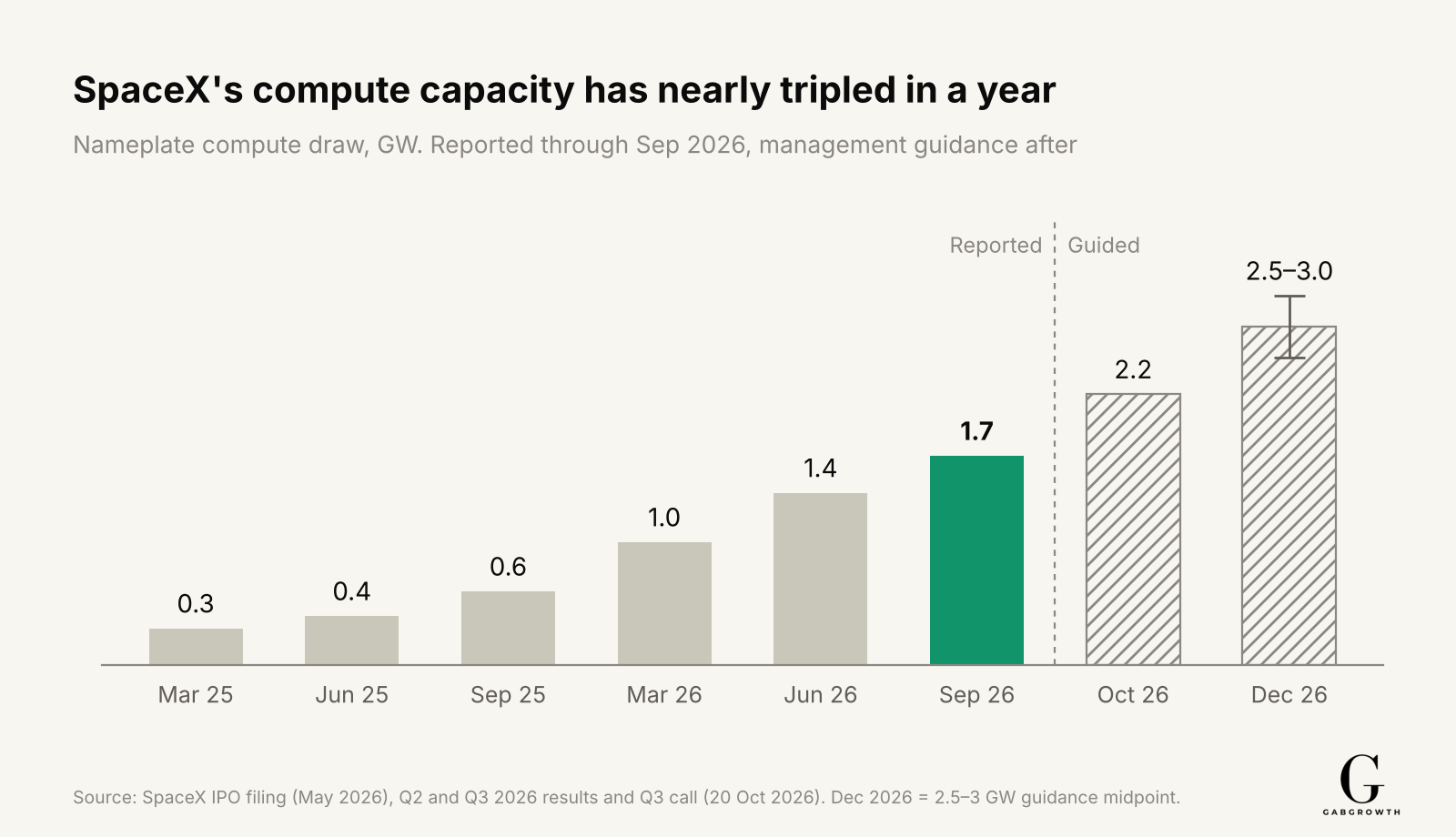
On the demand side, SpaceX’s CFO confirmed on the latest Q3 call that new deployments were paying back in under a year at current pricing, and management said customers were seeking more capacity than it could offer.
In a market like that, the operator who can actually hand over working capacity chooses its customers and its price. (We can see this with the Anthropic deal structure, more on this later)
Capital, Capital, Capital
Funding is the holy grail today for compute. We just saw the Neoclouds sell off massively in recent months.
A falling stock price means more dilution per dollar raised, and less favourable terms on debt. Capacity that is not financed this year will mean no delivery next year.
SpaceX managed to raise before this window narrowed, and proved again why Elon is the best capital raiser in the world, by far.
June: $85.7 billion of net IPO proceeds at $135 a share, followed by a $25 billion debut bond deal on $89 billion of orders.
September: $51.3 billion of cash and $38.6 billion of marketable securities on the balance sheet.
20 November: Apollo and Goldman priced about $44 billion of notes, oversubscribed and upsized, with BlackRock, GSAM and KKR anchoring, for Vera Rubin deliveries in the first half of 2027.
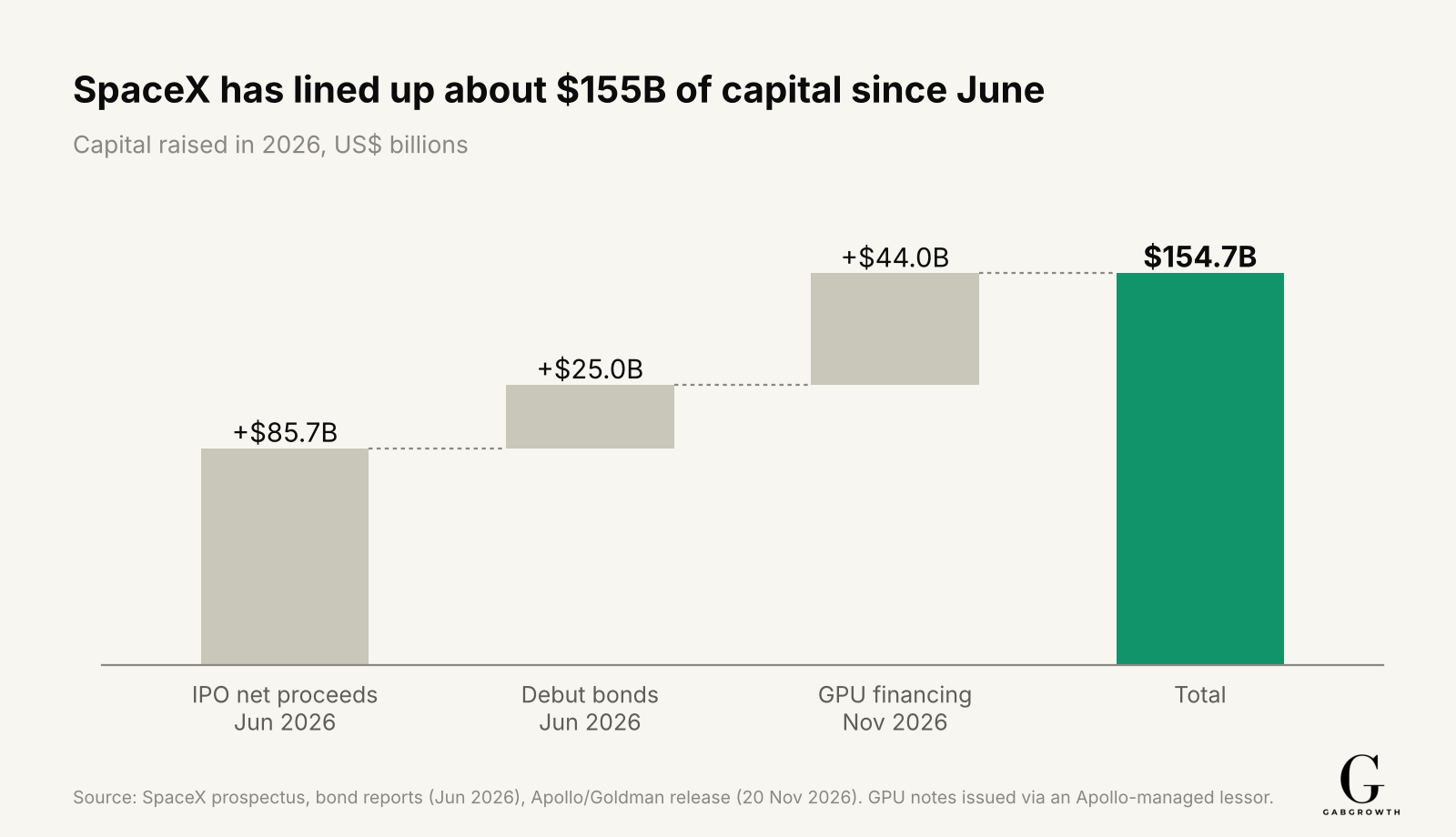
Their latest deal cost 8.26% on the largest tranche, but the point is that it priced at all, at record size, in the same weeks lenders were turning on the neoclouds, and was upsized.
Elon Musk has predicted a neocloud shakeout:
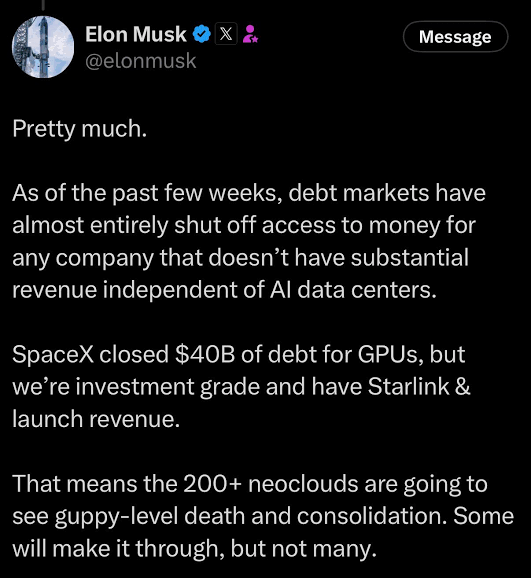
In fact, he doubled down just a couple days ago, questioning how capital is going to be raised for compute.
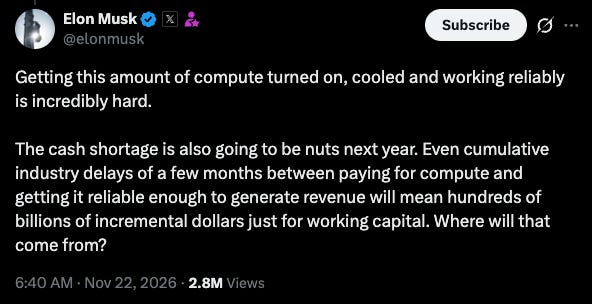
Now of course, it makes sense for Elon to say so. After all, these are his main competitors. Yet, it is a good point worth considering. It also shows how Elon’s decades of experience has enabled him to make the right decisions for SpaceX.
Here’s what he’s done in order:
Built capacity ahead of the bottleneck: Nameplate compute reached 1.7 GW at September-end, from 0.6 GW a year earlier, while many competitors were (and still are) arranging financing and sites. This is best symbolised by the original Colossus supercomputer in Memphis which came online in 122 days during the summer of 2024. Colossus II was then built in 91 days. In Jensen’s words: “Elon is singular in his understanding of engineering and construction and large systems and marshaling resources; it's just unbelievable”
Raised equity quickly and decisively: The June IPO money gives SpaceX flexibility it would not want to raise at today’s price. Elon announced plans to IPO the company and did it in a short space of time. It is clear that trying to IPO at a similar valuation now would be an uphill battle.
Added applications and distribution: Bought xAI in February, thereby bringing Grok and X together. He then purchased Cursor in an all-stock deal when the stock was trading near all-time highs. Again, a great decision.
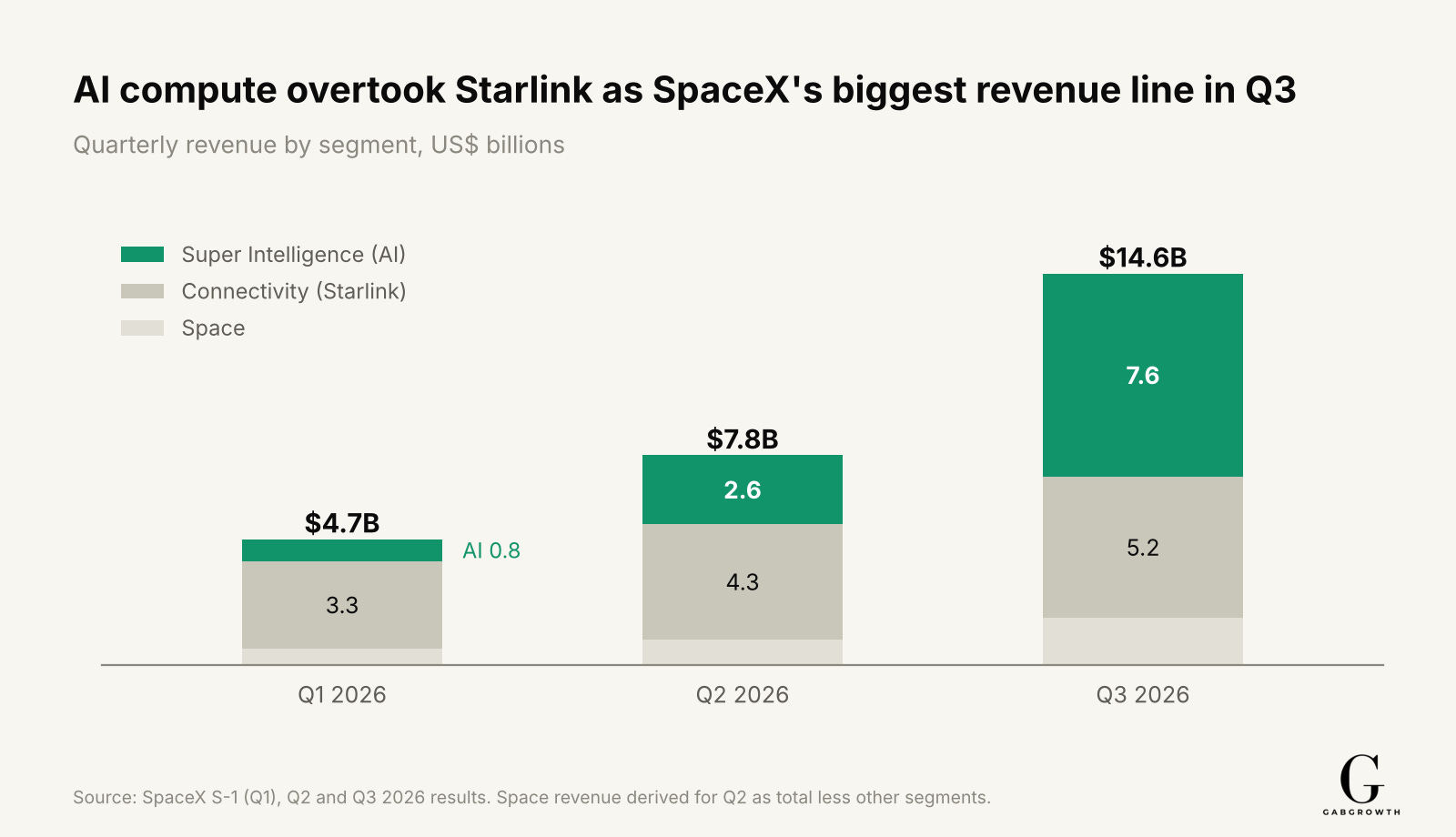
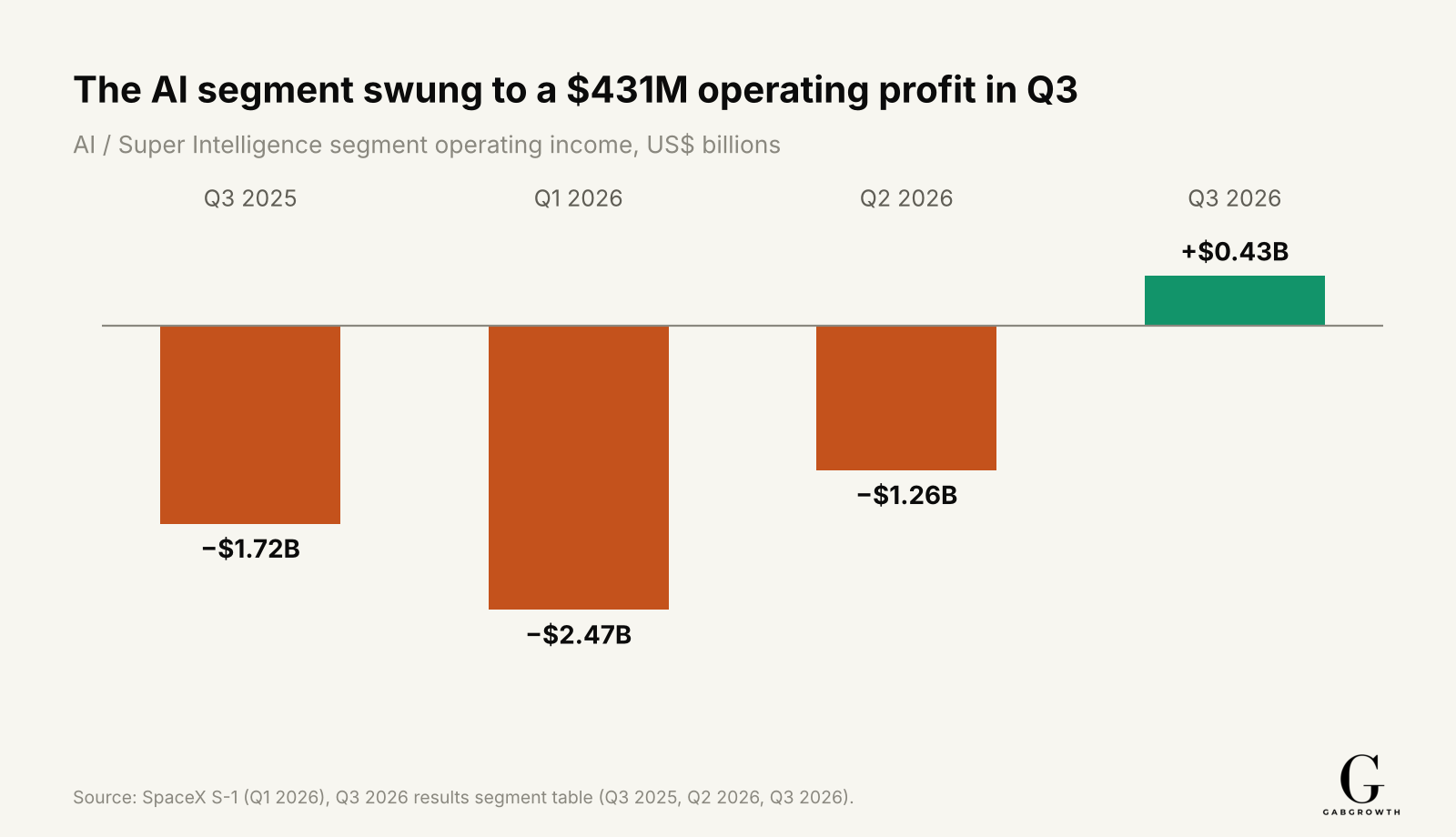
The results of this are beginning to show. The AI segment of the business posted $431M in operating income in Q3, against a $1.26B loss the quarter before, and its $7.56B of revenue overtook Connectivity for the first time.
The Anthropic cancel clause
When SpaceX announced its compute rental deal to Anthropic months ago, the first point of discussion was the 90-day exit for both sides. It was therefore seen as a weak spot, with Anthropic having the ability to switch once it found more sources for power.
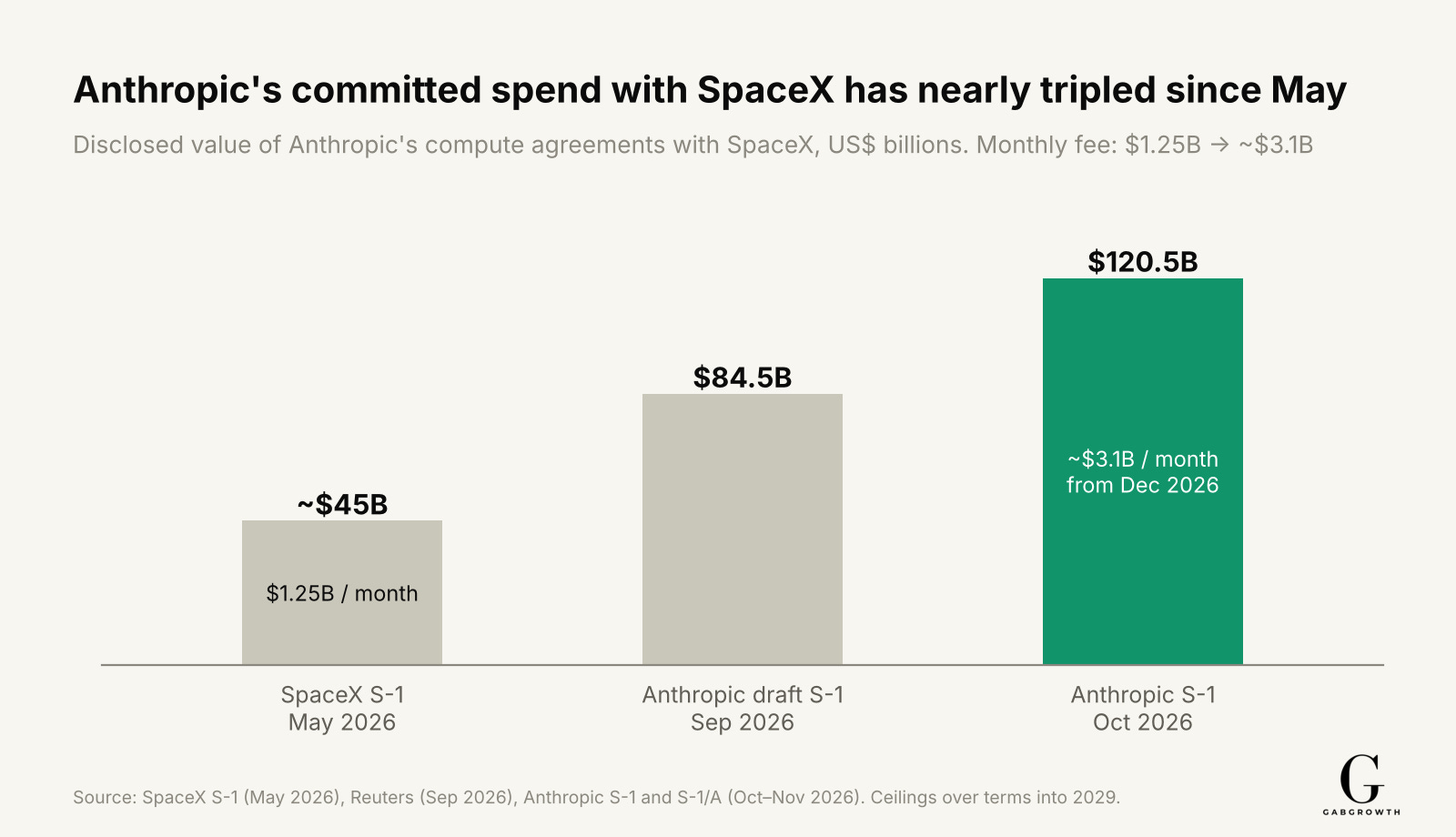
As we look at a scarce supply story, it appears that this was planned by SpaceX. Anthropic’s S-1 put payments at about $3.1B a month once all capacity is delivered, and up to $120.5B into 2029.
If Anthropic walks away, SpaceX simply re-rents. In fact, in the latest earnings call, management alluded to this:
“We are frankly hounded relentlessly by every hyperscaler and by dozens of smaller companies to rent more of our compute. So we could rent out our compute several times over if we said yes to everyone, that's the situation here.”
Elon Musk, CEO of SpaceX
This is not a surprise, as we are hearing it from all areas of the market.
As it stands, compute pricing is on an upward trajectory. If SpaceX wants to re-price, the 90-day exit clause will enable it to take capacity back for Grok or a higher bidder.
It’s clear that Anthropic would face replacement risk while SpaceX holds the re-pricing option.
Starship and the rest of SpaceX
As we’ve discussed, the primary limitation for compute players is simply access to cash. For SpaceX, they sit on a cash engine that very few AI infrastructure players possess to their scale.
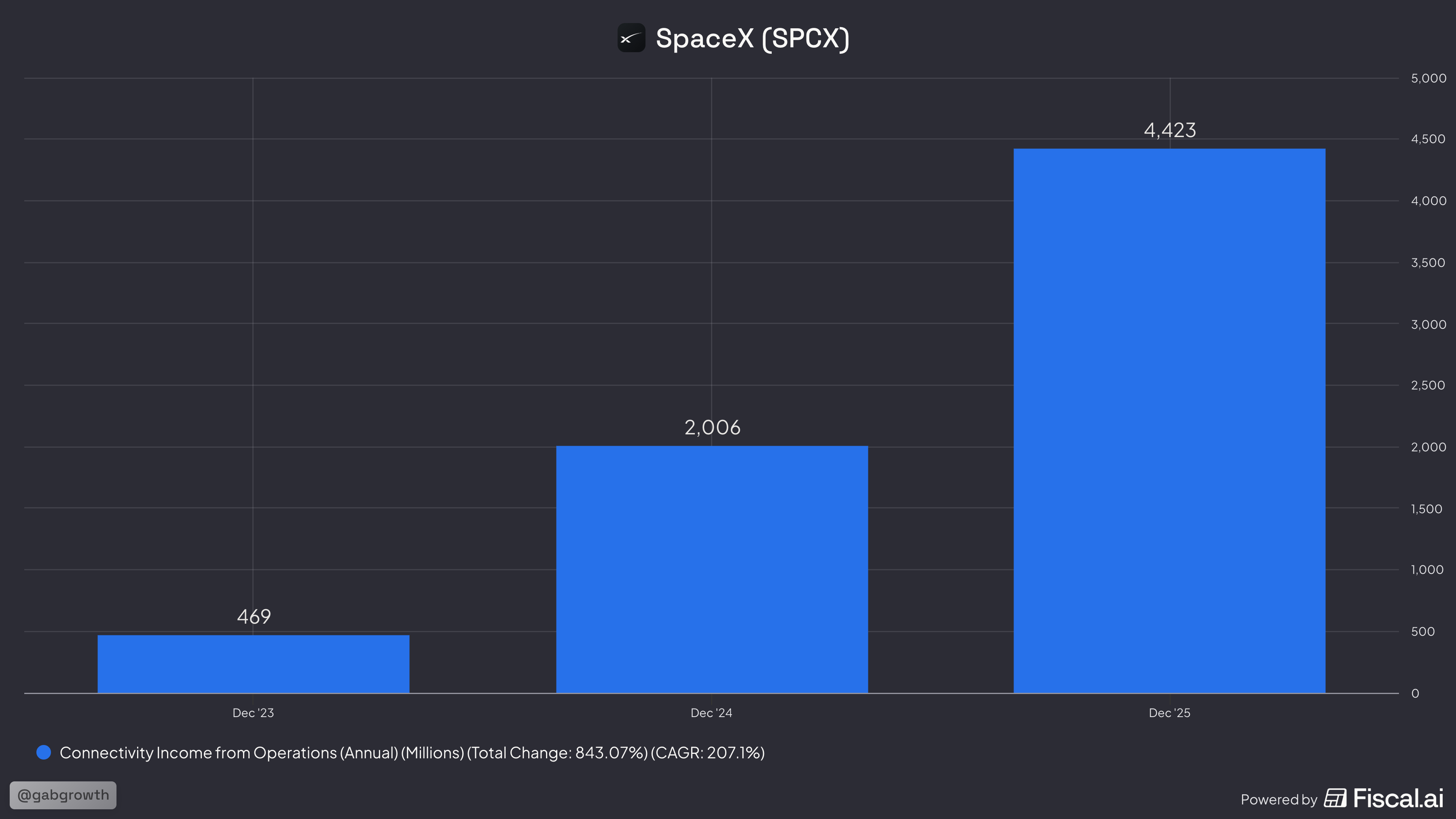
Connectivity generated $2.37B of operating income in Q3, and Elon himself explicitly credited Starlink and launch revenue for SpaceX’s ability to borrow at investment grade. This is a structural advantage over pure Neoclouds.
Starship has also continued closing the gap to full re-usability, as we’ve seen with yet another successful catch just a week ago (Flight 15). It was the first time a Starship second stage rather than just a Super Heavy booster, was caught by the tower.
This was also the second revenue-generating orbital mission for Starship and I think we are approaching a point of a step-change in revenue generation for the launch business.
Deploying 26 Starlink V3 satellites on a single Starship flight adds roughly 10x the downlink capacity of a standard Falcon 9 launch. Morgan Stanley estimates that a full load of 50 V3 satellites could generate roughly $400M in annualized incremental Starlink revenue per flight, achieving payback in under 20 weeks.
Conclusion
I fully expect AI compute to split into a few operators who actually own the capacity and customers. The vast majority of neoclouds are fated to die. I think that is actually pretty obvious.
I referenced Elon multiple times in this article, and I am aware of the conflict of interest. He is not saying stuff like this for fun. He knows that he is adding to the troubles of his fellow competitors, leading to even higher cost of capital.
Meanwhile, SpaceX is in a superior strategic position, not to mention the potential merger with Tesla, which would generate even more cash for it to fund its compute targets.
There is a huge assumption here, which is compute staying scarce through 2027 and 2028. As it stands, this is a consensus view. I personally think it does too, especially with the blue wave we saw, and what I believe will be a fight for control over compute among governments and politicians.
I have high conviction that SpaceX will win the compute race. What that means for the stock, especially considering the elevated valuation is anyone’s guess.
This is just the beginning of my research into this and perhaps I will have a better idea in a month’s time. That’s all for now.
Thanks for reading!
-Gab
Fiscal AI
The charts are courtesy of Fiscal AI.
For me, it is the best stock research platform available for retail investors. If you are interested in the service, they are offering a free 7-day trial for new users and 15% off any paid plan if you use the link below!
Paid Subscription Upgrade
If you’d like to support the work I do, consider becoming a paid subscriber. Your support will allow me to spend more time finding asymmetric opportunities in the market, writing and analysing various businesses.
As a reminder, paid subscribers get access to:
Monthly Portfolio Updates (+98% in 2024, +26% in 2025)
Earnings Reviews on Portfolio Companies (SE, GRAB, DLO, MELI etc)
Archive of Deep Dives and Posts (20 Deep Dives and counting)
You can get 30% off your first month with the link below.
Disclaimer: The content presented in this thesis is for informational and academic purposes only and does not constitute financial advice. The analysis and opinions expressed are based on research and should not be interpreted as a recommendation to buy, sell, or hold any security. Readers should conduct their own due diligence and consult with a qualified financial advisor before making any investment decisions.