

Sea Limited was my very first post on this Substack in September 2024.

At the time, the stock traded at $77. The stock went on a strong run from then till September 2025, with the most recent high at $199.30. In the past 8 months, the stock has seen an incredible drawdown, trading as low as $77 (again) in late March, down over 61% from 52-week highs.
In this piece, I will give an update on my view of Sea Limited today and my plans for the stock moving forward.
Quick Summary of Initial Sea Limited Thesis
This was my initial thesis for Sea Limited in September 2024 when I published the write-up. Today, I believe the points remain.
I view $SE as a compelling investment on a 5 to 10-year timeframe. Sea Limited has a strong foothold in Southeast Asia (SEA), excelling across several sectors and maintains dominance in one of the most competitive markets globally.
The investment thesis for Sea Limited hinges on its ability to maintain dominance in SEA despite intense competition, backed by strong economic moats and favourable demographic and structural trends. The company’s growth potential remains significant, driven by a young, growing population and increased digital adoption.
Sea Limited is not without its flaws; its central bear thesis aligns with many of the challenges that have threatened the company over the years, particularly the ongoing competitive pressures from e-commerce rivals such as TikTok Shop, which has leveraged the success of its hugely successful social media distribution platform. Nonetheless, I believe Sea Limited will navigate this competition effectively as it has done over the past decade and continue to dominate the SE Asian landscape.
Summary Update
In the past quarter, there have been several events and updates worth discussing. Let’s break it down below.
FY 2025 Financials:
This was, by almost all metrics, the best year in Sea’s history. FY 2025 revenue grew 36.4% YoY to $22.9B, while gross profit grew 42.2% to $10.2B, and net income reached $1.6B versus just $447.8M in 2024. Adjusted EBITDA was up 75.2% to $3.4B.
Shopee delivered $16.6B in revenue (+33.4% YoY) and $880.6M in Adjusted EBITDA, up from just $155.8M in 2024. Management shared that Shopee now serves 400 million active buyers and 20 million sellers, with FY 2025 GMV reaching $127B.
Monee was the standout segment in 2025. Revenue grew 60.1% YoY to $3.8B, with Adjusted EBITDA crossing $1B for the first time. The loan book reached $9.2B, up 80.4% YoY, while NPL90+ stayed disciplined at 1.1%. Over 20M unique first-time borrowers were added during the year, reaching a total of 37M active credit users.
Garena also had its best year since 2021, with bookings up 37% YoY to $2.9B and Adjusted EBITDA of $1.7B. There were over 100 million daily active users on average across the entire year.
Capital Allocation:
Management announced a $1B share buyback in November 2025, the first material capital return in Sea's history. I thought this was a significant signal that the company has crossed into a "mature compounder" phase rather than just a hyper-growth story. Cash and equivalents continued growing to over $11B.
2026 Guidance:
Management guided for Shopee GMV to grow ~25% YoY in 2026, which was generally a beat on consensus estimates. They also guided for Monee loan book to grow meaningfully faster than Shopee’s GMV. Garena bookings to grow double digits. Group-level adjusted EBITDA guided to be “at least flat” versus 2025.
Why Is The Stock Down?
Let’s address the elephant in the room. The sell-off, in my view, is a combination of three forces hitting Sea simultaneously.
2026 EBITDA guidance disappointed
I believe the market had priced in continued operating leverage, which would have required growing Adj. EBITDA numbers in 2026. By guiding for “at least flat” EBITDA on top-line growth of 25%, it meant an EBITDA margin of ~0.7% of GMV this year, versus the Street’s prior expectations of ~1.2%.
Competition from TikTok Shop
Adding to the fear, TikTok Shop’s growth in the past few years have been nothing short of staggering, leading to fears that it could be wrestling market share from Shopee. J&T Express, the main logistics partner of TikTok Shop has seen an acceleration in growth over the past year or so. The market has largely viewed Shopee’s investment in its VIP program, logistics investment and AI capabilities as an act of desperation to defend market share.
Geopolitical Worries + Oil Concerns
The Iran-U.S. war which ultimately led to the SoH closure has hit Southeast Asia with over two-thirds of the region’s crude oil imports transiting through the SoH. About 90% of the oil and 83% of the liquefied natural gas that normally pass through the Strait of Hormuz are bound for Asia. This has led to fears of a slowdown in general consumption across the region.
These headwinds are real and could persist. However, none of these headwinds change the core thesis, as I will discuss below.
Addressing the Concerns
Let me address each of these one by one, because I believe the market is significantly mis-pricing the situation.
On 2026 EBITDA Guidance
The core bear thesis and fear that has shrouded the business due to the weak EBITDA guidance is that the margin compression is structural and permanent. It assumes Shopee is being forced into permanent reinvestment to fend off TikTok Shop and that terminal margins might be closer to 1% of GMV rather than the 3% or higher that bulls had hoped for.
This cannot be further from the truth. When we look at the e-commerce space and where terminal margins might be heading, it’s hard to avoid China, where the space is intensely competitive and probably 5-10 years ahead of Southeast Asia. There are 4 main players in the region, Alibaba, JD, PDD and ByteDance. Despite the fierce competition, it is notable that during the period of competition between 2022 to 2024, they ran at 2.5%, 1.1%* and 1.9% EBITDA/GMV.
*JD’s 1.1% here is an outlier due to its focus on 1P, electronics and home appliances focus where margins are materially lower.
Shopee as a 3P marketplace with a much higher mix of apparel, beauty and long-tail SKUs which carry far higher take rates and margins, should be compared to Alibaba and PDD. As long as TikTok Shop remains rational in pricing and competitiveness, we should see Shopee’s margins trend towards 2% or higher in the coming years. (More on this later)
On TikTok Shop Competition
This is probably the largest concern for investors today, and is directly tied to the above point. Let’s look at what the data says.
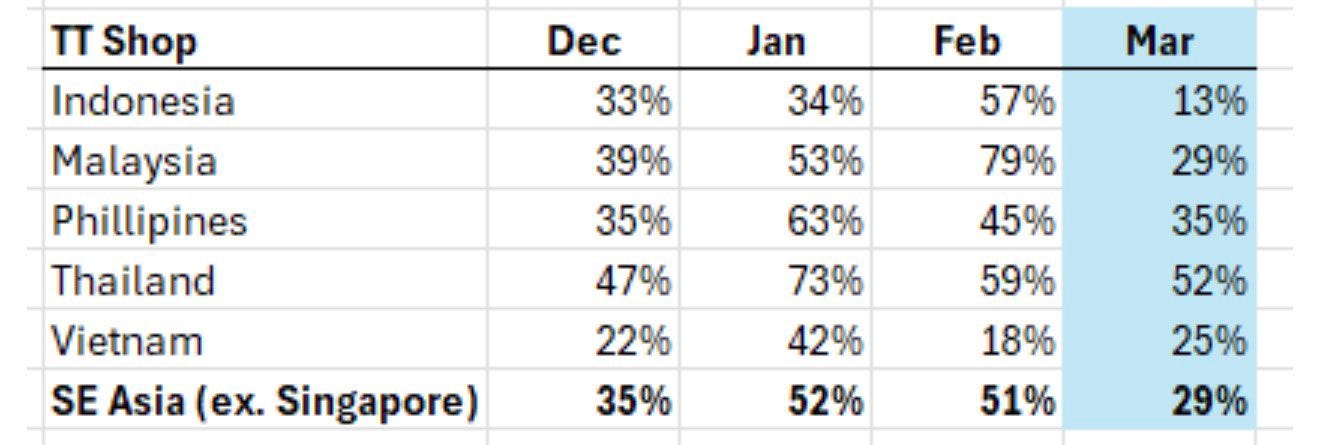
Alternative data (Yipit) suggests that TikTok Shop's GMV growth in Southeast Asia has decelerated materially over the past few quarters, from ~70% YoY in Q2 2025 down to ~30% YoY by late 2025. That's only modestly above Shopee's own ~25% YoY growth. More importantly, TikTok's relative market share versus Shopee in Indonesia, the region's largest market, has effectively flat-lined over the past year. (This can be seen in Momentum Works’ report too)
Of course, this data could be wrong. So let’s look at another key tell. TikTok Shop has been raising fees in the past year, following Shopee’s footsteps within days. This is a sign of stabilising competition, not one of an aggressive competitor trying to capture share at all costs. This was also corroborated by management’s comments in Q3 2025 and Q4 2025’s earnings calls where they specifically mentioned:
“What we see is a relatively stable competitive landscape. I think as you can probably observe as well from your own sources, we didn’t see any particular market behaving differently from another. The trends in competitive intensity and behaviour have been fairly consistent across Southeast Asia.”
- Sea Limited Q3 2025 Earnings Call
When we look at absolute numbers, the picture isn’t as scary as the headlines suggest too. TikTok Shop did ~$45B in GMV last year versus Shopee at ~$127B. Internal targets at TikTok Shop reportedly point to ~50% growth for TikTok Shop in 2026, while Shopee is targeting ~25% growth. If both of these targets play out, TikTok would add ~$22B in GMV as compared to Shopee’s ~$32B. Shopee is still growing faster in absolute terms and increasing their competitive lead in terms of logistics.
There is also a more nuanced point worth making here. Most of TikTok Shop's growth is coming from rural areas and Tier 2/3 cities, consumers who are entirely new to e-commerce. Many of these are impulse buys triggered by watching livestreams. Crucially, this is a segment of the population that Shopee had never been able to acquire due to the higher relative shipping costs, lower discretionary income and lower purchase frequency. In this way, TikTok Shop is likely expanding the overall e-commerce TAM and pie, rather than eating Shopee’s lunch directly. As these consumers mature into savvier shoppers, many will inevitably find their way onto Shopee too.
What about J&T’s growth in parcel volume share within SEA, with TikTok Shop being the major contributor?
The most common pushback, which I myself have highlighted, is around J&T Express’ reported parcel volume growth of ~74% YoY in Q4 2025. Let’s break down the growth here:
Underlying SEA e-commerce parcel market growth: If J&T had simply held share flat at 27% (2024 levels), it would have grown 39% just by riding the tide.
Per J&T's own 1H25 prospectus filings, its market share rose from 28.6% in 2024 to 34.4% in 2025. That's another ~28% of growth from share gains alone.
Non-Platform Parcels: J&T's non-platform parcel business has grown materially in the past year and possibly accounts for ~5-10% of growth.
When we put all these together, you can see why J&T’s headline growth number is a misleading proxy for TikTok Shop’s underlying performance. Adding the numbers up, it reconciles pretty well, without requiring TikTok Shop to be growing at a scary rate that the headline implies.
The SEA logistics market is consolidating around J&T as smaller players exit, and J&T is leveraging its scale to expand into adjacent non-platform business lines. Neither of these is a Shopee bear signal.
If anything, the competitive backdrop appears to be improving, not deteriorating. And if that is correct, then Shopee’s current reinvestment cycle could be an offensive choice to widen the moat while competitors are seeing slowing growth, rather than a defensive scramble to stay alive.
On Geopolitics & Oil
The Iran-U.S. conflict and the SoH disruption are real, and it's affecting consumer sentiment across the region. With ~2/3 of SEA's crude oil imports transiting through the SoH, a slowdown in regional consumption is a legitimate near-term concern.
That said, two things are worth keeping in mind. Firstly, this is a macro headwind that affects all consumer-facing businesses across the region. It is not Sea-specific, and Sea is no more exposed than any other consumer business in SEA. If anything, e-commerce tends to be more resilient than offline retail in downturns due to its discount-led value proposition.
Secondly, my thesis on Sea is decade-long. I've said before that I believe Sea will be the first SEA-headquartered trillion dollar business. That trajectory is built on the structural digital adoption of 600M+ people, not on whether oil prices spike for a few quarters. If the macro environment remains weak, Sea will face short-term revenue and credit risks at Monee. But the long-term opportunity is unchanged, and a weaker macro environment historically favours the strongest players in any market, which Sea undeniably is in SEA.
