

Hi fellow investors!
In this piece, I wanted to cover something slightly different from usual.
While I often share deep dive research reports, I thought it might be helpful for some of you if I were to document my own research process too.
Here’s my no-nonsense approach to research as a long-term minded investor.
Step 1: Always start with the business
Before I look into valuation, stock prices, sentiment etc…
I always ask these 5 simple questions:
What problem does this company solve?
This sounds basic, but you'd be surprised how many investors can't articulate this clearly for stocks they own. If I can't explain the problem the company solves to a 10-year-old, I probably don't understand the business well enough to invest in it.
The best businesses solve painful, recurring problems that customers can't easily ignore. The more painful and unavoidable the problem, the more durable the business tends to be.
How does it truly make money?
Revenue composition is massively important for me. I want to understand the actual mechanics of monetisation. Is it a subscription model with predictable recurring revenue? A transactional model where revenue scales with volume? A platform model that takes a cut of every transaction? An advertising model dependent on eyeballs? Each model has very different characteristics in terms of predictability, scalability, and resilience during downturns.
I dig into the revenue breakdown by segment, geography, and customer type. I want to know if 40% of revenue comes from a single client (a major red flag) or if it's diversified across thousands of customers. I also look at how the company prices its product (per seat, per transaction, usage-based), because pricing power is one of the clearest indicators of a strong competitive position.
Why do customers choose this business over other alternatives?
This is where I start thinking about differentiation. I compare the business to its competitors, look through NPS scores, GlassDoor ratings, and more. I also look at churn rates and net revenue retention rates, if existing customers are spending more each year, it is a good indicator that they love the product.
What is the company’s moat?
The company’s moat determines how long it maintains its competitive advantage. As a long-term investor, this is possibly the most important question to ask.
I focus on the 5 main moats, network effects, switching costs, intangible assets, cost advantages and efficient scale. There is a 6th that isn’t a traditional moat, but one that I view to be the greatest moat of them all, and that is innovation. The 5 main moats are static moats that have been built in the past. Innovation makes a business a moving target.
The best businesses have multiple moats that are widening over time. I pay close attention to this distinction as a business with a large but narrowing moat is more often that not, a value trap.
What would kill this business permanently?
As Charlie Munger said: “Invert, always Invert”. Rather than focus on what can go right, it is sometimes more important to focus on what can go wrong. This question forces myself to imagine a scenario where the stock goes to zero and working backwards from there.
What would have to happen? Regulatory action that bans the product? A technological shift that makes it obsolete? A competitor that offers the same thing for free? Customer behaviour shifting away entirely?
The key word here is “permanently”. Every business goes through cycles of temporary uncertainty, be it recessions, bad quarters, PR crises etc. This question focuses on existential risks. If the only scenarios I can construct for permanent destruction are extremely low-probability events, that's a good sign. If I can easily imagine a realistic path to obsolescence within 5-10 years, that's a dealbreaker for me.
Oftentimes, just answering these 5 questions, gives me a very good understanding of whether to proceed with my analysis. For instance, if a business has no moat, or makes money in a non-sustainable manner, it would make the decision very easy for me. I simply move onto the next.
Step 2: Company History
The next step for me would be to look deeper into the history of the business.
It is my belief that truly understanding the current context of the business and structure of the company is only possible after learning about how the business got to this stage.
In the past, this would include tons of google searches, reading biographies, wikipedia pages, company filings and even books.
However, with LLMs today, it all begins with a prompt. This is what I like to use:
“Give me a comprehensive, chronological company history of [Company Name] from its founding to the present day [Insert today’s date]. I want this to be extremely thorough and detailed, written at the level of a professional investment research report or business case study, not a short summary.
Include and clearly explain the founding story, key founders and early executives, evolution of each business segment, major strategic decisions and pivots, important product launches, capital markets events, crises and downturns, key partnerships and acquisitions, as well as recent strategic direction.
Do not omit uncomfortable details. Treat this as a complete history chapter for an investor who will challenge missing years, unclear leadership changes, and vague claims. Use high-quality primary sources wherever possible (SEC filings, annual reports, earnings call transcripts) and provide citations for important claims.”
Importantly, this is just the starting point for my research. Once I find a thread I can pull on, I then re-prompt to find out more details regarding that specific event and/or individual for instance.
What I’m actually looking for in the company history includes:
Founder-Market Fit
Did the founders start this company because they deeply understood the problem, or was it a pivot from something unrelated? Companies born from genuine domain expertise tend to make better long-term strategic decisions.
Capital Allocation Track Record
How has the company deployed capital over time? Were acquisitions value-accretive or dilutive? Did they buy back stock at good prices or at the top? Did they invest in R&D consistently or slash it during downturns? A 10-20 year track record of capital allocation tells me more about management quality than any single earnings call.
Crisis Behaviour
How did the company navigate past recessions, competitive threats, or operational failures? Companies that emerge from crises stronger, through management decisions like cutting costs intelligently, gaining market share through short-term pain, or making opportunistic acquisitions for instance, tend to be run by exceptional management teams.
Strategic Consistency
Has the company stayed true to its core mission, or has it chased trends? Some pivots have been brilliant (Netflix from DVDs to streaming), but most diversification efforts destroy value. Businesses must have a coherent strategy that ensures they stay the course.
I often feed this prompt into multiple LLMs as they tend to come up with differing approaches and results. Regarding deep research, my favourite* LLMs in order are ChatGPT, Claude, Grok, followed by Gemini.
*Note that this changes often as LLMs update their models and this is as of today’s post.
Step 3: Industry Landscape
Once I’ve grounded myself in the company’s core business and historical evolution, I shift my focus onto the broader ecosystem it operates within.
This is absolutely crucial in contextualising the company’s position.
After all, even a great business can falter if it operates in a shrinking market or gets out-competed by younger, hungrier competitors.
These are the key questions I ask:
What’s the total addressable market and the growth trajectory of this industry?
I want to understand both the current market size and, more importantly, the direction. A $50 billion market growing at 15% annually is a very different investment proposition than a $500 billion market growing at 2%. Both can produce great investments, but they require very different frameworks. Personally, as a growth investor, I look for large and growing markets. Another important point is penetration rate; specifically, how much of the TAM has been captured? Early-stage markets with low penetration rates offer the most explosive growth potential, but they also carry more uncertainty.
Who are the key players, and how do they stack up against each other?
Here, I map out the competitive landscape in detail. Market share data, growth rates relative to competitors, profitability comparisons, and product differentiation. I want to understand the industry structure. Is it a winner-takes-all market, a duopoly, or a fragmented market that is set for consolidation? Each structure implies different competitive dynamics and margin trajectories.
Are there regulatory tailwinds or headwinds?
Regulation can make or break an industry. Some regulations create barriers to entry that protect incumbents (banking, healthcare). Others can disrupt entire business models (data privacy laws impacting ad-tech). I pay particular attention to regulatory direction. Is the trend towards more or less regulation, and how does the company I’m researching stand to benefit or suffer? (Also take note that different geographies have very different regulations by sector)
What could potentially disrupt the industry?
I think about this from a first-principles perspective. What underlying technology, consumer behaviour, or economic shift could fundamentally change how this industry works? For example, AI is currently disrupting software per-seat businesses, electric vehicles are disrupting traditional ICE automakers, digital payments are disrupting traditional banks and legacy payments rails, and quick commerce is set to disrupt traditional grocery models and physical retail to a further extent. The key here is to understand whether the company I'm researching is the disruptor, the disrupted, or relatively insulated.
To gather this, I start with high-level overviews from sources like McKinsey reports, Grand View Research reports, industry associations, slide decks from the company or competitors. I also utilise LLMs, with a prompt like this:
“Provide a detailed analysis of the [Industry Name] as of [today’s date], including market size, growth projections (CAGR over 5-10 years), key trends, regulatory environment, and major competitive forces using the most suitable framework. Focus on [Company Name]’s position within it, comparing it to top competitors like [list 3-5 relevant peers]. Use data from primary sources such as Gartner, IDC, SEC filings, earnings reports, commentary and call transcripts, and recent analyst reports, with citations.”
With this data in hand, I begin to gain a much better understanding of the business model, competitive advantage of the particular company, and whether there is a case to be had for investing.
Step 4: Financials
Numbers aren’t everything, but they play a large part, especially with regard to valuation. Also, management and analysts may lie, but numbers don’t lie.
I dive into the financials. My favourite tool here is Fiscal AI. There are of course sources where you can access company financials for free such as Yahoo Finance, Morningstar, etc…
Personally, I use Fiscal AI as they provide up to 20 years of data in a very standardised and easy to use format. I highly recommend using them if you aren’t already doing so.
For those interested, I have an affiliate link that gives you 15% off the subscription pricing. Or, simply use the free version which works great too.
Here, I review the last 5-10 years of the 3 core financial statements (Income Statement, Balance Sheet, Cash Flow Statement). I focus particularly on top-line growth rate, which I utilise to judge which part of the business life cycle it is in.
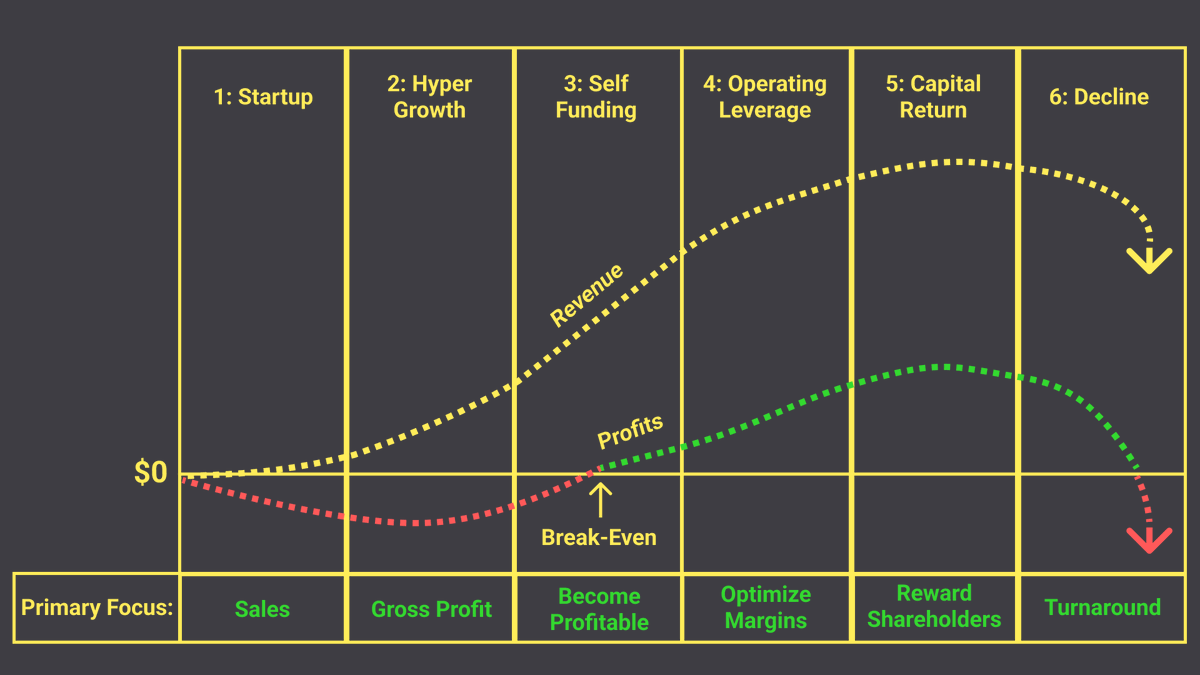
My favourite businesses to invest in lie within self funding and operating leverage. These are typically businesses that are inflecting towards profitability or are at the early stages of operating leverage in the business.
Another key focus is with regard to margins. For industry disruptors, I would compare to industry heavyweights to get a gauge of where the optimal margin profile would be. This will be very helpful in the valuation stage of the analysis.
Other key areas of focus:
Revenues: Are they recurring or one-off? Is there geographic diversity? Is there significant customer concentration?
Profitability: Have margins expanded over time? What is the optimal margin profile for the business? Is there room for operating leverage?
Efficiency & Returns: This goes more for businesses that are in Stage 4 and 5 of the life cycle chart above. I focus on ROIC/ROE, working capital cycles. For tech businesses, I look at R&D/CAPEX as % of revenue.
Balance Sheet: How much cash does the business have? Are their debt levels elevated? Is it a business that requires enormous leverage?
Cash Flows: Especially if the business is unprofitable, I want to ensure they are free cash flow positive or reaching there imminently.
Stock Based Compensation: Is it egregious? How is management compensated, is it based on top or bottom-line or stock price performance?
This step takes the longest, but is non-negotiable for me. I’ve avoided many losses by spotting eroding fundamentals early.
Step 5: Management
Of course, numbers only tell one side of the story. Management is arguably the most important for me.
Think of all the successful businesses over the years. Each of them have been run either by extraordinary entrepreneurs or ruthless executioners. Think Apple, Microsoft, Tesla, Google, Nvidia. Each of these businesses are closely tied to one or two individuals who have been the face for decades.
Ultimately, businesses are people-driven, so I scrutinise the stewards of capital very closely.
I profile the C-suite and board:
Is the founding team still in-charge?
Read as many news reports, especially if they are first-hand interview transcripts.
Watch as many interviews of the C-suite/Board as possible, going back 10-20 years if possible. Understand how their views have changed over time. Are they trustworthy people?
Is the board filled with “Yes Men”? Or do they constantly challenge decisions? I want a board that is intellectually honest and willing to be contrarian.
Does the C-suite have skin in the game? Is the company stock the majority of their net worth?
How do they handle tough questions? Do they give direct, thoughtful answers, or do they deflect, ramble and redirect to pre-planned talking points?
Do they under-promise and over-deliver, or vice-versa? I go back through old earnings call transcripts and compare forward guidance to actual results.
How do they discuss failures? Every company has bad quarters, failed products, or strategic missteps. Leaders who own these mistakes openly and explain what they learned earn my trust. Those who blame macro conditions, one-time events, or "transitory" factors for repeated misses do not.
Step 6: Valuation & Scenario Modelling
The final decision to invest, often comes down to valuation. More specifically, investors should warrant a margin of safety when investing.
Valuation isn’t precise, but is often probabilistic. There are a huge variety of different methods to value a business, but I do believe that every business has an optimal way of being valued.
For instance, diversified conglomerates like Sea Limited and Mercado Libre, in my view, should be valued through a Sum-of-the-Parts valuation model. DCFs are generally one of my favourite methods and is considered by many to be the gold standard. Multiples is another method to value, through P/E, P/S, EV/EBITDA and other various ratios.
Valuation often determines the amount of size I deploy into a stock, and I think it is absolutely key to nail this down.
Choosing the Right Valuation Method:
Discounted Cash Flow (DCF):
The DCF is generally one of my favourite methods and is considered by many to be the gold standard. The core premise is simple: a business is worth the sum of all its future cash flows, discounted back to present value. However, this is a very subjective process and that is where numbers tend to differ.
My approach to building a DCF:
Revenue projections: I start with the company’s own guidance, then cross-reference with industry growth rates, competitive dynamics, and historical trends. I build a 10-year explicit forecast period, with revenue growth rates that gradually decelerate towards the industry’s long-term growth rate. The key is to temper expectations and never assume hyper-growth persists indefinitely.
Margin assumptions: I project margin expansion (or contraction) based on the operating leverage analysis from Step 4, benchmarked against mature peers. In certain cases, where I expect a disruption in the business model, terminal margins could be higher than
Discount rate: I use WACC (weighted average cost of capital) as my discount rate. For most established companies, this falls in the 8-12% range. For higher-risk growth companies, I use a higher rate (12-15%) to account for the additional uncertainty. Some investors use a flat 10% as a simplification. I don’t disagree with this approach as long as you’re consistent.
Terminal value: This is the most important and most dangerous part of the DCF, as it typically drives 60-80% of the total valuation. I use both an exit multiple approach and a perpetual growth rate approach, and I check them against each other. I never use a terminal growth rate above 3-4% (roughly in line with nominal GDP growth), and I sanity-check the implied exit multiple to make sure it’s reasonable relative to the company’s peer group.
Multiples-Based Valuation:
Multiples is another method to value businesses, through P/E, P/S, EV/EBITDA, and other various ratios. While simpler than a DCF, multiples can be misleading if used sloppily. The key is selecting the right multiple for the right type of business:
P/E works well for mature, profitable companies with stable earnings.
EV/EBITDA is better for companies with varying capital structures, as it strips out the effects of debt and taxes.
P/S (price-to-sales) is useful for high-growth companies that aren’t yet profitable, but should always be used alongside a clear path-to-profitability analysis.
P/FCF (price-to-free cash flow) is my preferred multiple for companies that are already generating meaningful cash flow as it cuts through accounting noise.
I personally always compare multiples to historical averages and peer comparisons. For instance, where has the stock traded over the last 5-10 years? How does this compare to similar companies in the space? A stock trading at 30x earnings might look expensive in a vacuum but could be cheap if the company is growing twice as fast as peers trading at 25x.
Sum-of-the-Parts (SOTP):
For diversified conglomerates like Sea Limited and Mercado Libre, I believe SOTP is the most appropriate approach. These companies have distinct business segments with very different growth profiles, margin structures, and comparable companies. Valuing them on a blended multiple obscures the true value of each piece. I value each segment independently using the most appropriate methodology (DCF or multiples), sum the values, subtract net debt, and divide by shares outstanding.
Valuation often determines the amount of size I deploy into a stock, and I think it is absolutely key to nail this down.
Step 7: GabGrowth Quality Score
I use a checklist scoring system to rate stocks. The best investments have common, durable traits. I’ve used what I found over many years to come up with this and enables me to separate the good from great businesses.
I’ve written a full piece (FREE) on this that you can view below.

Step 8: Portfolio Fit & Final Decision
Ultimately, the final decision comes down to this step. While I’m not against investing a huge portion of my portfolio into a particular sector if I believe there are significant tailwinds going for it, I do need to compare the new company I’m adding to others that are already in the portfolio.
Every dollar I allocate to a new position is a dollar I'm not adding to an existing holding. So the new company doesn't just need to be "good", it needs to be better than adding to my current highest-conviction positions.
Regarding position sizing, I use a tiered approach based on conviction level and risk profile. For a high-conviction idea with a high margin of safety, I’m willing to size it at over 5% of the portfolio to start and letting it compound from there. I also tend to size up over time as the business proves itself through strong earnings beats. Each quarterly report is an opportunity to test the thesis. If the company is executing as expected or better, I'll add to the position on pullbacks. If the thesis is deteriorating (for e.g., slowing growth, compressing margins, poor management decisions), I’ll reduce or exit regardless of what the stock price is doing.
I will let my positions grow over time and am not afraid for a single name to become a substantial portion of my holdings. However, I will typically try to limit any one holding to around 30% of total portfolio size. Beyond that, the position-specific risk becomes too large regardless of conviction. If a position naturally grows past 30% through price appreciation, that's when I start trimming.
Final Thoughts
I hope this sharing is helpful for some of you who would like to get into the habit of researching stocks. I’ve always believed in the Peter Lynch saying:
“The person that turns over the most rocks wins the game”
This process is tedious and extremely tiring, but also very rewarding. A thorough analysis takes me anywhere from a few days to several weeks, depending on the complexity of the business. But rushing through it defeats the purpose entirely. The whole point is to build conviction, as it is the only way to hold through volatility, add on weakness and ignore the noise.
A large part of my investing success has been putting in the hours to study businesses. Less than 10% are investable ideas, but every single one has lessons to be learned. The companies I pass on sharpen my pattern recognition for the companies I eventually invest in.
Thank you for reading!
-Gab
Solid process — starting with the business before the valuation is the right order. Most retail investors do it backwards and wonder why they keep overpaying for mediocre moats.