

One of the most common questions I’ve received recently is how Pinduoduo’s expansion into Southeast Asia will affect Shopee.
Pinduoduo has been aggressively marketing and advertising in Southeast Asia in recent months, and if you are based in Singapore, Malaysia or Thailand, you would probably have seen their ads on Instagram, Facebook etc…

For those unfamiliar, Pinduoduo is one of China’s largest e-commerce platforms, owned by PDD Holdings, which also operates Temu.
Both Pinduoduo and Temu are being rolled out across Southeast Asia, in 5 of the 6 major markets, with the exception of Indonesia, which continues to block cross-border e-commerce.
The natural question is: why is PDD Holdings allowing both their subsidiaries to compete with each other?
Momentum Works wrote an article recently discussing this:

In short, it is because of PDD’s culture of internal competition.
The next question is, what is the difference between Pinduoduo and Temu?
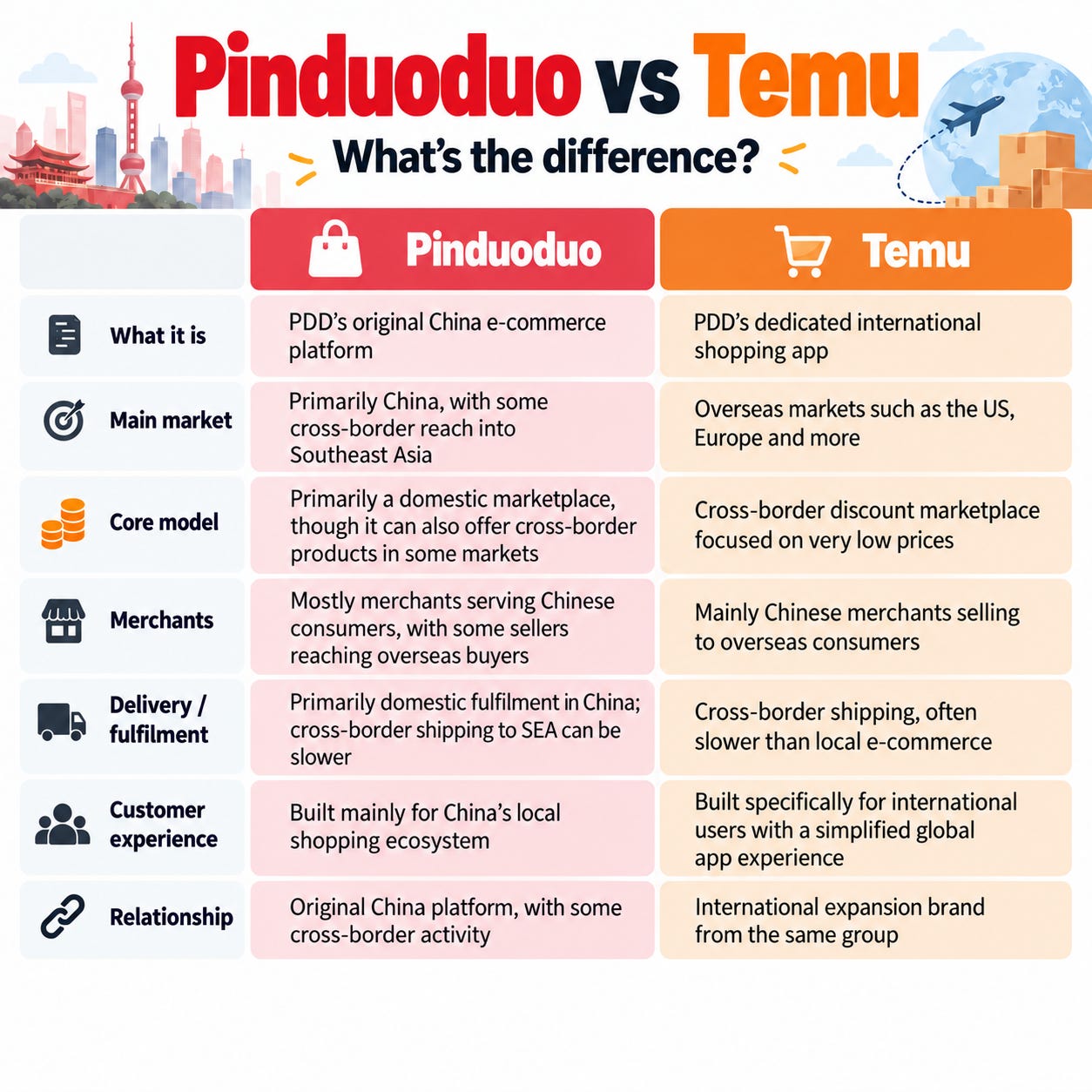
Realistically, there is very little between them, as they both operate cross-border e-commerce services. The difference lies in their approach.
Pinduoduo essentially gives consumers access to China's domestic marketplace, offering extremely low prices but generally longer delivery times and a less localised shopping experience. Temu, on the other hand, was designed specifically for international markets, offering a more localised platform, easier payment options and generally faster delivery, albeit often at slightly higher prices.
Their competitive proposition is very straightforward. They sell extremely cheap products, often sourced directly from Chinese manufacturers, supported by aggressive pricing and promotional strategies.
It is understandable that Shopee investors may be concerned as Pinduoduo has built an enormous business in China, while Temu has demonstrated that the group is capable of rapidly attracting consumers in overseas markets.
However, I think investors are making a mistake by extrapolating Pinduoduo’s success in China and Temu’s in North America and Europe directly to Southeast Asia.
In this piece, I will argue the case for why I’m not particularly worried about Pinduoduo entering Southeast Asia: