

Grab reported Q3 2026 Earnings after the market close on 3rd November 2026.
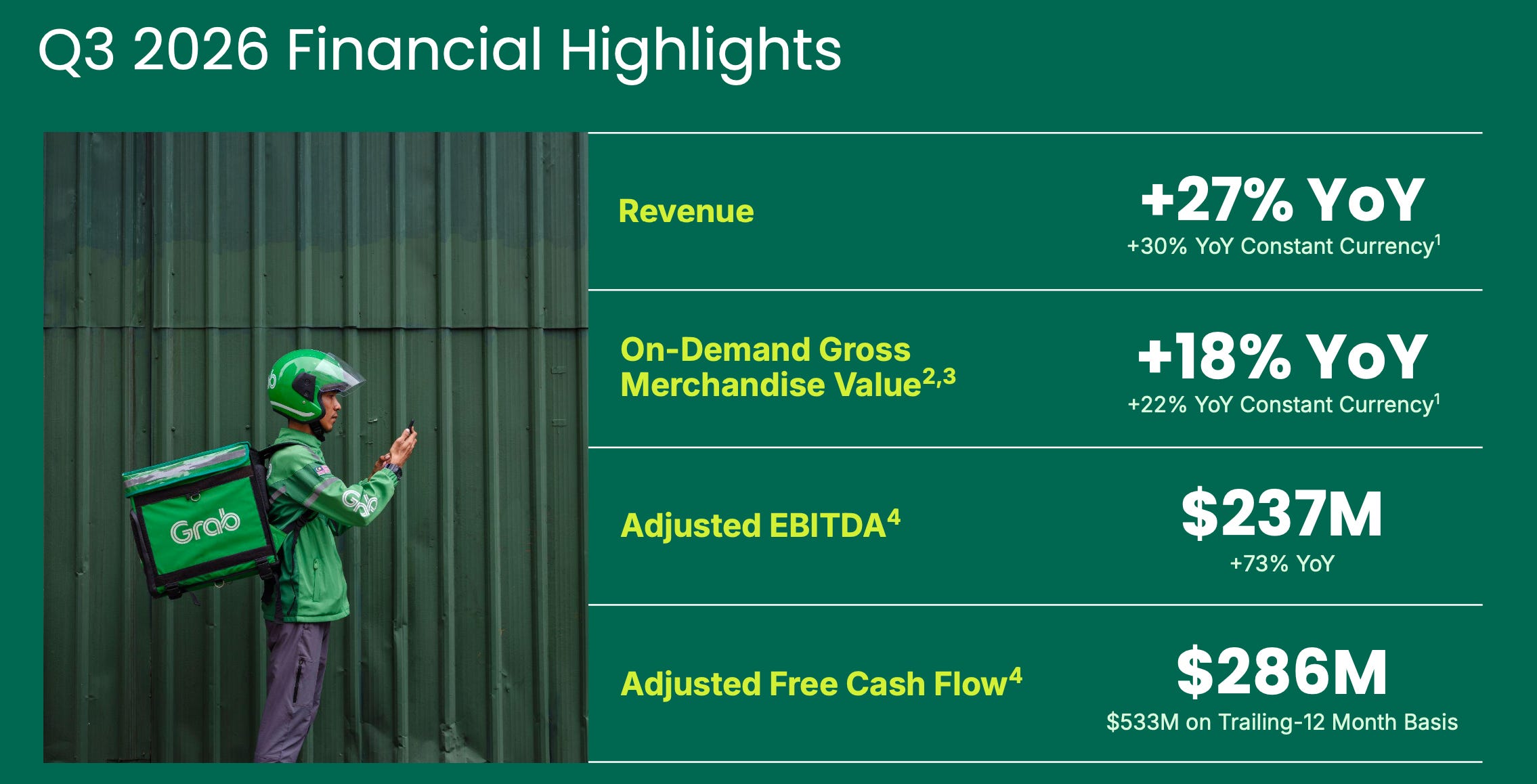
Revenue: $1.11B v $1.07B est. (+27% YoY, +30% Constant Currency)
Adj. EBITDA: $237M v $197M est. (+73% YoY)
EPS: $0.00 v $0.03 est.
Selected Key Metrics
On-Demand GMV: $6.84B (+18% YoY)
Group MTUs: 57.2M (+20% YoY)
Gross Loan Portfolio: $2.7B (+200% YoY)
Raised FY26 Guide:
Revenue: $4.15B-$4.20B (est. $4.18B), from $4.10B-$4.15B
Adj. EBITDA: $790M-$800M (est. $732M), from $720M-$740M
Gross Loan Portfolio: $2.7B (+200% YoY)
Adj. Free Cash Flow: $286M (+41% YoY)
Net Cash Liquidity: $5.0B
This was a strong quarter from Grab again. For the first time, all 3 segments are profitable, and I expect it to remain so moving forward.
Last quarter, the $235M GAAP profit flattered the business because of a one-off $307M gain on Superbank. This quarter, the $18M GAAP profit understates it.
The $18M includes a $57M net fair value loss on financial assets and liabilities (largely the convertible-note derivative again), a $12M impairment on an equity-accounted investee, $12M less finance income than a year ago and $5M of higher tax.
If we strip out the $68M of non-cash charges, profit attributable to shareholders would have been $95M, or $0.02 per share, which is in-line with consensus.
Grab raised FY 2026 guidance for the second time this year, to $4.15B-$4.20B in revenue (from $4.10B-$4.15B) and $790M-$800M in Adj. EBITDA (from $720M-$740M). Management also reiterated its 2028 targets of 30%+ revenue CAGR and $1.7B of Adj. EBITDA, although these now include the proposed Atome acquisition.
On capital returns, Grab repurchased $400M of shares in September and October alone, with $500M remaining under its $900M programme, which management intends to complete by September 2027 and cancel. On completion, cumulative buybacks since 2024 will total $1.75B, retiring more than 10% of shares outstanding.
The other piece of news is that Taiwan’s Fair Trade Commission blocked the foodpanda Taiwan acquisition in October. Grab will book a $60M break fee in Q4 (excluded from Adj. EBITDA) but keeps the ~$550M it had earmarked for the deal.
In this piece, I will break down the earnings in full, highlight key points on management commentary during the call and discuss my personal thoughts in the last section.
Table of Contents
Deliveries & Mobility
GFin, Financial Services
Key Call Commentary
Positives & Negatives
Conclusion
1. Deliveries & Mobility
Deliveries
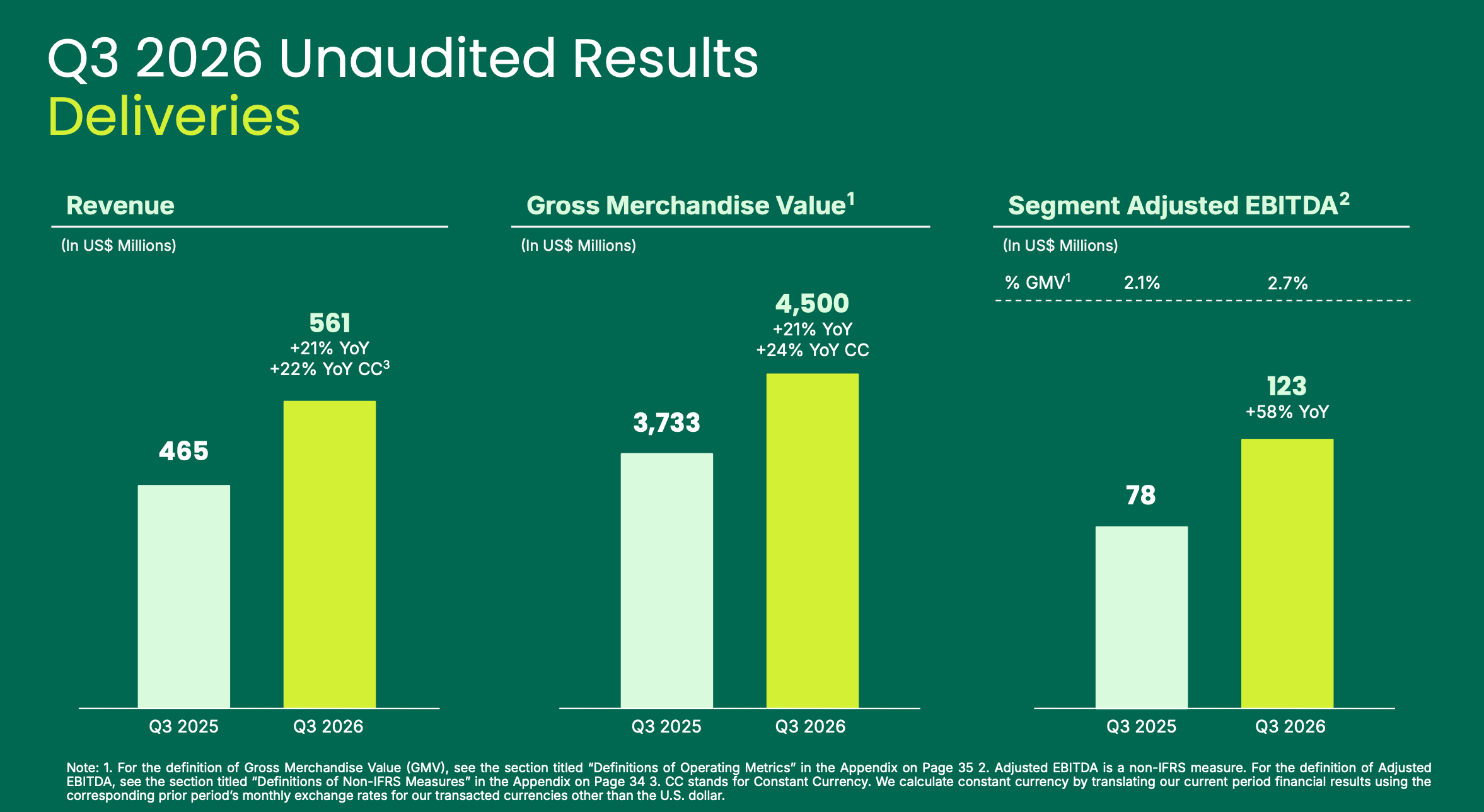
Deliveries remains the largest segment by GMV and Revenue.
Revenue grew 21% YoY (22% CC) to $561M, while GMV grew 21% YoY (24% CC) to $4,500M. Segment Adj. EBITDA grew 58% to $123M, and margin jumped to 2.7% of GMV from 2.1% a year ago and 2.3% last quarter.
That is a 47bps sequential step-up and the highest margins have been, tracking closer to management’s long-term target of 4%+.
This was more impressive because Grab increased driver incentives in Deliveries to support supply through the fuel spike, and grocery, the lowest-margin category, continued to grow faster than food. The driver of margins was as expected, advertising and operating leverage.
Advertising continues to be the key lever. Quarterly active advertisers on the self-serve platform grew 39% YoY (vs 21% in Q2), while average spend per advertiser grew 13% (vs 24% in Q2).
This implies ad revenue grew roughly 55-60% YoY, an acceleration from 50% last quarter. The mix is shifting from existing advertisers spending more to new advertisers coming on, which I think is the healthier of the two because it widens the base.
Grocery also kept compounding. Groceries GMV grew 1.8x faster than food (vs 1.7x in Q2), and 16% of food MTUs also ordered through GrabMart this quarter, up from roughly 14% last quarter.
Grab also launched GrabMall, extending the catalogue into branded retail, beauty, personal care and electronics. This, as I’ve discussed in many articles, is to be expected, as the quick commerce war heats up.
Management shared some info on GrabUnlimited, with more than 1 in 5 Deliveries MTUs now a subscriber. Subscribers account for 35% of Deliveries GMV and they transact almost 3x as often as non-subscribers.
Mobility
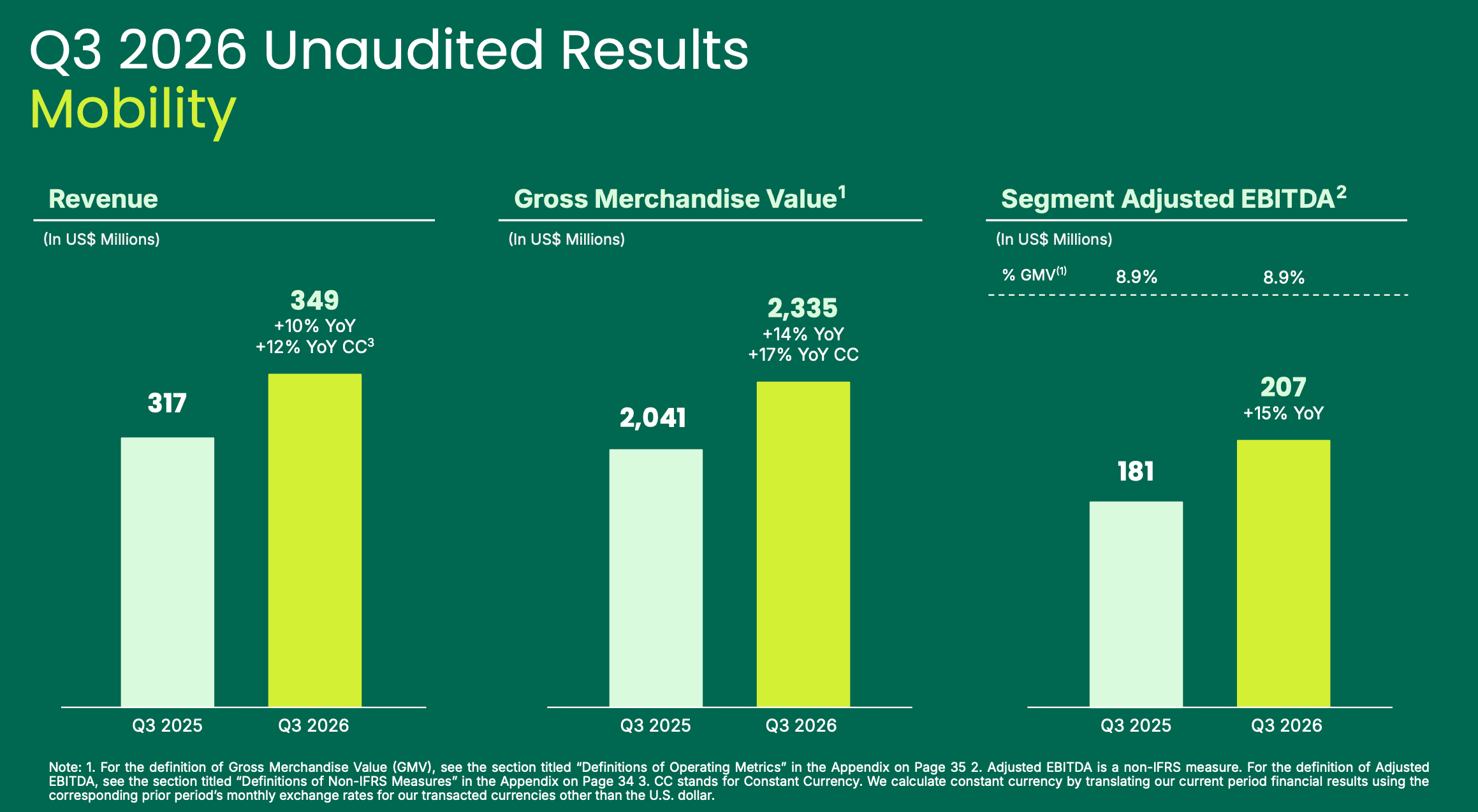
Mobility continues to be hit by the elevated oil prices, leading to a supply crunch. This has led to a slowdown, despite Grab’s best efforts to incentivise drivers. Revenue grew just 10% YoY (12% CC) to $349M, decelerating again from 12% in Q2 and 19% in Q1. GMV grew 14% YoY (17% CC) to $2.335B, while transactions grew 21%, down from 28% last quarter.
Average tickets continue to fall, 6% YoY in Q3, in-line with Grab’s affordability focus. Mobility MTUs grew 15% to a record, and 46% of new Mobility users transacted in another Grab service within 30 days, so it appears that the affordability strategy is doing its job as a funnel for the rest of the ecosystem.
Segment Adj. EBITDA grew 15% to $207M and margin held at 8.9% of GMV, flat YoY and up 26bps QoQ, within the 8.5%-9.0% range management promised last quarter despite Indonesia’s two-wheeler commission framework taking effect in July.
As I’ve said, and continue to say, supply is the limiting factor for Grab, not demand. On that front, the quarter was encouraging. Monthly active driver-partners grew 20% YoY and 4% QoQ to another all-time high, and EVs now account for 18% of four-wheel trips regionally, up from 13% in Q1.
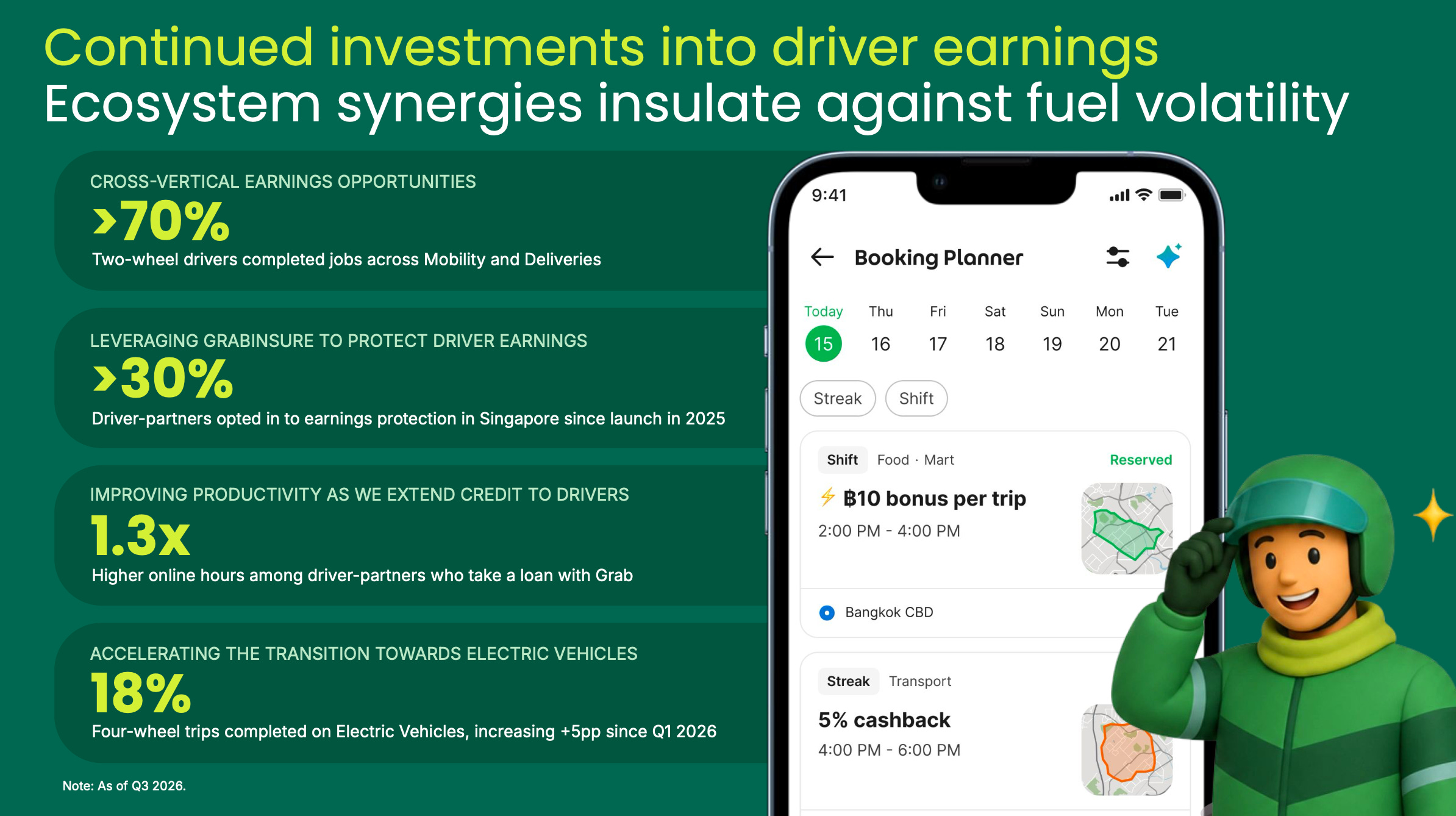
EVs are the structural answer to the fuel problem, and Grab is now financing that transition through GXS Bank and Superbank, which ties Mobility and GFin together neatly.
High Value Rides GMV also grew over 2x faster than overall Mobility GMV, which shows Grab is not just growing at the bottom of the market.
2. GFin, Financial Services
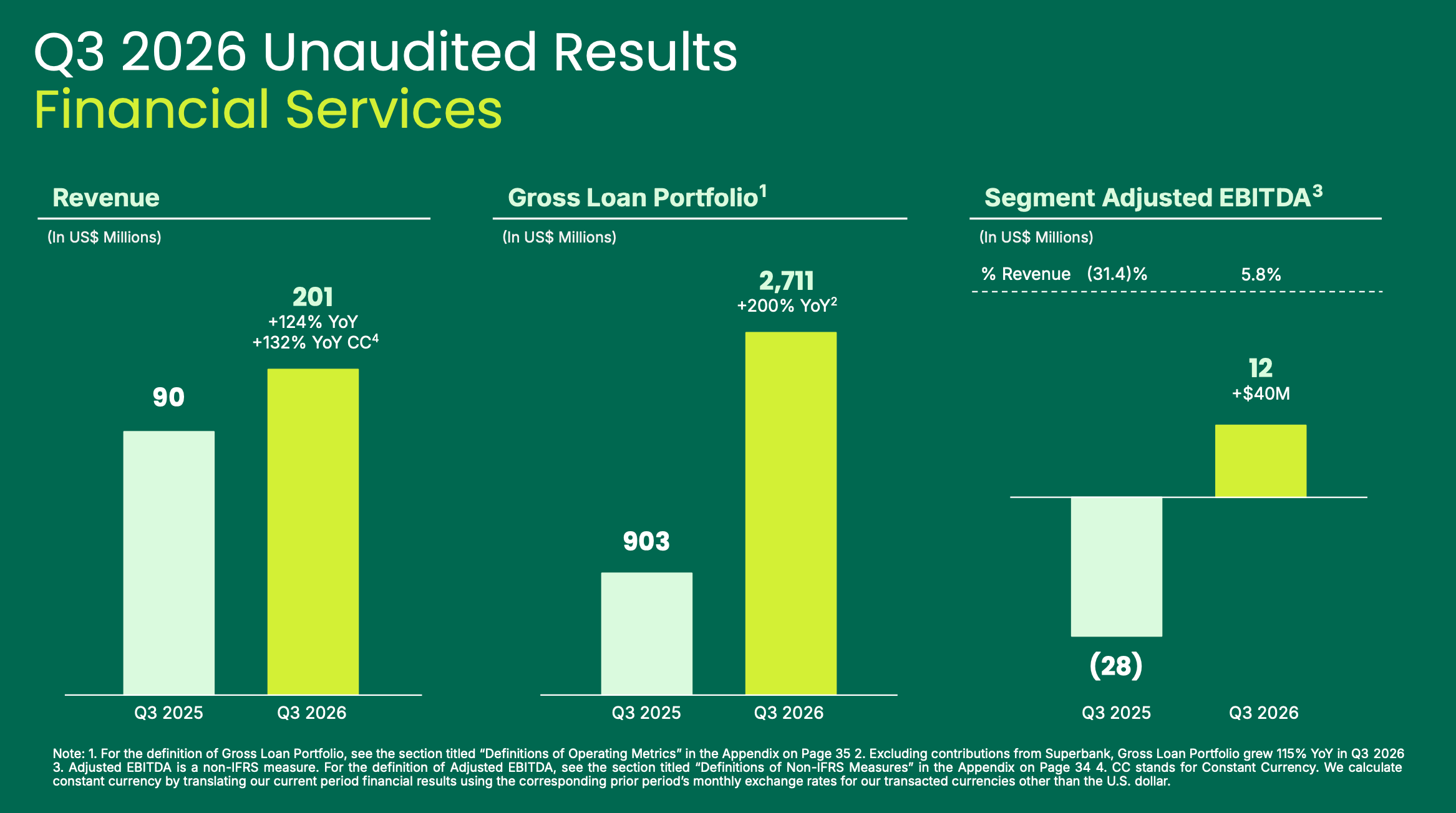
Financial Services turned profitable for the first time, as promised by management. GFin posted $12M of Segment Adj. EBITDA vs -$28M a year ago and -$15M last quarter.
Alex Hungate reminded during the call that he first promised break-even back in September 2022. Last quarter management guided to profitability in H2 2026, and they delivered it in the first quarter of H2. Credit where it is due, this is a management team that has hit nearly every profitability milestone it has set.
Revenue grew 124% YoY (132% CC) to $201M, boosted by the first full quarter of Superbank and the first quarter of Stash. The Gross Loan Portfolio grew 200% to $2,711M, but the more useful number is ex-Superbank growth of 115%, an acceleration from roughly 100% last quarter. Loans disbursed hit another all-time high of $1.9B (+115% YoY), up from $1.2B in Q2, and customer deposits across the three digibanks rose to $2.7B from $2.5B.
I have argued for several quarters that at Grab’s scale, the loan book should be growing at ~100%, especially with the cash to support it. It is now doing that, and the profitability milestone shows it can do so without burning money.
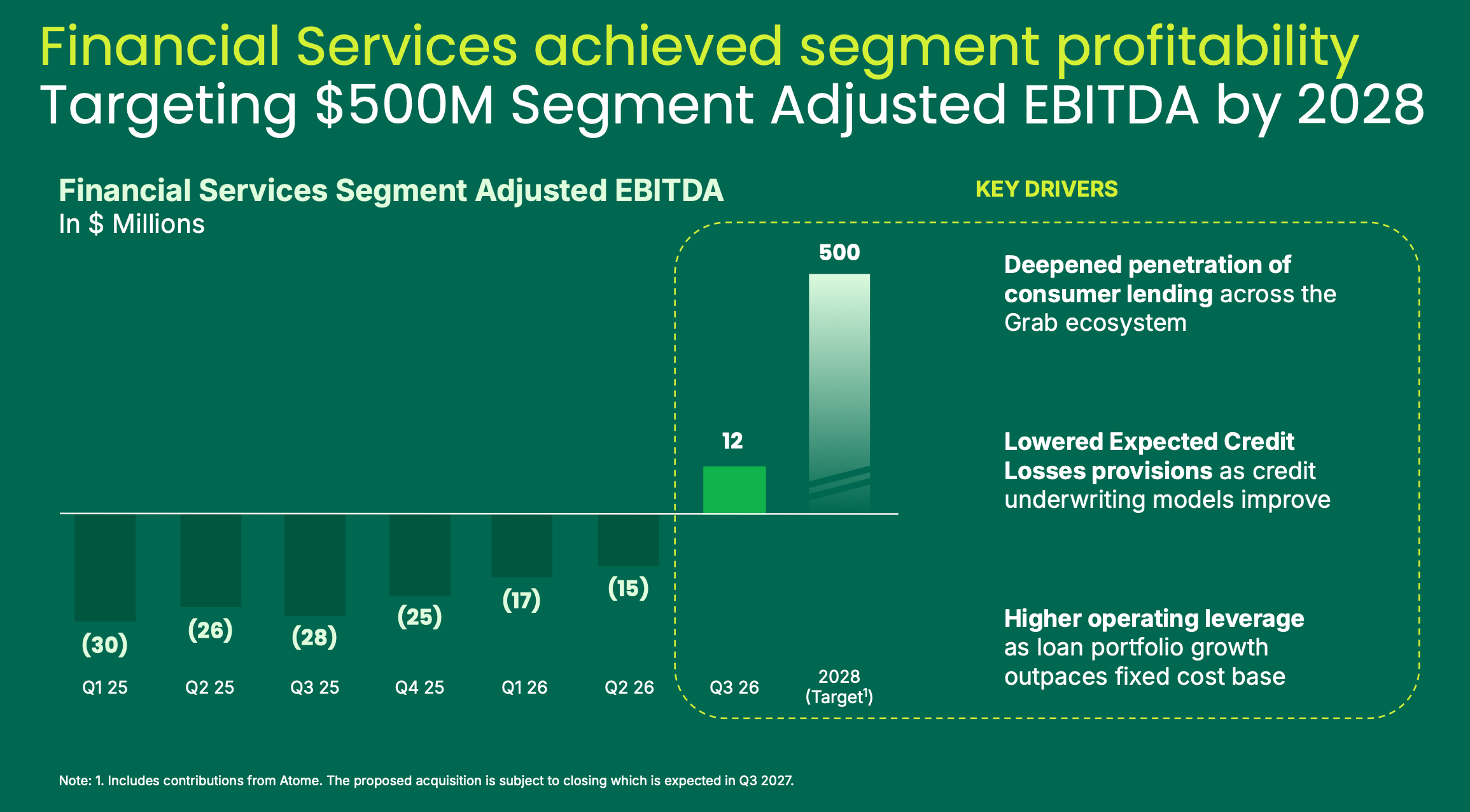
It must be noted that the path to profitability has been boosted by acquisitions of Superbank and Stash, enabling those balance sheets to be consolidated. I generally prefer organic growth, but Grab is in a situation where it has a huge cash pile that keeps growing. It is too early to tell if those acquisitions were the right move, so we will have to give management benefit of the doubt here.
Credit Quality