

dLocal reported Q2 2026 earnings after the market close on 13th August 2026.

Revenue: $399.7M v $369M est. (+56% YoY, +69% FX-Neutral) 🟢
Diluted EPS: $0.18 v $0.19 est. (+87% YoY, +7% QoQ) 🔴
Selected Key Metrics
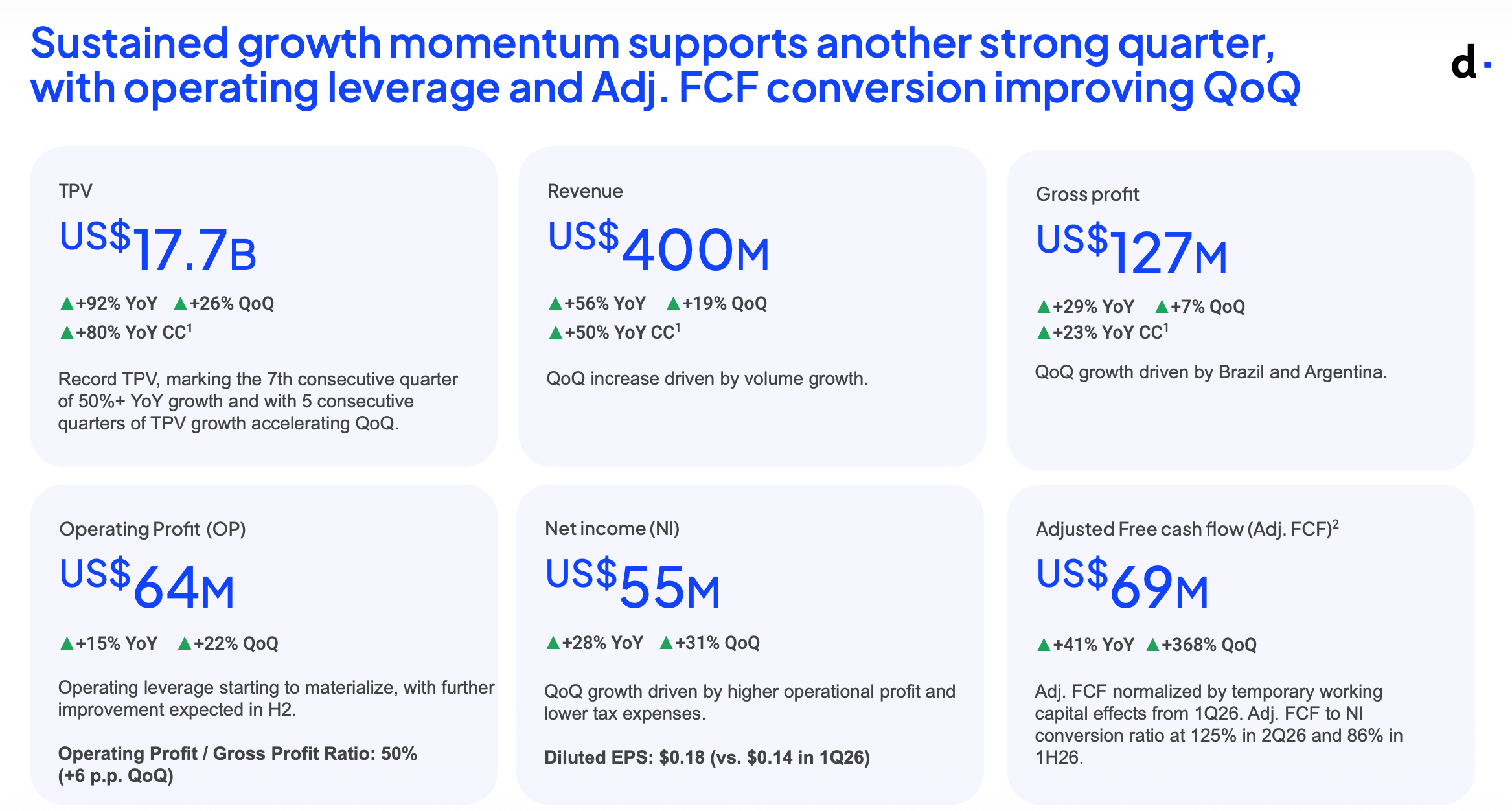
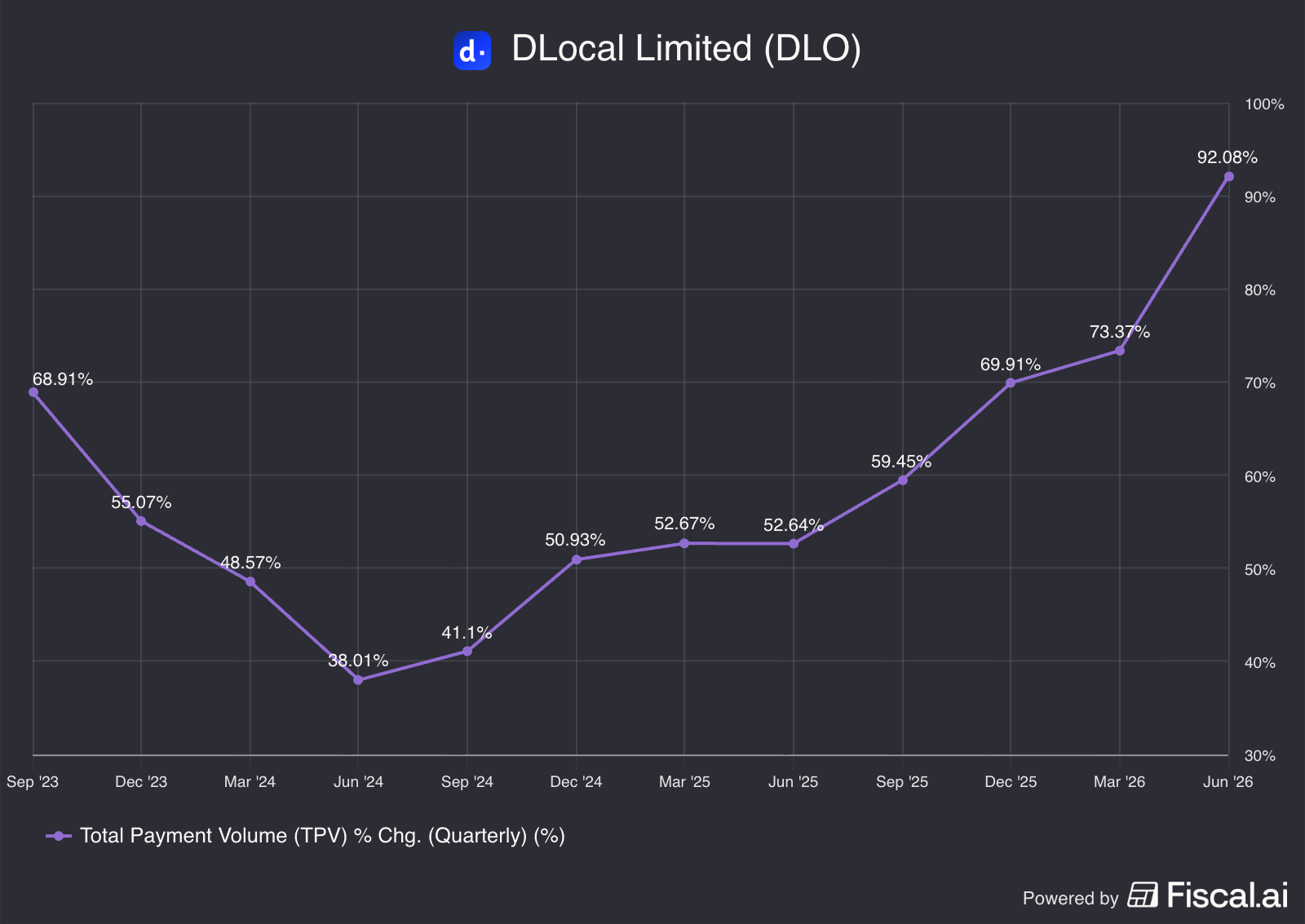
dLocal saw continued YoY and QoQ growth across all 6 key metrics. Revenue hit $400M for the first time, driven by TPV growth that came in at 92%. The turnaround in TPV growth within the past 8 quarters have been nothing short of extraordinary.
The glaring issue, of course is that while TPV grew 92%, net income growth came in at just 28%. There are a few layers between that, but there is no doubt that take rates is the main culprit behind that gap.
TPV: $17.7B (+92% YoY) ✅
Revenue: $400M (+56% YoY) ✅
Gross Profit: $127M (+29% YoY) ✅
Operating Profit: $64M (+15% YoY) ✅
Net Income: $55M (+28% YoY) ✅
Adj. FCF: $69M (+41% YoY) ✅
Management also announced that they re-purchased 6.9M shares for $86.1M under their $300M share buyback program and have secured a new $150M senior unsecured facility at Term SOFR + 2%.
Table of Contents
Introduction
Financials
Guidance
Product Development
Management Commentary
Concluding Thoughts
1. Introduction
dLocal is a Latin American-based company that facilitates payment flows for businesses ranging from small startups to large conglomerates on a B2B basis, specifically targeting underserved emerging markets.
It thrives in complex payment environments, which are currently a huge tailwind for the business. Effectively, dLocal is a capital-light “toll bridge” business.
dLocal was first pitched to subscribers in July 2025 at $10.98. It has seen volatile stock price performance since but remains a positive returner at this stage.
dLocal (Deep Dive)

It is no secret that I am a big fan of emerging market businesses. I believe they are often overlooked by the market, which is exactly where alpha tends to reside.
2. Financials
As I always state in my discussion for dLocal, there are really 2 key guiding metrics for the business.
Firstly, total payment volume (TPV). This tracks the total monetary value of all transactions processed through a company’s platform.
Secondly, net take rates. This determines the amount of gross profit generated from TPV, which ultimately affects profitability of the business.
When we multiply these 2 numbers, we get gross profit, which I personally perceive as the true top-line metric for the business.
Total Payment Volume
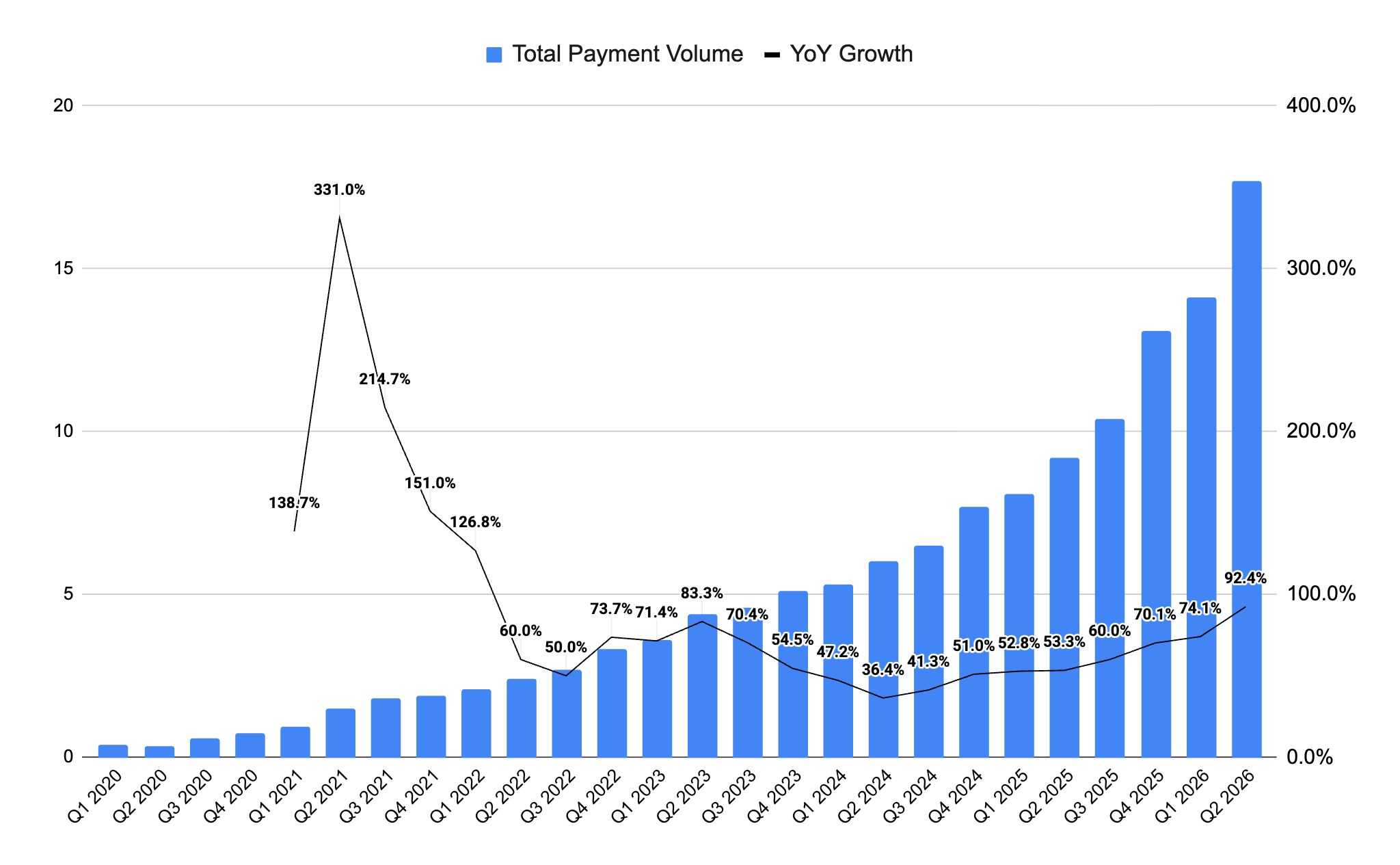
TPV was up 92% YoY and 26% QoQ, marking the 8th successive quarter of acceleration in TPV. TPV is now at $17.7B and judging by the trajectory, we are likely to see TPV reach ~$25B by Q4 this year.
Net Take Rates (Gross Profit/TPV)
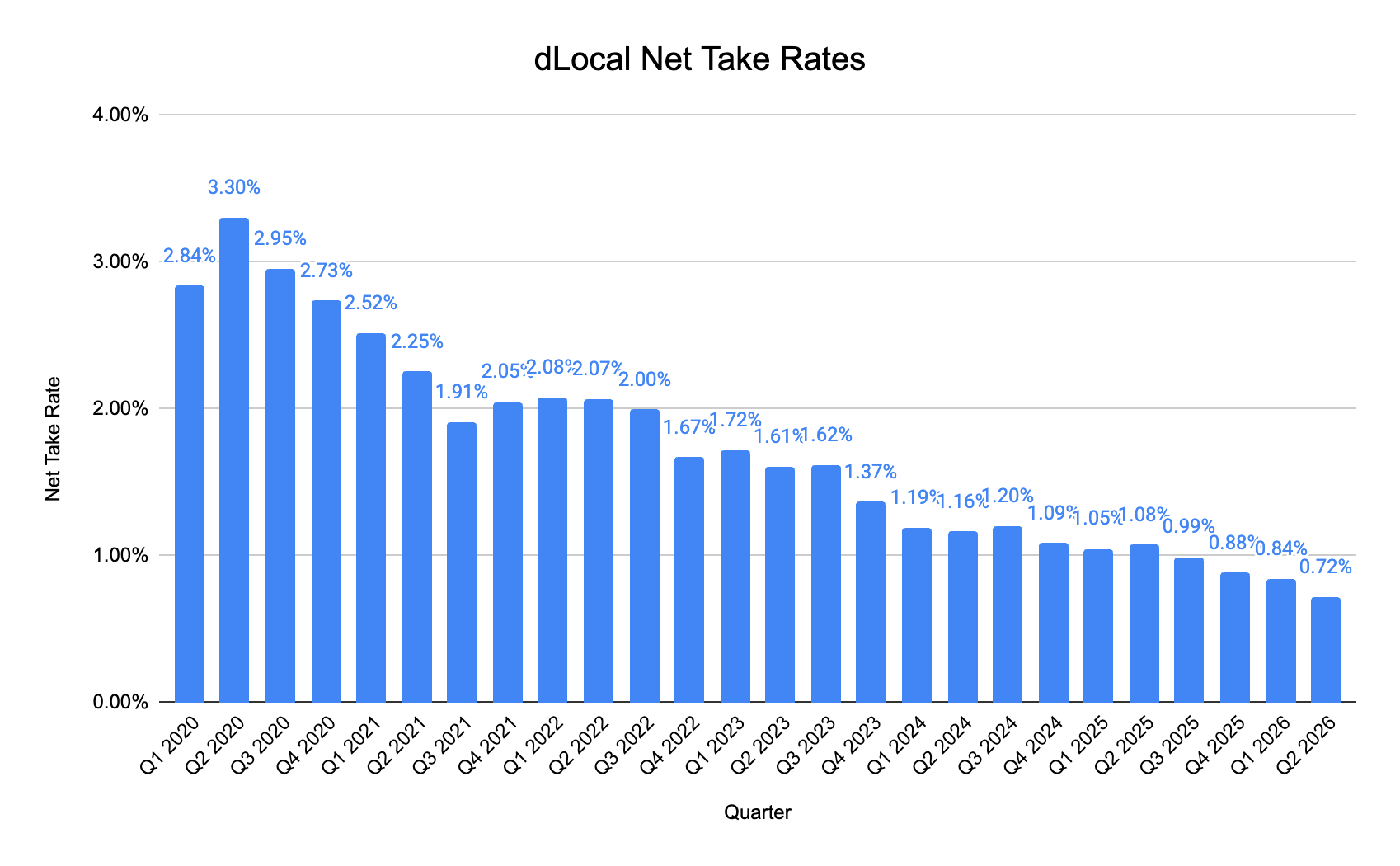
Net take rates are the true share of money that dLocal keeps after paying direct costs like local partner networks, payment rails, processing fees, etc.
This quarter, net take rates fell to 0.72%, less than a quarter of the net take rates 6 years ago this quarter. This is par for the course for any payments business, and especially one like dLocal that serves large enterprise merchants, and hence should not come as a surprise.
Notably, CEO Pedro Arnt said during the call:
“Were you to back out that one very large ride-hailing merchant's mixed gains at a lower take rate, take rate would have been relatively flat sequentially. That doesn't necessarily signal a bottom, but it does show that there is potentially increasingly an asymptotic shape to this.”
Gross Profit
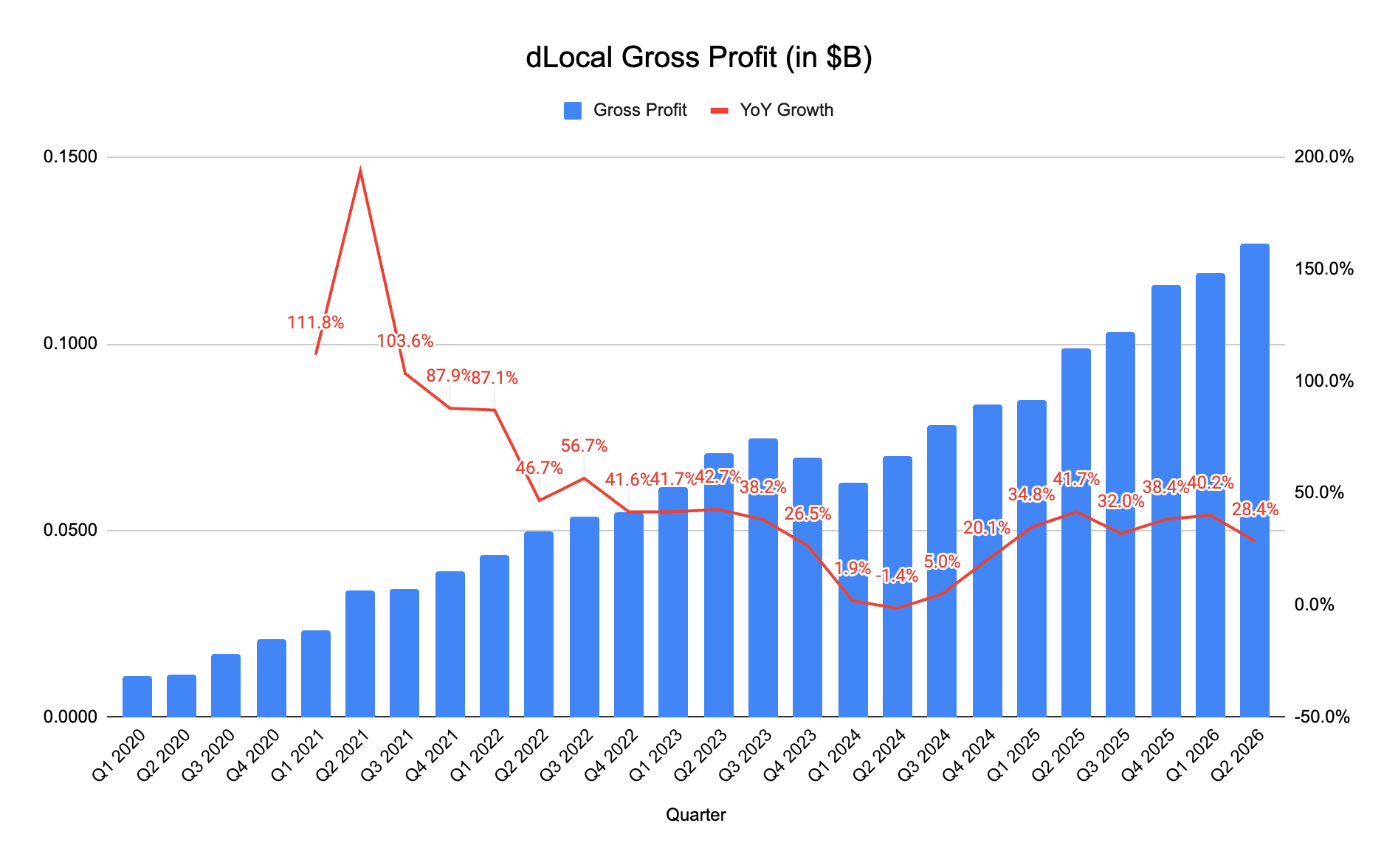
dLocal’s true top-line in my view, is gross profit. That was up 28.4% YoY, the weakest since Q4 2024. As Pedro shared during the call, this was due to the ramp up of a singular ride hailing merchant.
I would personally like to see this number grow at 30%+, and it was disappointing to see it dip below this quarter.
3. Guidance
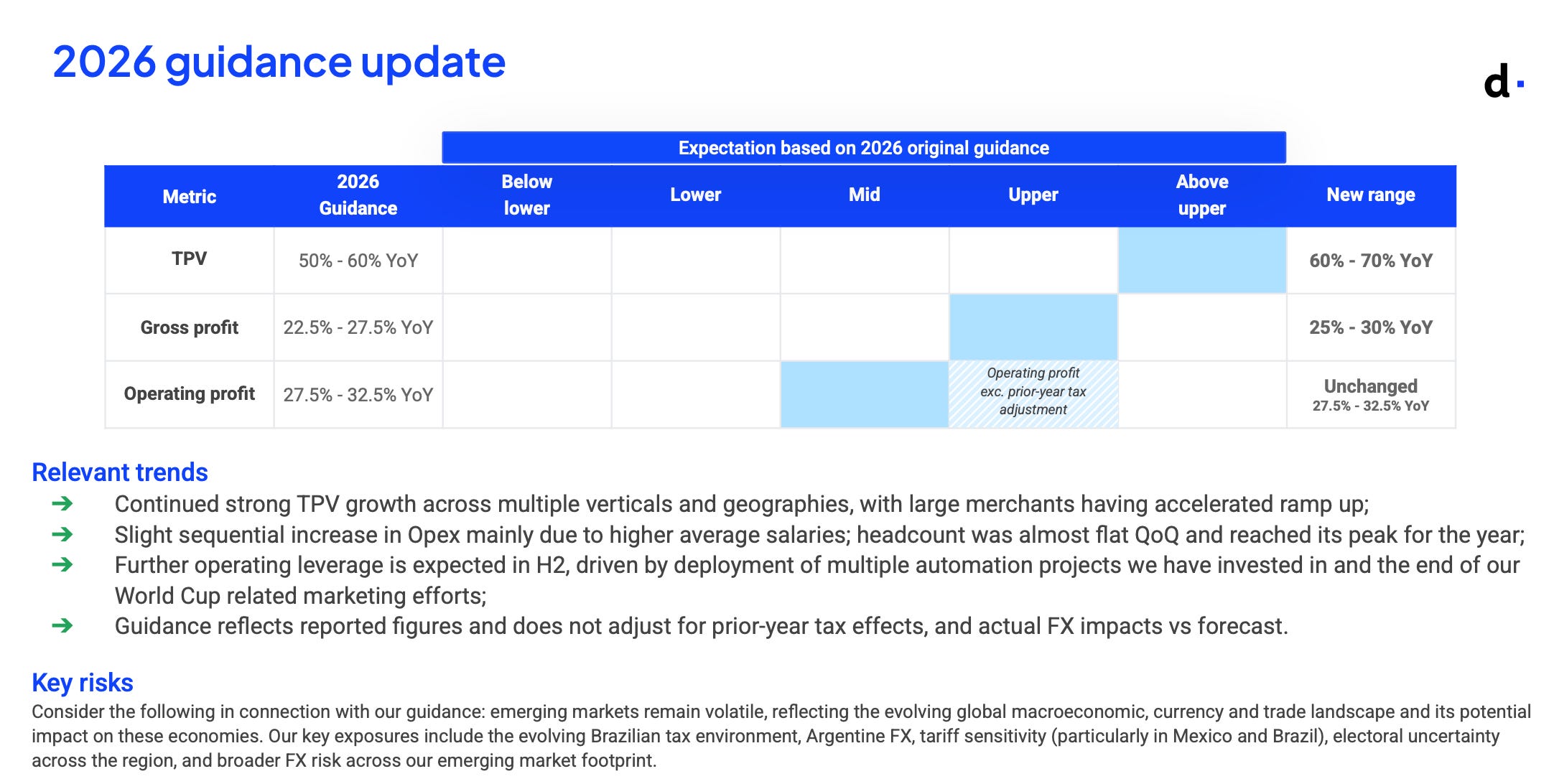
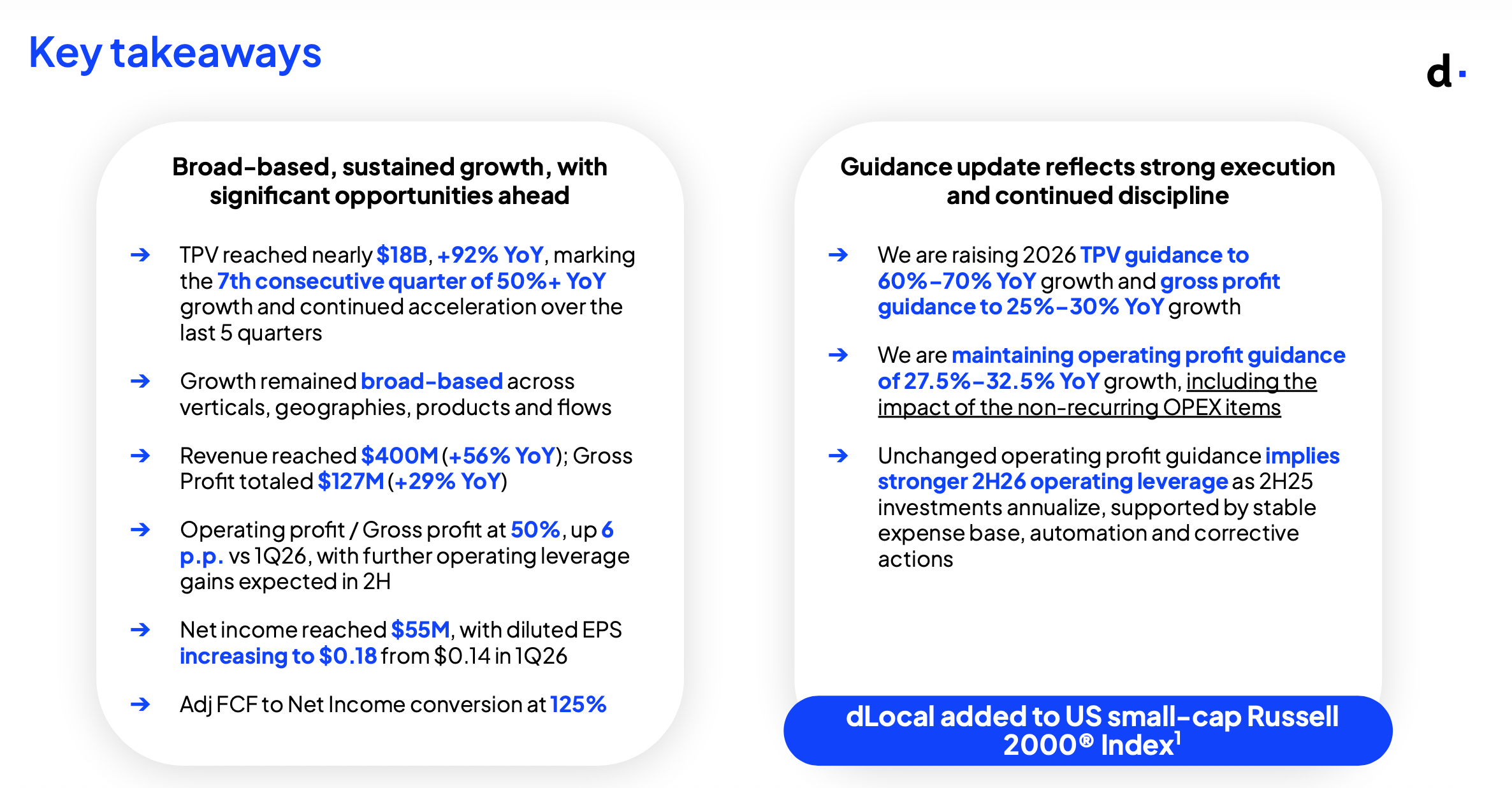
Management updated guidance for FY2026, guiding for 60-70% TPV growth for 2026. With the first 2 quarters coming in at 74% and 92% respectively, this probably is still a sandbagged target. Gross profit guidance was also slightly raised, although only 2.5% at the low and high end. Operating profit was unchanged, and this is perhaps surprising to some.
Management elaborated, stating that this is due to the prior-year tax adjustment, that would otherwise have operating profit come in at the higher end of the range. They have also been very consistent in their guidance. For instance, in Q4 2025, they stated that the new OPEX baseline introduced post-2025 investment cycle would temporarily pressure 1H26 margins but drive operating leverage improvements in 2H26. (I believe this is where the opportunity for investors lie and I will elaborate later)
Operating profit growth was 15% YoY in both Q1 2026 and Q2 2026. As such, we should see numbers closer to 45% YoY growth in H2 2026 in order to bring numbers in line with management’s guidance.
4. Product Development
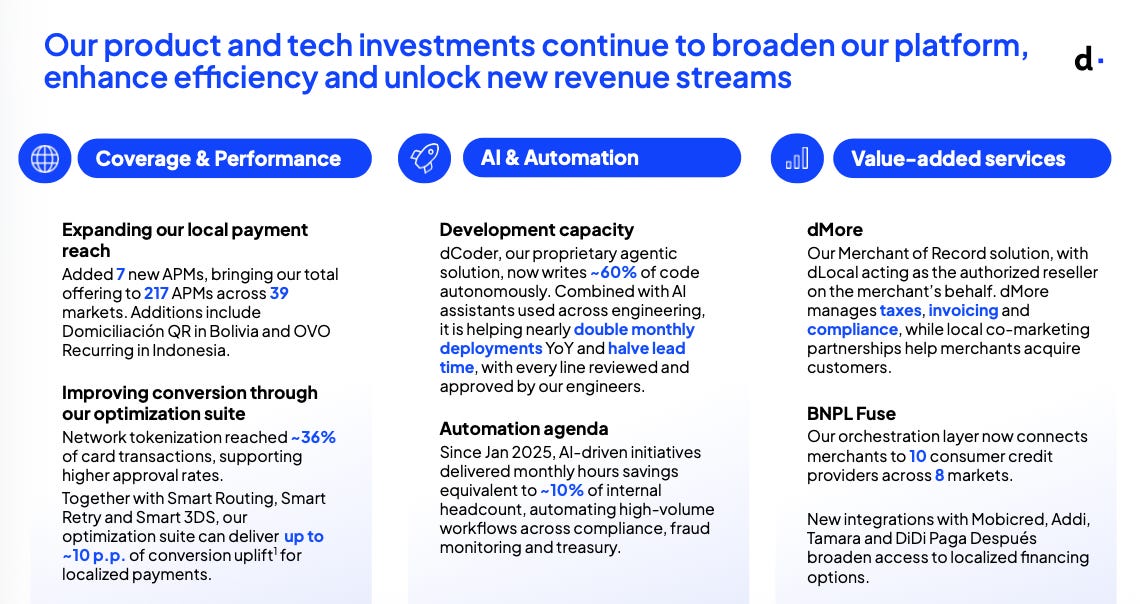
dLocal has continued to prioritise expanding coverage. In Q2 2026, they added 7 new APMs, reaching 217 APMs across 39 markets. Every additional market and payment method makes dLocal more valuable to existing and new merchants alike. For example, a business like Spotify having to decide between a provider that services 12 markets and 50 payment methods versus dLocal that services 39 markets and 217 payment methods. Even if Spotify only needs access to 10 countries today, they will still favour dLocal as it gives them optionality when expanding into other markets. Hence, this is a crucial customer acquisition and retention metric.
dLocal also shared that their optimisation suite can deliver up to 10 percentage points of conversion uplift for localised payments. This is huge for dLocal as it changes them from just a generic payment processor into a revenue optimisation product. Take for instance, a generic PSP approves 80% of payment attempts, while dLocal approves 85%. If Uber sends $1B of payment attempts, that extra 5% is $50M of additional completed transactions for Uber.
dMore is also a very important addition in the context of take rate pressure that, as we discussed, is the biggest worry for investors. Currently, dLocal’s primary revenue source is earning a fraction of TPV. Through dMore, it could capture economics across a much larger service stack. For example, if dLocal processes $100 worth of transactions, it keeps about $0.72 today in gross profit.
With dMore, that same $100 transaction enables dLocal to handle FX, tax administration, invoicing, compliance and eventually provide additional merchant services on top. As dLocal matures, this will be a key part of its business.
dLocal also highlighted the use of AI with ~60% of code autonomously written and ~10% in headcount equivalent savings through automation. This is all great news but I would expect it.
5. Management Commentary
Existing merchant wallet-share gains are materially exceeding expectations
“Directionally, if we were to update that data, you would see more performance from share of wallet gains of the existing book, less from new merchants, and less from new products... there’s been more than one existing merchant with very, very strong share of wallet gains that have exceeded initial forecasts.”
dLocal’s growth is coming from existing global merchants giving dLocal more volume every quarter. This is corroborated by the 188% TPV retention, and 92% TPV growth. It means just 4% of TPV growth is from new merchants.
The wallet-share opportunity remains large
“Interestingly, even with this massive ramp-up for that merchant, it’s not like we’re maxing out share of wallet or that it has a significantly different share of wallet with us... in the future, potentially there still could be more and more share of wallet gains from someone like this if we’re able to serve them in a growing number of African, Middle Eastern, or Asian markets.”
“We still have a very large untapped addressable market ahead of us if we continue to execute, even when you look at it on a per merchant basis.”
This quote was with regard to the ride-hailing business that largely led to doubling of volumes running through the dLocal platform QoQ. The one obvious concern after this doubling of volume of course is, doesn’t this mean dLocal has already earned most of its business?
Management is clearly saying no and stating that the extraordinary Q2 ramp was heavily concentrated in LATAM, and more gains can be had by expanding that relationship to Africa, the Middle East and Asia.
This means that even a merchant which has already generated enormous incremental TPV can theoretically remain a significant future growth source.
Pedro reiterated what is really most important to dLocal
“When merchants have these significant spikes in volume, they do rapidly hit new pricing tiers. That’s still all incremental gross profit to us, and it’s very positive, but it does drive down the headline take rate.”
“It confirms what we’ve said all along, that incremental TPV at incremental gross profit is really the financial model here and not managing to any specific take rate.”
The eventual aim of dLocal is to maximise shareholder value, and that comes by generating more dollars every quarter. Management is essentially telling investors that gross profit dollars matter more than take rate percentages, and I have stated this too in the past.
dLocal is prioritising scale for a reason
“Payments is ultimately a scale business. As our volumes grow, we gain greater leverage with downstream providers, deepen our FX liquidity, and generate more data to improve performance. These dynamics reinforce one another over time and are central to the long-term value creation of our business model.”
“As our TPV grows across a market, it allows us... to lower our cost of processing, which then improves our net take rate across the rest of the book, just because pricing is flat, cost is coming down.”
TPV growth can create a moat, and is not simply a means of stemming the take-rate decline. Scale gives dLocal better bargaining power with processors/acquirers, better FX liquidity and more payment data.
Management expects automation to structurally reduce middle and back-office hiring intensity
“We expect to be able to selectively add headcount, but primarily feet on the ground and localisation, while at a centralised and overall middle and back office level... we expect to be able to really push the envelope in terms of automation and high operational leverage there.”
In the latest Q, dLocal added just 4 employees, compared to 27, 60 and 55 in the previous 3 quarters. As dLocal’s investment cycle comes to a close, I believe we should see similar numbers in the next few quarters as the one in Q2. This will bode very well for dLocal’s FCF per share generation as I will elaborate on later as part of my thesis moving forward.
Mexico was a disappointment due to dLocal’s failure to control costs
“Mexico obviously continues to have very strong TPV growth. It actually had very strong revenue growth of 64% year-on-year... Then disappointing gross profit line... what that points to is that that is primarily a cost issue.”
“What we need to do a better job at... is to manage the Mexican cost basis, primarily that of processing payments better, and that should begin to align gross profit growth closer to revenue growth.”
This is certainly one of Pedro’s strong points, acknowledging the mistakes they’ve made and seeking to correct them. He is one of the most excellent communicators and is always transparent.
6. Conclusion
Overall, this was a rather mixed quarter. TPV growth coming in at 92% is incredible, and I continue to be amazed at how Pedro has turned this around since becoming co-CEO and now sole CEO.
Margins continue to be an overhang, but I remain very optimistic.
If we look at the next few quarters, I really like the setup of dLocal. Gross profit growth is in the 30% range, they are extremely capital light, and taking market share. The investment cycle has just ended, headcount is now flat moving into H2 and AI efficiencies are expected to cut costs. We are seeing operating leverage in real-time. Combined with buybacks, I think we are about to see FCF/share growth go vertical soon, and valuation will look ridiculously cheap if the stock remains range-bound.
Below, I will write about what I plan to do with the stock:
