

AppLovin has always been a bit of an anomaly. From the beginning, venture capitalists wrote the business off, and throughout the history of the business, many short-sellers have attempted to take the business down.
It is difficult to understand how a business with fewer than 1,000 employees can make $5.48B in revenue, grow 70% year-on-year, and convert 65% of revenue into net income. In many ways, it is a 1 of 1 business.
It has seen an incredible 91.5% drawdown in 2022, followed by an even more astounding 80x return from those lows within 4 years.
Diving deeper into the history of the business makes it stand out even more as an anomaly, and I think there is not a more misunderstood business in the large-cap space.
In this piece, I hope to bust the myth of AppLovin and determine if this is a truly generational business, or a deservedly overlooked one.
Table of Contents
Introduction
Company History
Business Model & Products
Moats & Differentiation
Competitive Landscape
Financials
The Short Thesis & SEC Investigation
Ownership & Management
Valuation
Bull and Bear Case
GabGrowth Quality Score
Concluding Thoughts
1. Introduction
To understand how AppLovin makes money, we must first understand the concept of performance advertising.
If we break it down to first principles, it is simply the business of getting a specific person to take a specific, measurable action. For instance, installing an app, buying a product, or subscribing to a service, and charging the advertiser based on how well that action is delivered.
It is the unglamorous, yet deeply lucrative core of digital advertising, distinct from brand advertising (where you pay to be seen and hope it works). In performance advertising, the advertiser can measure return on ad spend (ROAS) to the dollar and will keep feeding budget into any channel where a dollar in, reliably returns more than a dollar out.
For roughly 15 years, this has been a duopoly. Meta and Google capture the majority of global performance advertising dollars because they own both halves of the equation:
The inventory (billions of logged-in users and the attention they spend)
The data (who those users are, what they search, what they buy, what they linger on)
The closed loop between owning the audience and owning the outcome data is what makes their ad machines so hard to beat. Everyone else, also known as the "open internet" and the independent ad-tech sector, has fought over the remainder, usually at thin margins, frequently going bankrupt.
Why exactly is performance advertising such a lucrative business?
Global digital ad spend is on the order of $780B in 2026 (part of a total ad market that now exceeds $1 trillion), and performance-based pricing accounts for roughly 63% of online ad revenue.
In-app advertising, where AppLovin competes, is a ~$250B market and one of the fastest-growing segments of digital. The adjacent prize AppLovin is now chasing, e-commerce and retail media advertising, is a ~$165B global market growing mid-teens, faster than digital advertising as a whole.
The fundamental reason performance advertising is lucrative is that it is priced against verified outcomes, not estimated reach. Advertisers pay only when the model delivers. That means platforms that excel get rewarded again and again.
Meta and Google tapped into that durable profit pool for years, leaving it effectively closed to new entrants.
AppLovin is the first credible attempt in years to pry open a third position in that profit pool and it arrived from a strange direction, mobile games.
Games turned out to be the perfect training ground for a performance-advertising AI, because a game generates an enormous, continuous stream of measurable user actions (installs, sessions, in-app purchases), and the advertisers (game studios) are ruthless ROAS optimisers who will move budget instantly when the math improves.
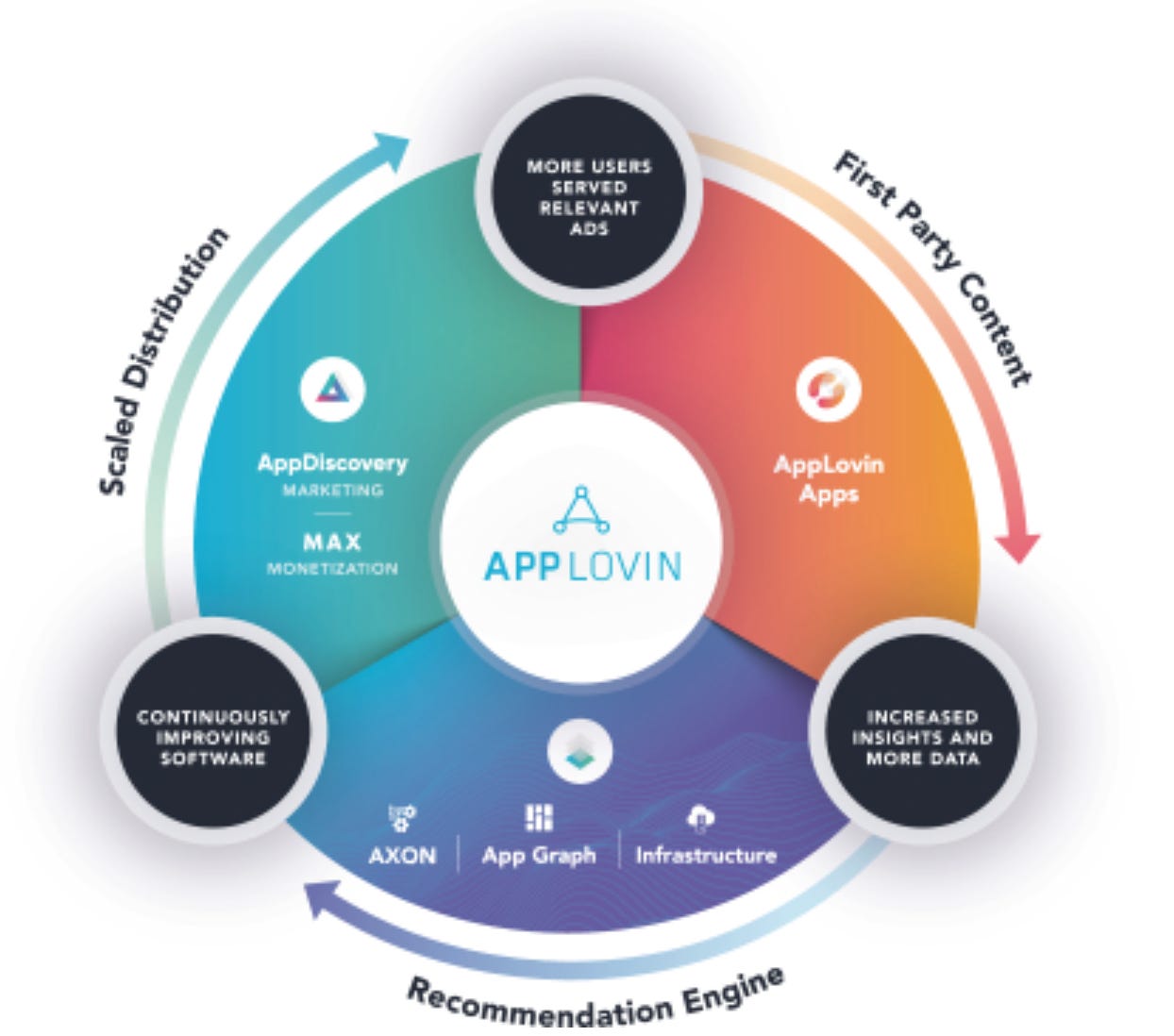
AppLovin built an AI engine, AXON, that learned, inside that environment, to predict which user would convert and how much to bid for the impression, in real time, across billions of auctions.
Once that engine was demonstrably better than the alternatives at selling mobile games, the obvious question was, is this technology transferrable to other non-gaming sectors? For instance, would AXON be able to sell running shoes, supplements, software subscriptions, and streaming services?
Management estimates the non-gaming opportunity is five to ten times the size of the gaming market that AppLovin currently dominates. At the end of June 2026, AppLovin has opened its self-serve advertising platform and a dedicated e-commerce product to general availability.
This product launch will determine where the stock goes over the next decade, and will be a large part of what we will discuss below.
2. Company History
Before we get any further, it is important to understand the journey of AppLovin as knowing the full origin story gives a much better context of the business it is today.
Founding (2012-2014)
AppLovin was founded in 2012 by Adam Foroughi, John Krystynak, and Andrew Karam.
Adam, born in 1980 to a family that emigrated from Iran around the Iran-Iraq war, studied economics at UC Berkeley. Prior to AppLovin, he had already run 2 successful advertising businesses focused on performance advertising.
AppLovin was built to solve a problem that began brewing from 2008, the year the App Store was launched by Apple. By 2012, there were hundreds of thousands of games in the App Store competing for attention from consumers.
The problem facing every mobile developer was the same: how do you get users to install your app when no one knows it exists?
The mobile advertising market was new, developers had difficulty attracting users and building a steady income, and the market was split into many parts without easy access to good marketing and monetisation tools. There were ad networks, but they were fragmented, opaque, and often ineffective. A gaming studio in San Francisco had to deal with ten different networks, each with separate dashboards, separate contracts, and no unified way to know which one was actually working.
AppLovin's earliest product was straightforward. It was a performance advertising network connecting two parties:
Advertisers (mobile app developers, particularly game studios) who wanted new users for their apps.
Publishers (other mobile app developers) who had users already inside their apps and could show ads to those users.
The company most commonly charged on a cost-per-install (CPI) basis for each successful conversion. Publishers connect to ad networks like AppLovin to find the best bids for their inventory. Whenever the network successfully places an ad with a publisher, it pays the publisher on a cost-per-thousand-impressions (CPM) basis and keeps a portion of the proceeds for facilitating the transaction.
Example:
A small studio game developer making a puzzle game, wants 10,000 new installs. They go to AppLovin and say: "I will pay you $2 for every user who installs my app." AppLovin then goes to publishers (i.e., other apps with ad inventory) and negotiates to show that install ad inside their apps.
If a user sees the ad and installs the puzzle game, AppLovin collects $2 from the advertiser, pays $1.40 to the publisher, and keeps the $0.60 difference as its margin. If there is no install, there will be no charge to the advertiser.
This was the entire original business model, which was effectively a brokerage where AppLovin matched supply (publisher ad inventory) with demand (advertiser budgets) and took a spread.
Impressively, AppLovin took almost no outside money at the start (around $4M in seed funding from Streamlined Ventures, the Webb Investment Network and others) and was profitable early. Adam took founder's equity and no meaningful cash salary for the better part of a decade. This shaped a culture of capital discipline that still defines the company.
Early Growth & First Pivot (2014-2018)
The company scaled as an ad network during the surge in iOS and Android app install campaigns. AppLovin was ranked #10 on the 2016 Deloitte Fast 500 North America list.
In September 2016, AppLovin agreed to be acquired by Chinese private equity firm Orient Hontai Capital for $1.42B. The acquisition was subsequently abandoned after opposition from CFIUS, and was converted instead into a debt investment. In 2018, AppLovin sold a 9.98% minority stake to KKR, raised debt, and restructured to preserve US-aligned governance and founder control.
The CFIUS block turned out to be a crucial decision. It forced the company to stay independent, retain founder control, and find its own path to scale rather than becoming a Chinese-owned ad network, which would have severely constrained its data access and US market positioning.
In July 2018, AppLovin launched Lion Studios, which works with mobile developers to publish and promote their games. However, the real purpose was to feed AppLovin’s advertising engine. Owning games gave AppLovin full-funnel, first-party data on how users behave after they install, which was the exact signal its ad models needed to predict and price conversions.
In September 2018, AppLovin acquired MAX, an eight-person in-app header bidding startup founded less than a year earlier by Jim Payne, the same Jim Payne who had co-founded MoPub and sold it to Twitter in 2013. (More on this later)
This acquisition solved a structural problem that was plaguing the business. As a pure ad network, AppLovin could help buyers acquire users but couldn't actually help developers sell their inventory well.
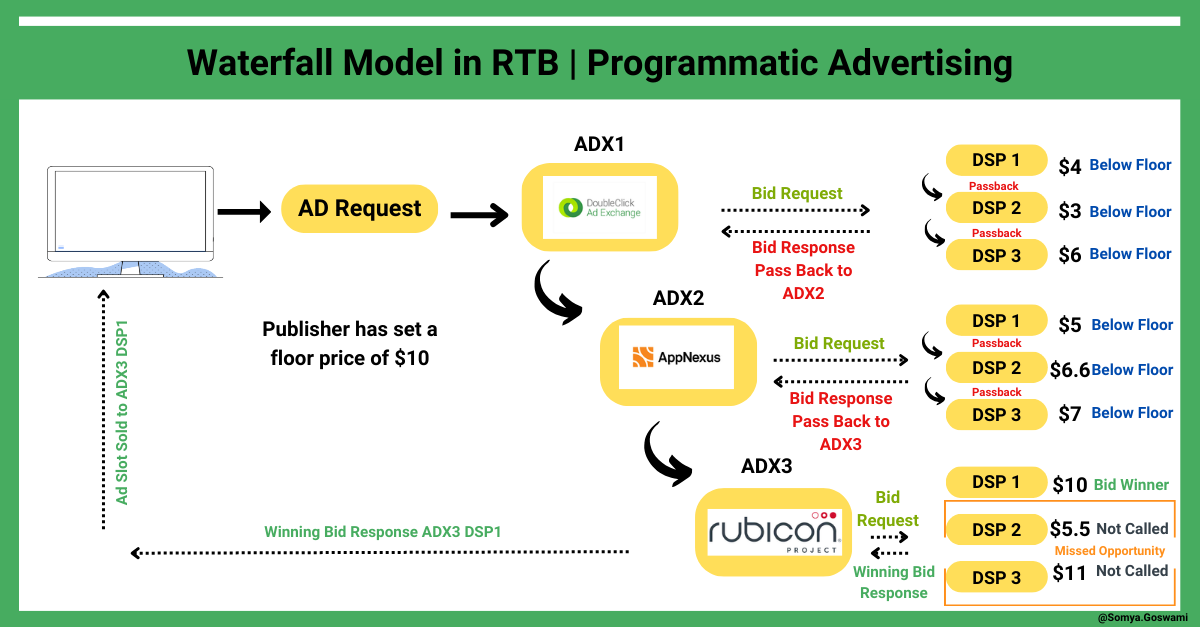
The industry standard at the time was the "waterfall" model, where publishers offered each impression to ad networks sequentially, in a pre-set order ranked on historical eCPMs and fill rates. If network A passed, the impression went to B, then C. The process was queue-based, slow, and systematically underpriced inventory, because rankings reflected stale historical averages rather than what any bidder would actually pay for that specific impression.
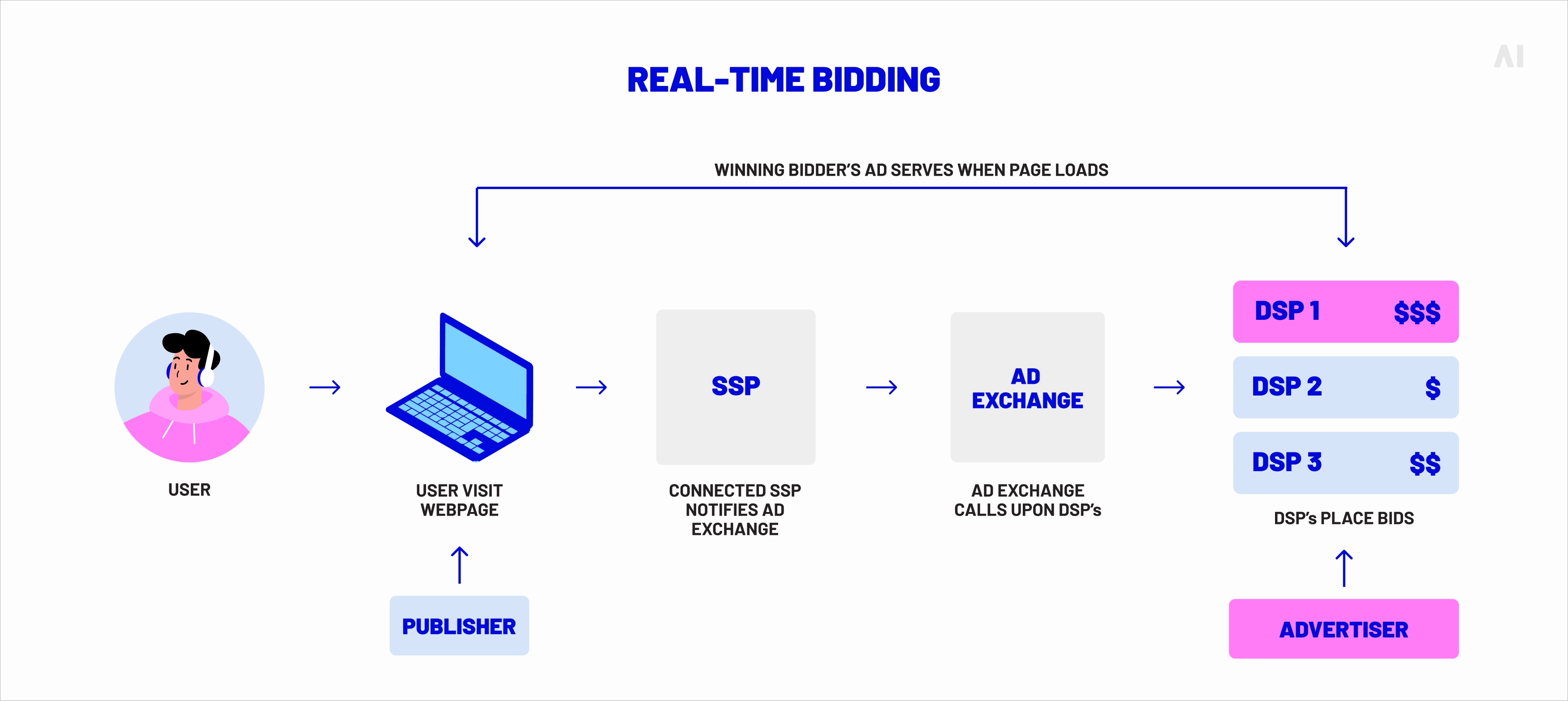
MAX replaced the waterfall with in-app real-time bidding where every impression is auctioned to all demand sources simultaneously and clears at the highest bid. Developers immediately earned more per impression, while advertisers still came out ahead as long as they bid below expected return. MAX was the first move toward owning both sides of the transaction. AppLovin would now sit between publisher inventory and advertiser demand, capturing bid-stream data from both directions, and it transformed AppLovin from a platform that only served buyers into one serving both advertisers and publishers.
Acquisitions and Vertical Integration (2018-2022)
Also in 2018, private-equity firm KKR made a minority investment that valued AppLovin around $2B. That capital funded a sustained acquisition spree across both sides of the business. The logic was to build a closed-loop stack where AppLovin owned supply, demand, measurement, and first-party behavioural data simultaneously.
On the supply/demand side, AppLovin built out its ad infrastructure by acquiring the MAX in-app bidding/mediation platform as we discussed, and acquiring mobile-attribution firm Adjust, and then purchasing MoPub from Twitter for $1.05B.
Adjust, acquired for roughly $1B in 2021 alongside the IPO, solved the measurement problem. Attribution (the process of identifying which ads, clicks, and marketing channels lead to a sale or action) in mobile advertising was a black box where an ad passes through impression, click, install, usage, and payment, with data scattered across systems advertisers can't see.
Advertisers could measure outcomes cleanly on Meta but not on independent networks, capping how much budget AppLovin could win. Adjust let advertisers break down what each dollar produced, turning AppLovin into a platform that could take accountability for results, which was the foundation of its LTV-based optimisation pitch.
MoPub can be best understood as a massive ad marketplace that aggregated ad space from numerous apps (45,000 to be exact), selling it to advertisers, taking a cut in the process. This acquisition solved the scale problem that had limited AppLovin (as their data was focused only on gaming). MoPub aggregated inventory across tens of thousands of non-gaming apps, (news, utilities, lifestyle) reaching roughly 700M daily active users, expanding both AppLovin's inventory and its audience diversity beyond gamers, and injecting a continuous stream of bid data into the platform.
On the content side, it bought game studios such as Machine Zone, PeopleFun, and Belka Games to generate first-party demand and, critically, the proprietary data that would train the ad engine. This combination meant AXON could train on more diverse outcome data than any competitor.
On April 15, 2021, AppLovin went public on Nasdaq at a valuation of approximately $28B, pricing at $80 per share.
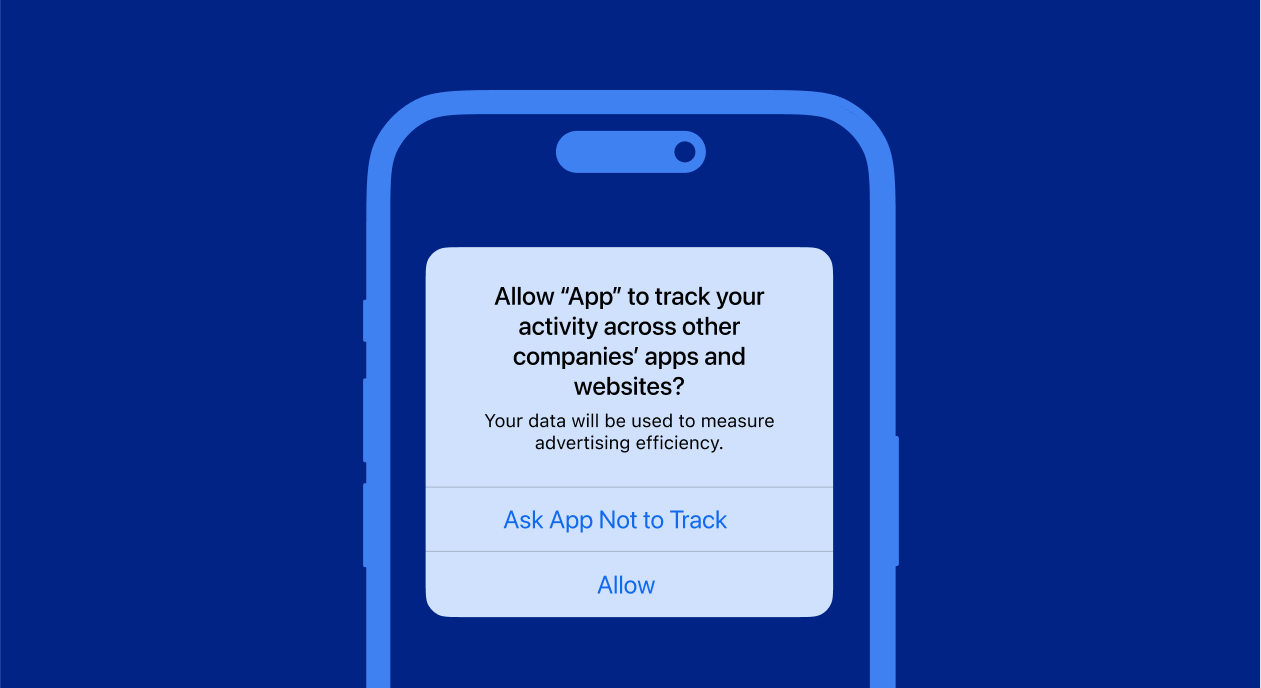
However, Apple's App Tracking Transparency (the post-IDFA privacy regime) was released about a week after AppLovin went public, which gutted the signal that mobile advertisers relied on. To add to that, the SPAC/growth bubble burst in 2022, resulting in AppLovin stock that was burning cash at the point to lose over 90% of its value.
In the midst of that in August 2022, AppLovin made an offer to buy Unity Technologies for $17.54B in stock. Unity's board rejected the offer and committed to completing its acquisition of ironSource. Had the Unity deal gone through, AppLovin would have owned the dominant game engine and the dominant mobile ad network simultaneously, an extraordinary chokehold on the mobile gaming economy. Its failure left both companies weaker heading into 2022.
Adam Foroughi’s Bet on Himself (2022-2024)
AppLovin’s stock price fell to as low as $9 in 2022. Around that period, Adam went to the board and proposed that his entire compensation for the next 4 years be paid out as a performance-stock-unit (PSU) grant, only if the stock recovered massively. The first hurdle was ~120% stock price appreciation, and the final hurdle requiring over 380% appreciation with a limited time window and no cash bonuses.
The recovery was arguably driven by a single product. In mid-2023, AppLovin shipped AXON 2.0, a rebuilt machine-learning engine for the ad business. The improvement in ROAS was large enough that advertisers shifted incremental budget almost immediately. Revenue and margins inflected, and the stock began a rebound that has now exceeded thousands of percentage points off the 2023 base.
Pivot To Pure Ad Company (2024-2026)
The management team soon realised that the underlying algorithm behind AXON 2.0 was the asset. Therefore, it doubled down on their crown jewel. Here is the timeline of events that unfolded:
Feb 2024: KKR sold down part of its stake in a secondary offering as the stock recovered.
Late 2024: AppLovin raised debt (senior notes) to fund buybacks rather than dilute.
May 7, 2025: Announced the sale of its entire mobile gaming business. All ten studios, including franchises like Wordscapes, Project Makeover, Hexa Sort, Cooking Madness, West Game, and Clockmaker were sold to Tripledot Studios.
AppLovin received roughly $400M in cash plus equity equal to about 20% of Tripledot (reported total value around $800M). Overnight, AppLovin stopped being a games company and focused on software.
Sept 22, 2025: Added to the S&P 500.
April 2, 2026: Adam Foroughi stepped down as Chairperson (remaining CEO), separating the chair and CEO roles.
Selling the games was a difficult decision at the time, but ultimately the right call. The studios were profitable and produced useful data, but they were lower-margin and capital-intensive. More importantly, they put AppLovin in direct competition with its own advertising customers.
In June 2026, AppLovin fully opened its AI-powered AppLovin Ads platform to the public, removing prior referral restrictions to scale access for e-commerce and non-gaming performance advertisers globally. This is a pivotal moment for the business, and it remains to be seen how this will impact the business from a financial standpoint.
3. Business Model and Products
AppLovin has gone through several iterations of its business model, as we have discussed. Today, the concept of their business model is pretty simple.
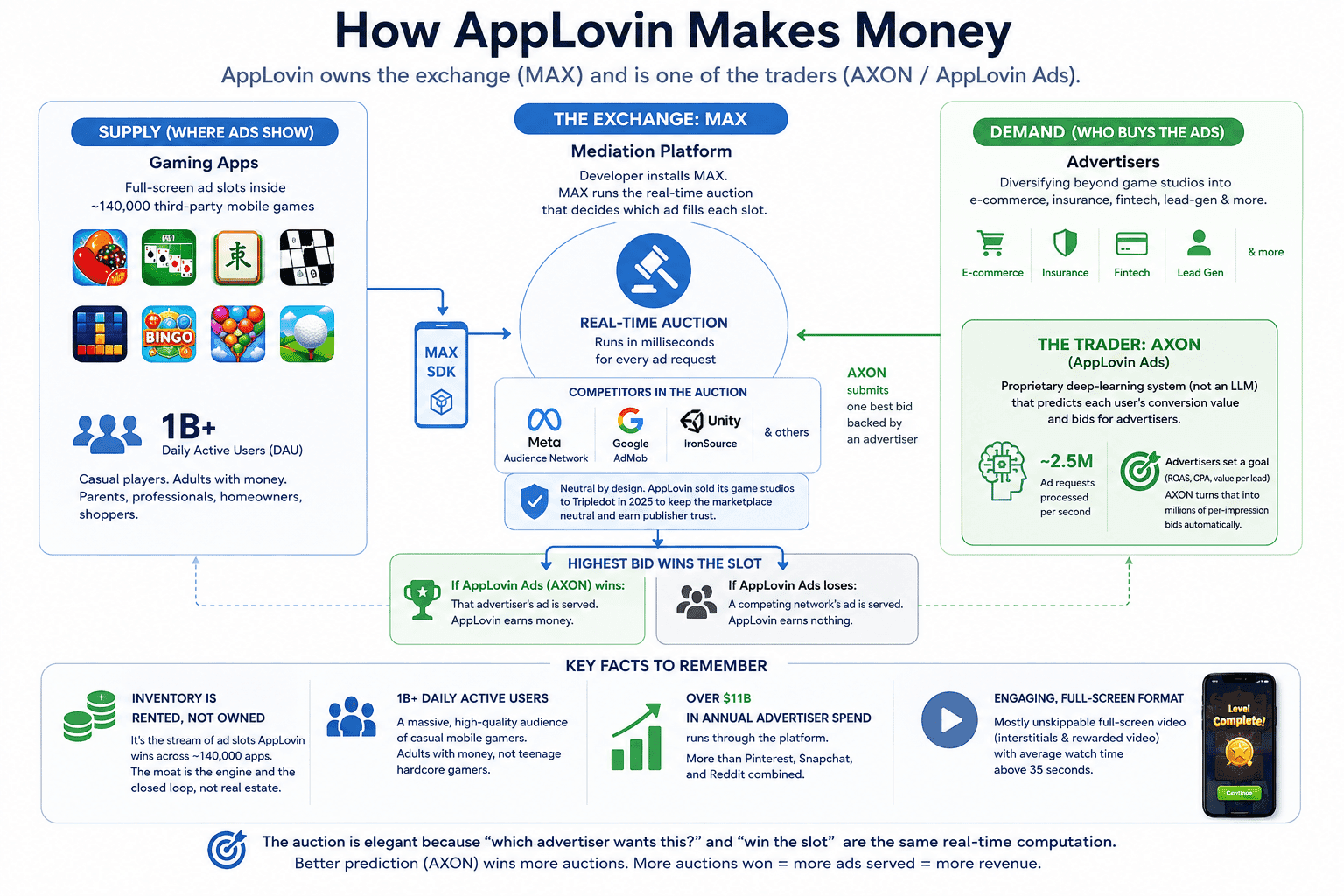
It runs an AI engine that matches advertisers to users, and takes a cut of the ad spend that it directs. This is essentially the oldest business model in advertising and what makes it possible, is AXON.
AXON is a real-time machine-learning system built around reinforcement learning. For every available ad impression, it predicts the probability that a given user will take the action the advertiser cares about (install, purchase, subscribe) and bids accordingly.
AXON’s scale is the key here:
Processes on the order of 2 million ad auctions per second
Draws behavioural signal from over 1 billion devices
Trained on trillions of daily in-app events from AppLovin’s former portfolio of games
Crucially, AXON does not primarily rely on the demographic or social-graph targeting that defined the old ad world. Instead, it is a behavioural prediction engine that learns, impression by impression, what kind of user-context-creative combination produces a conversion, and it updates continuously.
Every install, purchase or even a “non-click/tap” is a training signal that sharpens the next prediction. This is the same closed-loop dynamic that made Meta and Google's ad machines unbeatable, but AppLovin built a version that operates across the open mobile ecosystem.
The commercial output of all this is ROAS.
Ultimately, what advertisers truly care about is that a marginal dollar spent through AppLovin returns more than the same dollar spent elsewhere. When AXON 2.0 launched, measured ROAS jumped enough that advertisers reallocated budgets, and because the model improves with more spend (more spend → more data → better predictions → higher ROAS → more spend), the advantage compounds on itself. That self-reinforcing loop is the crux to this economic engine.
AppLovin’s Full Stack System
Of course, AXON is not the only part of the puzzle. AppLovin’s acquisitions over the years have built a full stack pipe that few competitors can match:
AppDiscovery: This is the demand side where advertisers buy user acquisition.
MAX: The supply and mediation side, an in-app bidding platform that auctions publisher inventory.
Adjust: The measurement layer that attributes outcomes back to ad spend.
AXON: The decisioning brain that sits on top of the 3 above.
Owning demand, supply, measurement, and decisioning together means AppLovin sees more of the signal end-to-end and can optimise across the whole chain compared to other competitors who have to stitch together 3rd party tools.
The Advertiser Expansion
This is a huge part of the thesis for AppLovin. Historically, AppLovin's advertisers were almost entirely mobile-game developers buying installs. It is a large market, but relatively capped. The story moving forward is AXON catering its services to everyone else, outside of just the gaming market.
E-commerce:
The target market here would be direct-to-consumer and online brands that intend to acquire customers. AppLovin ran this as a referral-only, white-glove pilot through 2024-2025.
Management has repeatedly said early e-commerce ROAS is comparable to Meta's Audience Network, which if true at scale, is massively bullish.
Self-serve:
At the end of June 2026, AppLovin launched its AXON Ads Manager self-serve platform plus a dedicated e-commerce platform to general availability.
Previously it was hand-held onboarding, which holds back the growth in usage. This is perhaps the most important near-term catalyst.
Onboarding bottleneck:
Roughly 57% of qualified e-commerce leads that have been vetted and want to advertise on AppLovin today. This means that the other 43% is still hesitant and is lost revenue sitting on the table.
The friction is largely creative where e-commerce brands without big creative teams struggle to produce enough ad variations.
AppLovin is piloting GenAI creative tools with 100+ advertisers specifically to break this bottleneck.
CTV and Streaming:
Through the 2022 acquisition of Wurl, AppLovin sells into connected-TV inventory, a growth vector management has flagged alongside the core. It is still small today but as it is not gaming-related inventory, it could be a great diversifying option.
Lead generation & new verticals
A forthcoming lead-gen campaign type is designed to push AppLovin beyond mid-market e-commerce into high-value verticals like automotive, insurance and subscriptions, meaningfully broadening the addressable advertiser base beyond Shopify sellers.
First-party inventory
AppLovin has signalled it is exploring its own social/owned-inventory surface. This is still early and speculative, but it would extend the model beyond renting other people’s inventory.
Monetisation Rate, Potential Hidden Optionality
AppLovin today monetises only about 1.3% of the impressions it serves. The other ~98.7% generate no revenue at all.
This is not a model quality issue, but rather a demand diversity problem. At the moment, the majority of ads AppLovin has to show are for other mobile games, which results in the engine quickly running out of relevant things to serve. Most users are perfectly happy with the game they are already playing and have no interest in installing another, so the vast majority of impressions get a repetitive, low-intent ad.
As the advertiser base broadens beyond gaming, AXON now has something relevant to show on inventory it already controls, a personalised product on almost every impression, while reserving scarce gaming ads for the high-intent moments where they already convert. Lifting the monetised share of impressions from 1.3% toward even 3% would roughly double the revenue capacity of the existing publisher base with no new supply added at all. Adam himself has mentioned previously that he believes 5% is a realistic target that they eventually hope to get to.
The e-commerce opportunity is therefore not a linear opportunity, but a massive, perhaps exponential opportunity for the business.
Huge Margins
AppLovin’s incredible margins are because it is essentially a software business, not a media business. AppLovin doesn't own most of the inventory and doesn't employ armies of salespeople.
AXON is the sales pitch and each incremental dollar of ad spend it processes costs almost nothing to serve. The easiest way to explain AppLovin, is that it is a tollbooth on performance advertising, where an AI sets the toll, and the road is being widened from just mobile games to all of digital commerce.
4. Moats & Differentiation
This is the most important section in the piece because everything else, from margins to growth and valuation, is downstream of whether the business moat is durable.
Data and Feedback flywheel
This is probably the most important part of AppLovin. As more ad spend flows through AXON, more conversion outcomes are observed, enabling the model to get more accurate. ROAS then improves and advertisers route even more spend, starting the next cycle.
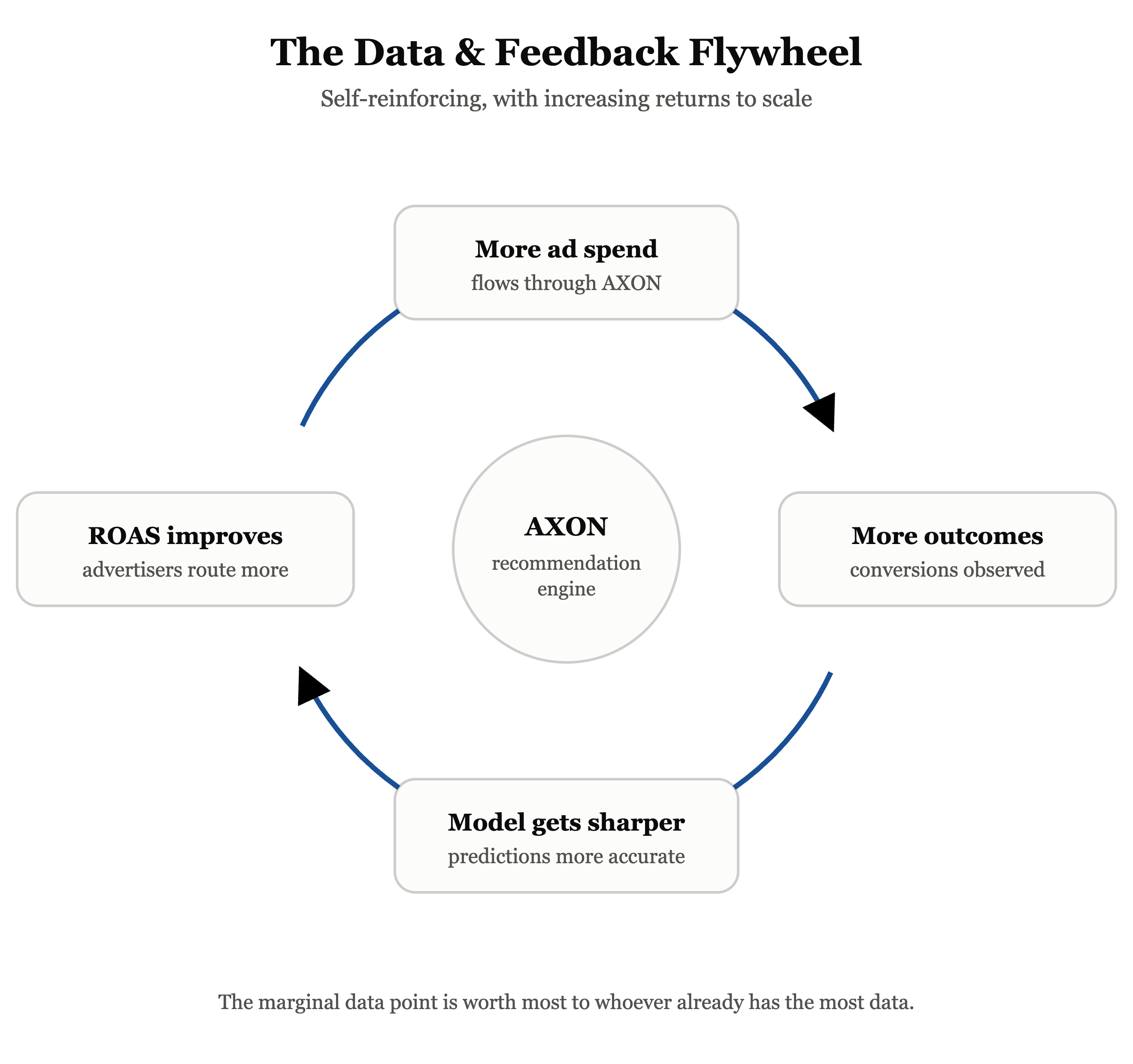
It is self-reinforcing and, crucially, has increasing returns to scale. The marginal data point is most valuable to the player who already has the most data because they can place it in the richest context.
AXON serves over $10 billion in annual media spend and learns from trillions of in-app events across 1B+ devices at 2M auctions/second. This is structurally the same strength that makes Meta and Google's ad machines impregnable.
What makes a moat important or durable of course, is that a competitor must not be able to buy their way in.
In this case, I believe this holds true. Data scale economies have a cold start problem where a new entrant has no data, which means a poor model with weak ROAS. This means they can’t attract the spend that would generate the data. Essentially, a chicken and egg problem.
Control of Supply via MAX
In my view, this is the most defensible moat that AppLovin owns. AppLovin’s in-app bidding and mediation platform, MAX, controls an estimated 60-80% of the mobile ad-mediation market.
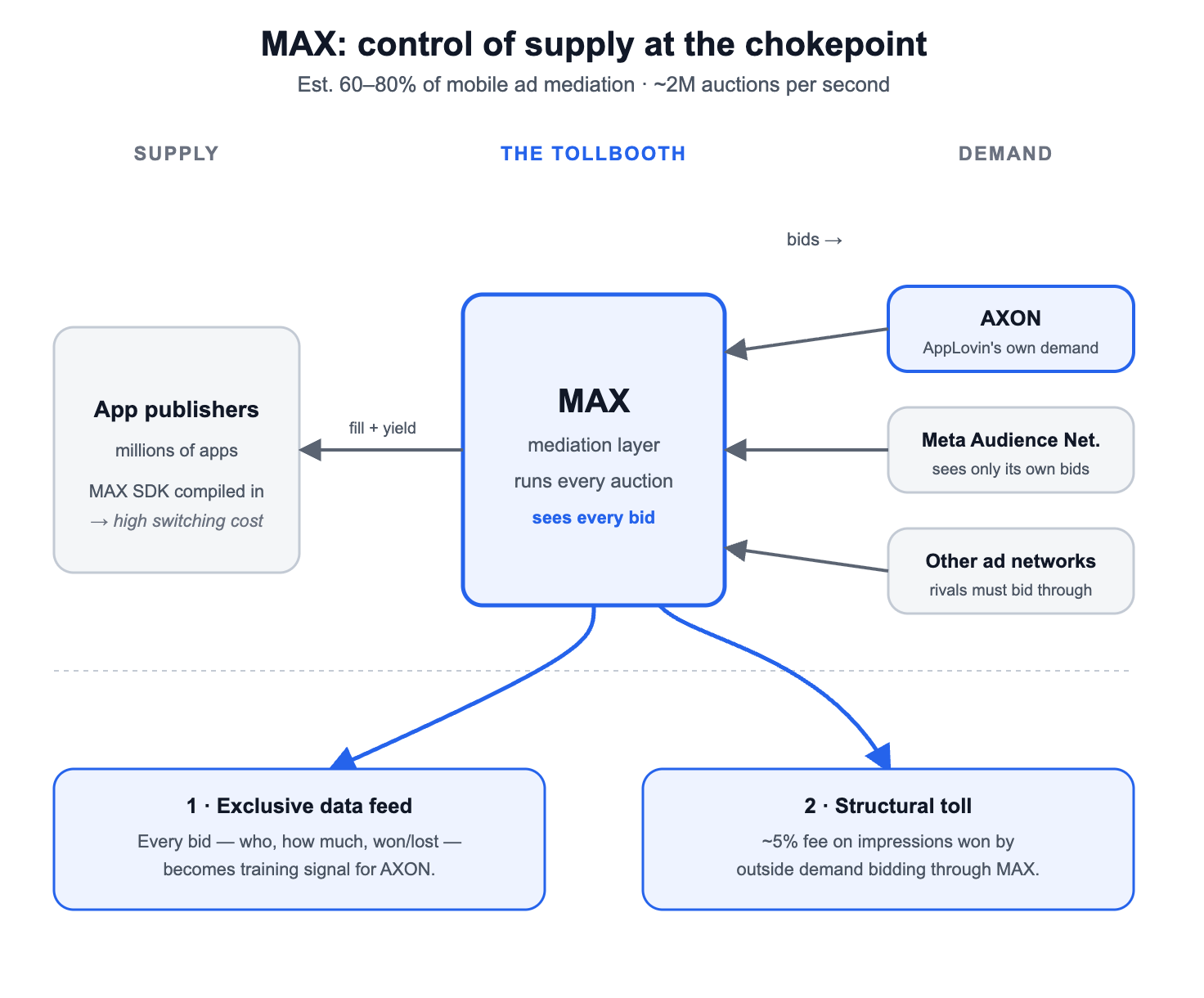
Firstly, what is mediation? It refers to the layer that decides which ad network gets to fill each impression in an app. Owning the dominant mediation platform means AppLovin sits at the chokepoint between the world's app publishers and every ad network bidding for their inventory, including its competitors.
This provides AppLovin with two advantages, (1) privileged, low-cost access to an enormous, exclusive stream of supply and bid-level data that trains AXON, (2) a structural toll position over rivals who must bid through AppLovin’s channel to reach that inventory.
Why is this sticky? Because MAX is integrated into the publisher's app at the SDK level (literally compiled into the app's code). Therefore, ripping it out and replacing it requires engineering work, re-integration, QA, and re-tuning of monetisation across every app in a portfolio. Publishers are unlikely to do so, especially when MAX is also delivering them top-tier fill rates and yield.
There is also a second, more subtle advantage that AppLovin possesses because of MAX. As MAX runs the auction, AppLovin observes every bid (who bid, how much, who won, who lost, on which inventory, at what price). A pure demand-side competitor, such as Meta's Audience Network, sees only its own bids and its own outcomes. That is a structural information asymmetry no bidder can replicate, and it means that when a rival like Meta bids more aggressively inside MAX, it is not purely zero-sum.
The auction pie grows, publishers earn more and recycle it into user acquisition on AppLovin. AppLovin also collects a ~5% fee on impressions won by outside demand bidding through MAX, and each competitive bid becomes training signal that makes AXON smarter.
Vertical integration that closes the loop
AppLovin owns every layer of the chain: AppDiscovery (demand), MAX (supply/mediation), Adjust (attribution/measurement), and AXON (the decisioning brain) sitting on top.
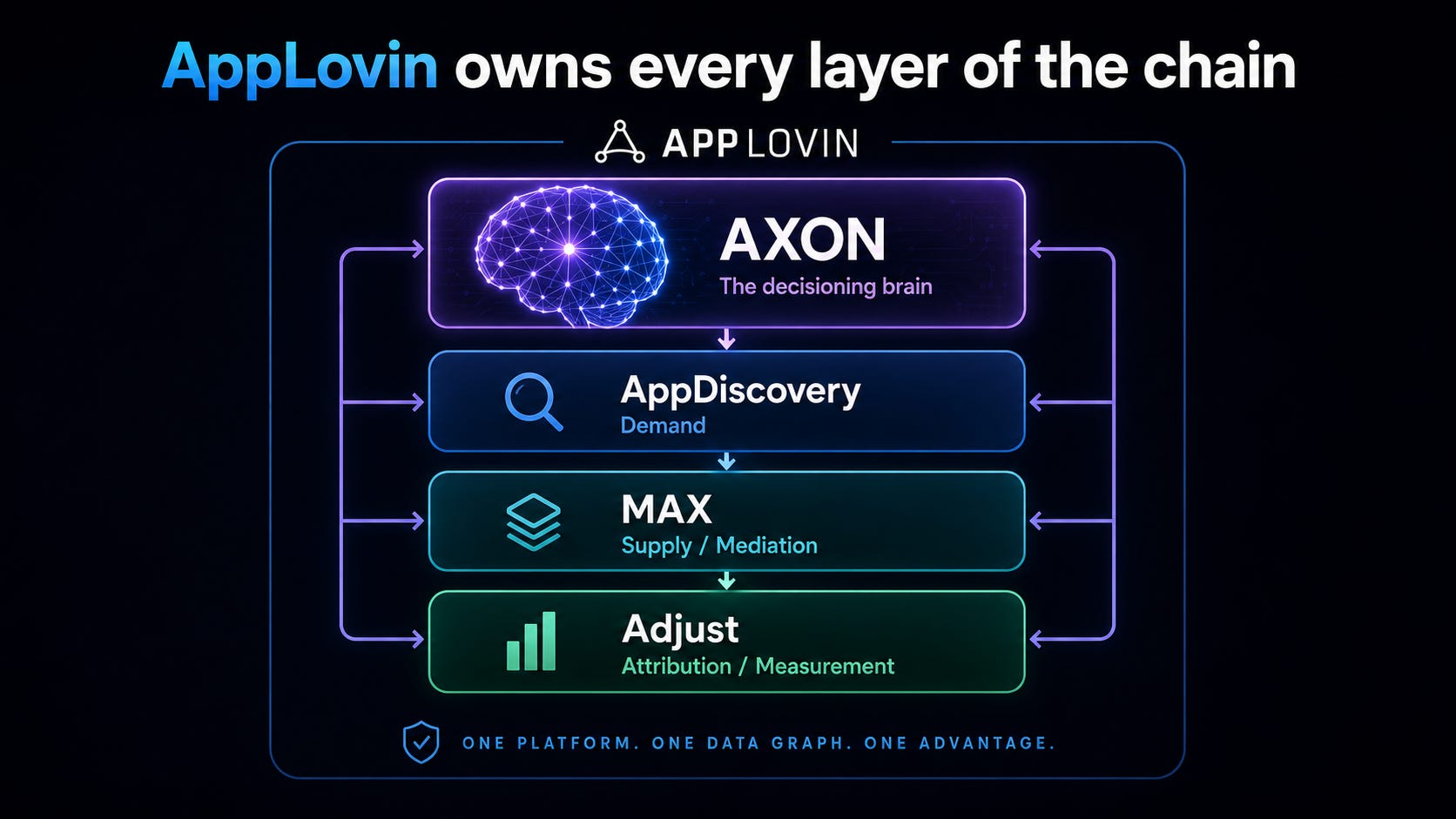
Each of these layers feed the others in a way competitors who own only one layer structurally cannot match.
Adjust's attribution data continuously sharpens MAX's bidding, MoPub's acquired traffic became training samples for AXON, MAX's supply gives AXON the inventory to act on.
Owning the whole pipe enables AppLovin to see end-to-end signals from impression → click → install → in-app purchase, with no data lost at the seams where most ad-tech stitches third-party tools together.
There is also a counter-positioning angle here. The Trade Desk built its brand on being a transparent, non-principal DSP that doesn't own inventory nor take hidden margin. That positioning makes it very hard for TTD to copy AppLovin's closed, principal, take-the-spread model without betraying its own value proposition and cannibalising its agency relationships.
Incumbents are often trapped by their existing model. AppLovin's full-stack, principal approach is something the open-internet players can't easily mirror. I believe the key lesson here that the industry is learning from AppLovin is that owning the infrastructure beats owning the inventory, and infrastructure of this completeness would take a rival many years and many billions to assemble.