

Grab’s proposed acquisition of $1.49B for 60% of Atome tells us a lot about where the business is heading.
Consumer lending is becoming a much larger priority for the group. In FY2028, Grab expects GFin to make up ~30% of total Adj. EBITDA. Groceries and retail are receiving more investment, and management increasingly sees financial services as the end-game.
Atome makes a lot of sense from a strategic fit perspective. In terms of pricing, I think we simply do not have enough information to make a determination on whether this acquisition is cheap or not.
I have some contrarian thoughts on what I think about Grab now given the amount of information that was shared in the Atome presentation.
After going through the investor update and management’s Q&A, here are my 8 main takeaways:
1. Grab has decided Financial Services is the end-game
Grab specifically described financial services as the next unlock. I personally believe this acquisition, and Stash, proves Grab is not simply seeing it as the next unlock, but instead the primary bet.
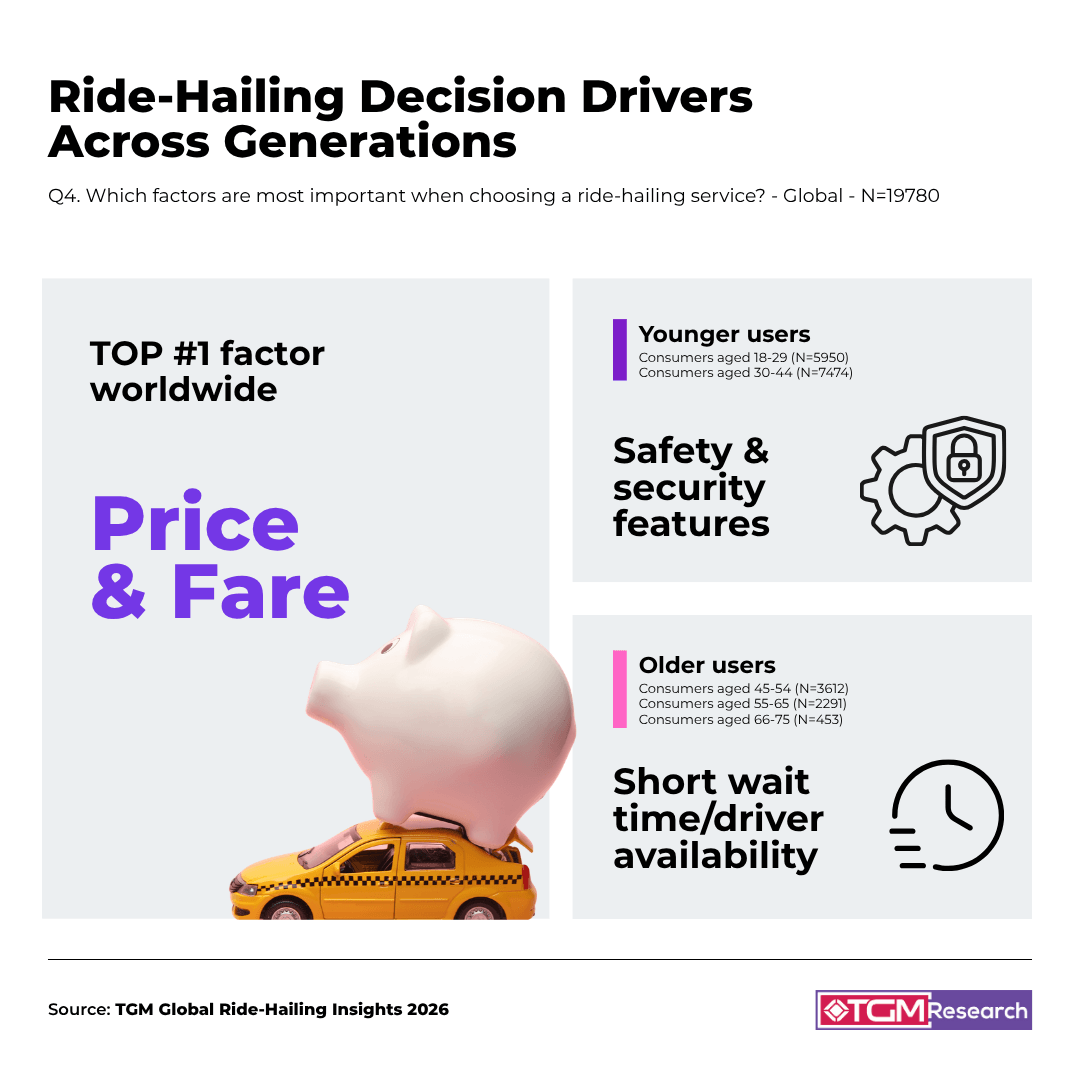
Much of this is down to necessity. While Grab dominates mobility and to a smaller extent deliveries in the region, both are commodity-type businesses. They compete primarily on price and convenience, with low switching cost. In Singapore, most consumers will have at least 3 or even 4 ride-hailing apps downloaded for instance. The experience may differ slightly, but if the aim is to get from point A to B, the primary consideration is about price.
Financial Services gives Grab another way to monetise its ecosystem. Using existing customer relationships and proprietary transaction data, they are able to acquire and underwrite borrowers more efficiently. If those advantages translate into lower acquisition costs and better credit outcomes, it would then support durable lending profits that competitors cannot replicate simply by matching the product or interest rate.
One more thing of note, is that within mobility and deliveries, we are seeing greater scrutiny by governments in the region. (Most recently, Indonesia with its commission caps)
Southeast Asia remains one of the most underbanked regions in the world and this is a massive opportunity for Grab.
2. Grab has identified Consumer Lending as the gap and they hope Atome is the solution
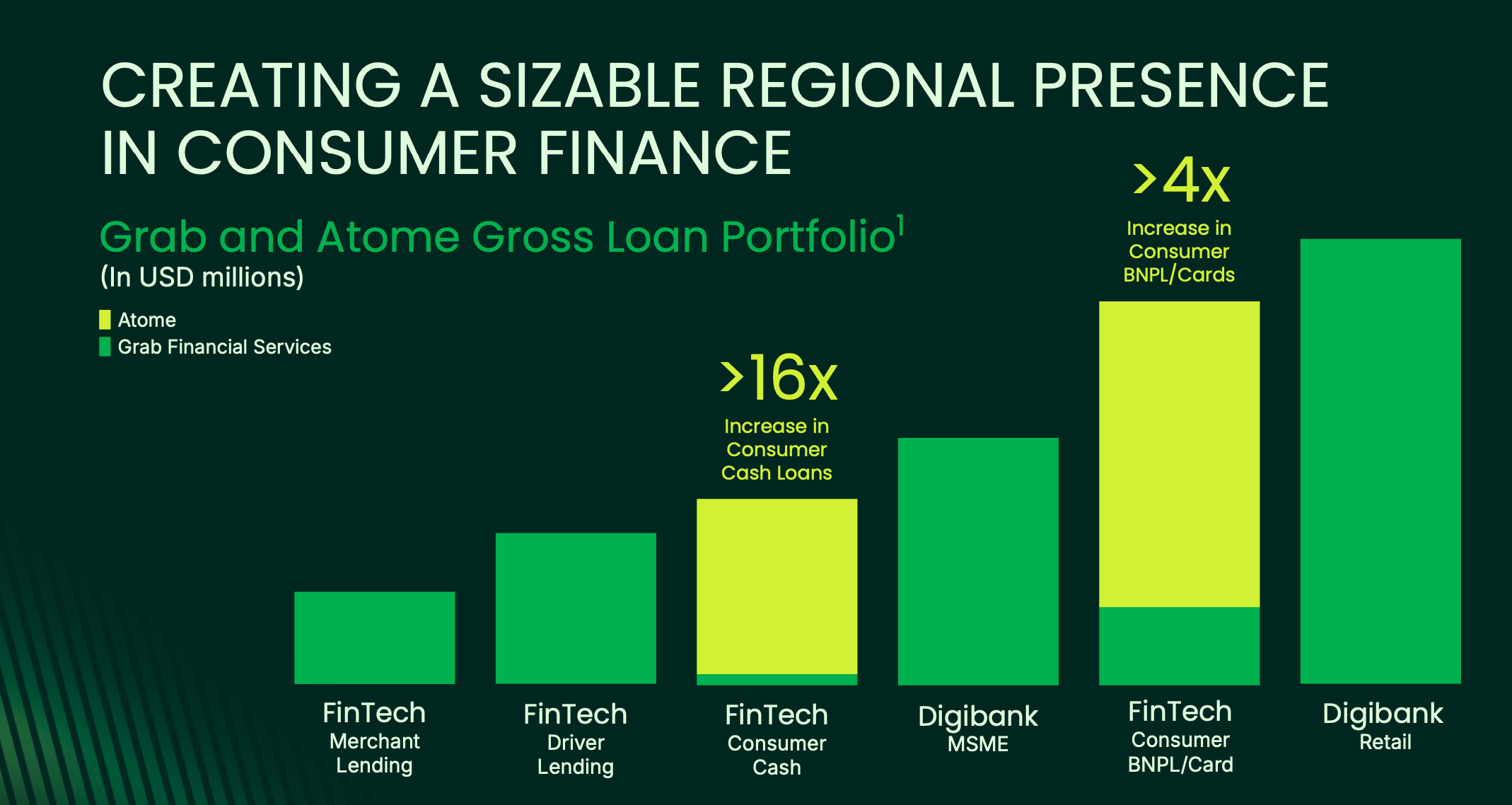
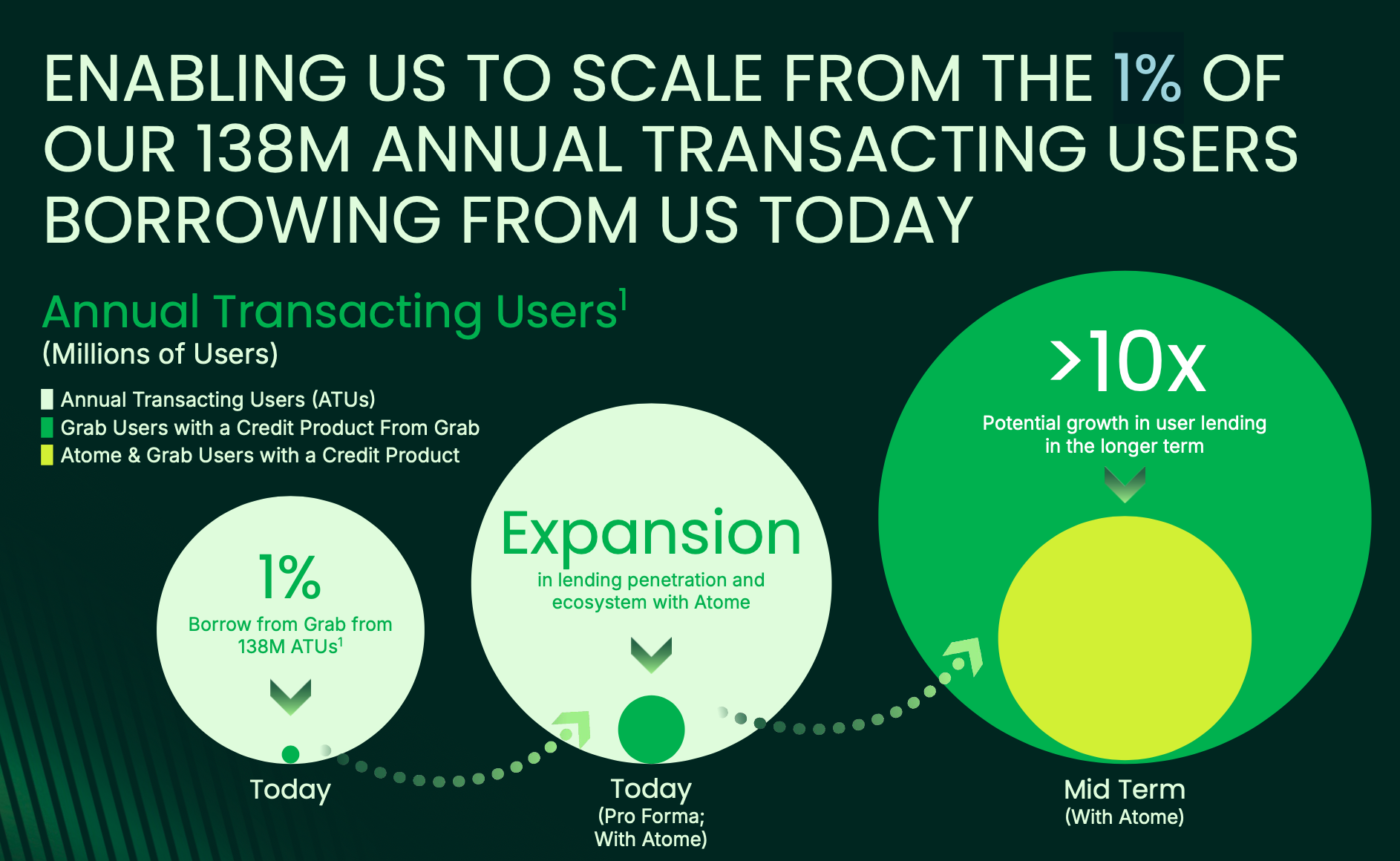
Grab shared the slide above that showed the weakness in consumer cash and consumer BNPL. Management also shared that only 1% of its 138M annual transacting users currently borrowed from Grab.
That is an astonishingly low number for a business of Grab’s size. For context, Sea’s Monee has over 40M active credit users, which if we were to compare to their annual transacting users on Shopee, equates to about 10%.
In other words, management's claims that they can 10x is certainly not hyperbole, it is very possible.
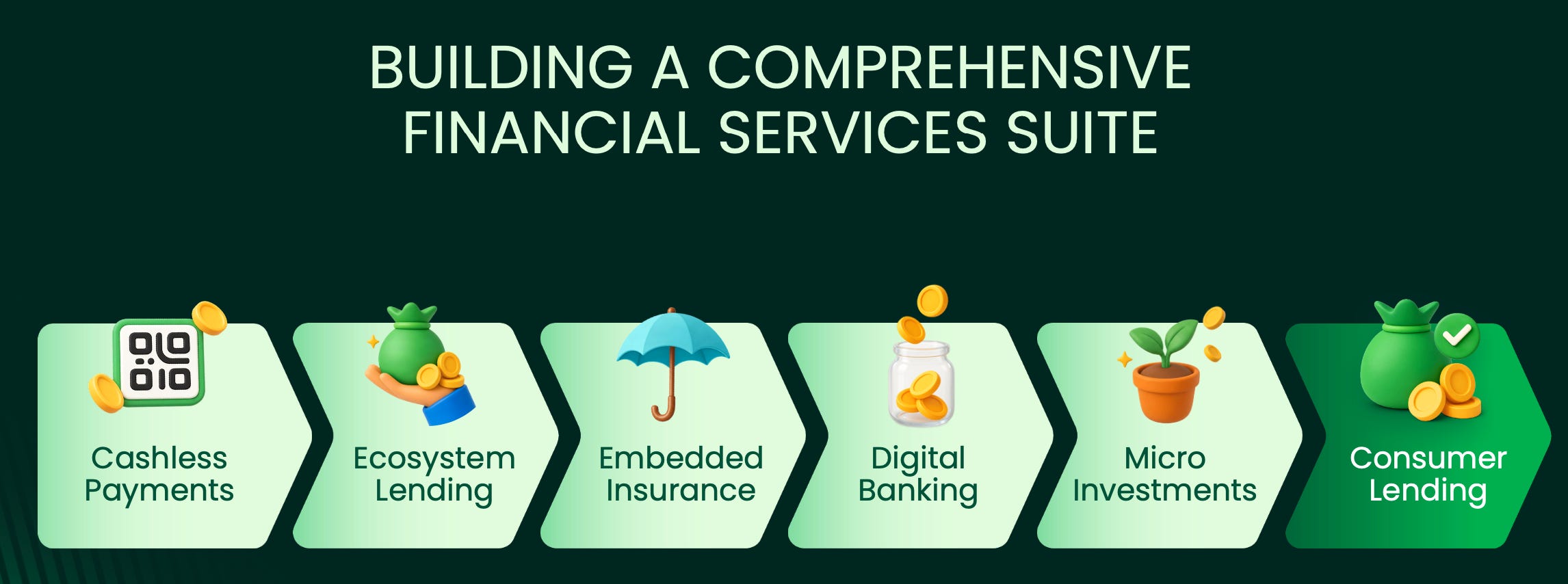
That said, it speaks to how much Grab has struggled to convert its delivery and mobility users into active credit borrowers.
In my view, there is a fundamental mismatch in the ticket sizes and type of transaction that has resulted in this situation. E-commerce has proven to be a fantastic customer acquisition tool for financial services, but not so much yet for Grab.
Atome should bridge that gap to an extent for Grab, but Grab has to also do much better at conversion.
3. Grab is deliberately investing more in affordability, groceries and retail
As part of the Atome acquisition, Grab increased its 2028 group Adj. EBITDA target from $1.5B to $1.7B. From the face of it, it would be easy to interpret the $200M increase as the profit Grab is buying through Atome.
However, the actual bridge is far different:
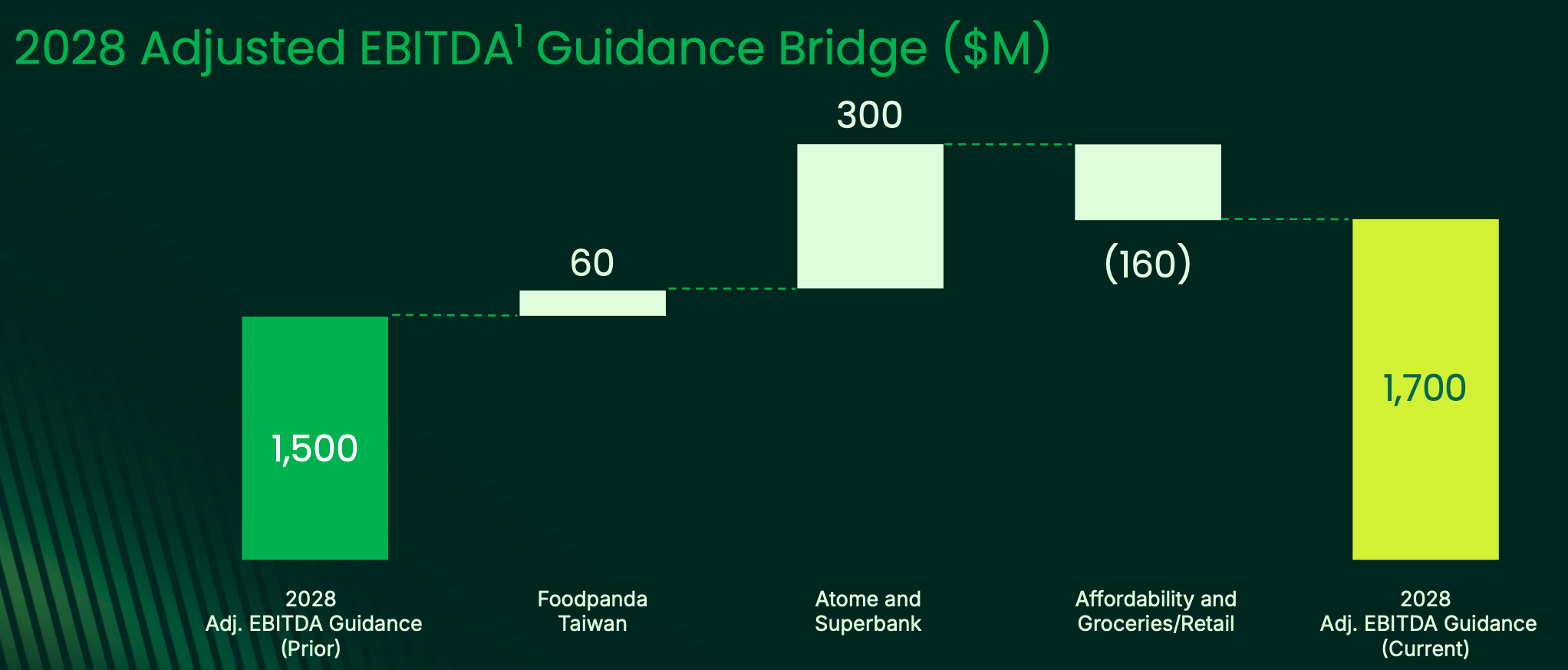
Firstly, the additions of FP Taiwan and Atome contribute $360M before the planned $160M investment in affordability, groceries and retail.
Secondly, Atome’s actual profit contribution was not shared as it was bundled with Superbank, which if you recall, was consolidated into Grab in May this year.
On the $160M investment, CFO Peter Oey discussed during the call that they intend to deploy this capital into deepening affordability across the platform, and specifically highlighted groceries (which is growing 2x faster than food), as a focus area.
The reason for the sudden change is the Atome acquisition. Peter mentioned that it will give them access to a new user base, enabling cross-sell opportunities, not to mention, the 30,000 merchants that Atome works with across travel, fashion, e-commerce etc.
Personally, I believe this will be a huge boost for their advertising segment.
The large majority of current advertisers are restaurants. Atome expands the advertiser base beyond restaurants, potentially attracting larger retail marketing budgets.
4. The merchant network on Atome could be as strategically valuable as the $1B loan book
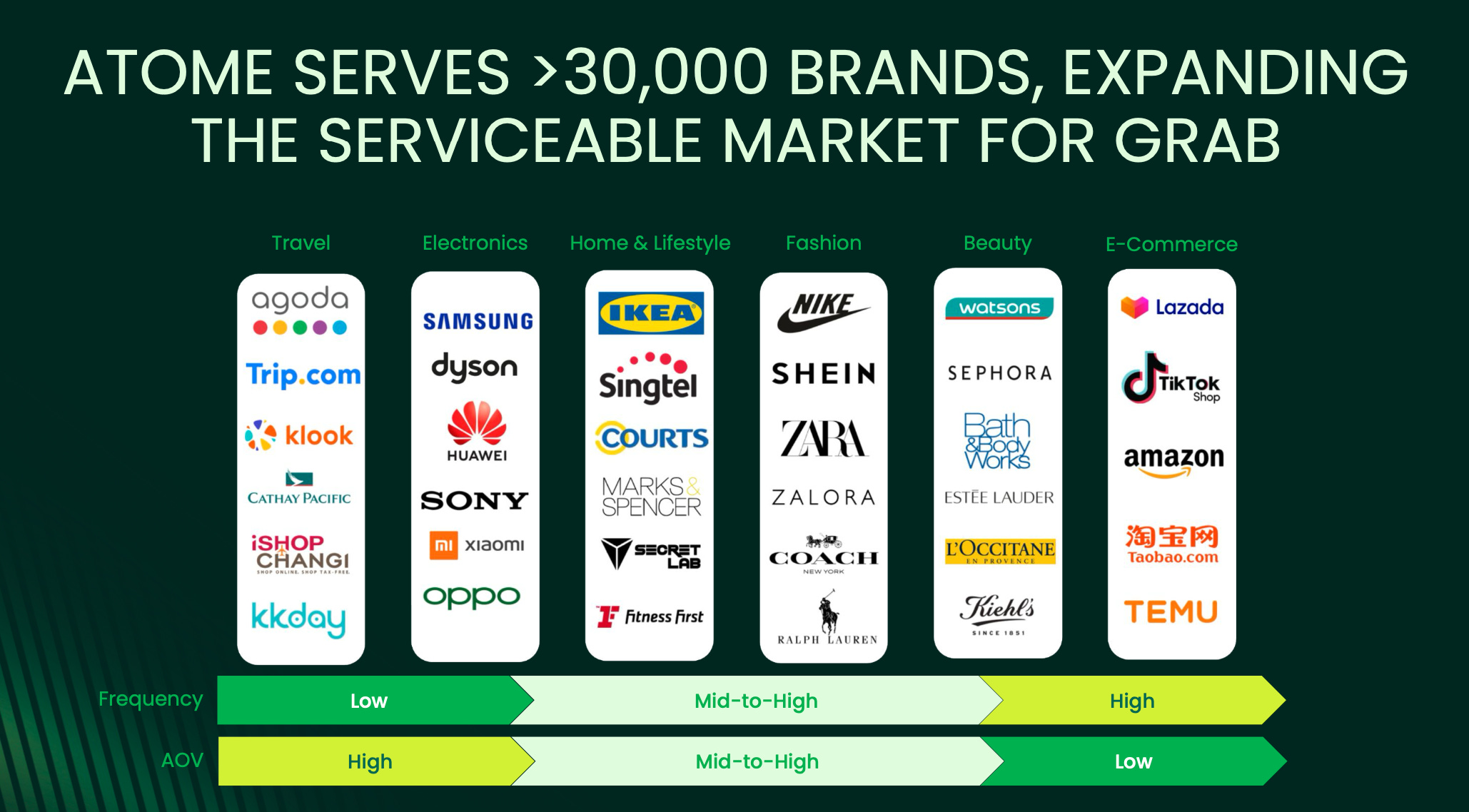
Atome has over 30,000 unique brands across categories including travel, electronics, fashion, beauty and home products.
These merchants sit at different points on the spending spectrum from Grab’s core F&B network. Some sell higher-value items, some have less frequent purchases, and some benefit more directly from instalment financing.
Management shared that they see opportunities to bring more merchant relationships into Grab’s marketplace and offer additional services.
Personally, I see several potential avenues:
Atome merchants becoming customers for Grab’s advertising and payment services.
Suitable retailers joining Grab’s commerce offerings.
Atome distributing credit products through Grab’s existing merchant network.
More purchasing activity giving the group additional information about customer needs and repayment behaviour.
These are opportunities for Grab, but not necessarily automatic outcomes. There is lots to execute too.
5. Grab has been extremely unsuccessful in consumer lending
One startling fact from the presentation was Grab sharing that only 1% of its annual transacting users were borrowing from them. For comparison, Sea Limited’s Monee has 40M active borrowers, while Shopee has 400M active annual buyers. That equates to a 10% rate.
Two things we can learn from this:
Grab’s claim of >10x potential growth is not hyperbole, it is very possible
Grab has been incredibly poor at converting its users to credit borrowers
On the 2nd point, Grab’s BNPL product has been around since 2019, so it cannot be blamed on a lack of time to execute. My friend Contrarian Perspectives wrote about this in a post on X. I largely agree with his views, do check it out.
I think the fundamental reason behind this is that mobility/deliveries with its small ticket sizes are a mismatch for BNPL.
6. This feels like a desperate move from Grab, and not from a position of strength
I know this might be a controversial take, but it is how I feel.
Management sharing that only ~1% of its 138M annual transacting users borrowing from Grab after years of investment in broader consumer lending raises an uncomfortable question: If Grab’s ecosystem advantages are so powerful, why has converting its users into borrowers been so difficult?
The investment case has long been that Grab already has the customers, distribution and transaction data to build a substantial lending business. Yet broader consumer lending remains underdeveloped, and Grab is now paying heavily to acquire the capabilities needed to accelerate it.
I see Atome, at least partly, as an expensive response to disappointing internal progress. Once the deal is completed, it will most likely come in the $2.5-$3B range for Grab, which is a substantial part of its cash pile. This means Grab is essentially betting half of its cash on this acquisition.
Management argues that building Atome’s capabilities internally would take years. Yet, Atome was started in the same year Grab launched its BNPL service. This is therefore an indictment on management’s failure to execute on its consumer lending segment in general.
On Atome’s side, my suspicion is that joining a larger platform was always an attractive potential outcome. A standalone lender has to secure funding, acquire customers and maintain engagement, while a broader ecosystem can support those activities through existing relationships. In that way, joining Grab was always going to be the ideal outcome.
Yet, the disclosed terms do not make it obvious that Grab secured a bargain from a seller with limited alternatives. Grab is paying a substantial initial amount, with further consideration linked to Atome’s subsequent performance. The remaining 40% appears to be a deal protecting the sellers, with a floor of $2B and ceiling of $4.5B.
I believe this is an acquisition driven partly by impatience with the pace of Grab’s own progress. It could still work, and the strategic fit is evident. However, the burden is on management to prove that this is the right decision.
Conclusion
Overall, I see the strategic logic behind Atome. It gives Grab the consumer lending capabilities, merchant relationships and higher-ticket transaction data that it has struggled to build internally. If management executes well, this could become a major growth driver across lending, advertising and commerce.
However, this is also an expensive admission that Grab’s existing ecosystem has not translated into consumer lending success. It is difficult to ascertain with the information on hand whether the purchase price is cheap or expensive, but Grab is committing a substantial portion of its cash to make this work. It is a massive bet.
I remain constructive on $GRAB, and it is still one of my higher-conviction businesses. However, the facts have changed, and my view has to change with them. The burden is now on management to prove that Atome can generate returns commensurate with the price paid, rather than simply buying the growth that Grab was unable to build itself.
Paid Subscription Upgrade
If you’d like to support the work I do, consider becoming a paid subscriber. Your support will allow me to spend more time finding asymmetric opportunities in the market, writing and analysing various businesses.
As a reminder, paid subscribers get access to:
Monthly Portfolio Updates (+98% in 2024, +26% in 2025)
Earnings Reviews on Portfolio Companies (SE, GRAB, DLO, MELI etc)
Archive of Deep Dives and Posts (20 Deep Dives and counting)
You can get 30% off your first month with the link below.
Disclaimer: The content presented in this thesis is for informational and academic purposes only and does not constitute financial advice. The analysis and opinions expressed are based on research and should not be interpreted as a recommendation to buy, sell, or hold any security. Readers should conduct their own due diligence and consult with a qualified financial advisor before making any investment decisions.